Benjamin D'Israeli
| Name | Benjamin D'Israeli |
| Title | Italian-born British merchant |
| Gender | Male |
| Birthday | 1730-09-22 |
| nationality | England |
| Source | https://www.wikidata.org/wiki/Q4888455 |
| pptrace | View Family Tree |
| LastUpdate | 2025-11-26T23:30:04.269Z |
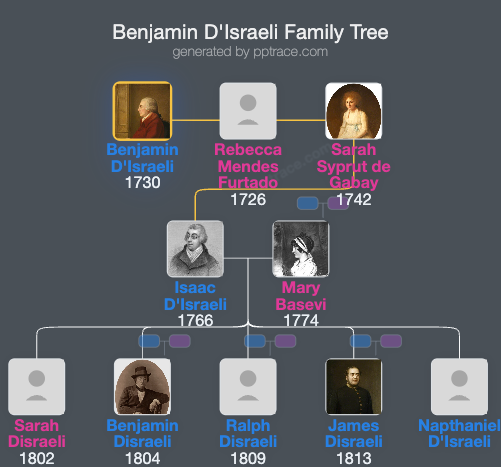
Family Tree
Tap  to expand more relatives
Introduction
Benjamin D'Israeli (1730–1816) was an Italian-born merchant and financier who later became a resident of England. He was born in Cento, near Ferrara, in the Papal States, on 22 September 1730. His family was of Sephardic Jewish descent, and his father was Isaac Israeli. D'Israeli was the eldest of three children, with two younger sisters named Rachel and Venturina. Rachel was born in 1741 and Venturina in 1745. Records indicate that Venturina died in the Venetian Ghetto in 1821 and Rachel in 1837; the family had some connection to Venice, though it appears to have been limited to his sisters.
The family lineage traced its origins to the Italian Jewish community, with possible ancestral ties to prominent Jewish families or philosopher-physicians, such as Ishac ibn Sulaiman El Israeli of Kairouan. Benjamin's mother was Rica or Eurichetta Rossi, of the ancient Ferrara-based Min-Haadumin family, which claimed descent from Jews taken into captivity after the destruction of Jerusalem.
Benjamin Israeli's family likely migrated from the Levant, and the surname "Israeli" may have been linked to a notable medieval philosopher and physician, Ishac ibn Sulaiman El Israeli. Following a brief apprenticeship in Modena, Benjamin emigrated to England at the age of eighteen, around 1748, during a period when Anglo-Italian trade was expanding, notably after the establishment of a Venetian and Levantine banking branch of Treves in London in 1740.
In England, D'Israeli initially worked at a modest salary in the accounting house of Messrs. Joseph and Pellegrin Treves in Fenchurch Street. He married Rebecca Mendez Furtado on 2 April 1756; she was of Portuguese origin and the daughter of Gaspar Mendes Furtado and Clara Henriques de Lara. The marriage produced a daughter named Rachel. Rebecca died on 1 February 1765. Subsequently, D'Israeli married Sarah Siprut de Gabay Villareal on 28 May 1765, with whom he had a son, Isaac D'Israeli, born on 11 May 1766.
After his marriage to Rebecca, D'Israeli established himself as an Italian merchant in London, importing straw hats, marble, alum, currants, and similar commodities. In 1759, he became involved in speculative activities at Change Alley, reflecting an interest in the financial markets. His early business endeavors faced difficulties, including litigation, and he struggled financially. The death of his first wife also impacted his fortunes.
His second marriage improved his financial standing, and for ten years he managed import businesses at Great St. Helens. By 1769, he was among London’s leading coral merchants, with commercial links to Livorno, Italy. He resided in Ferrara until 1776, when he moved to Baker Street, Enfield.
D'Israeli was increasingly involved in stock-market activities; he rented offices in Cornhill and formed partnerships, notably Messrs. D'Israeli, Stoke & Parkins, and later operated from Old Broad Street. His success in finance was recognized by his induction into the Stock Exchange and his appointment to the Committee for General Purposes as part of the plans for building new premises at Capel Court in 1801. He remained a stock exchange member until 1803, after which he retired but maintained an interest in financial affairs.
He was involved in a notable enterprise converting local wood into straw plait as a substitute for Italian Leghorn straw for hats and bonnets, although this venture was not ultimately successful. Benjamin D'Israeli died on 28 November 1816 at his residence in Stoke Newington, Middlesex. At his death, his estate was valued at approximately £35,000, equivalent to around £3.4 million in 2023 currency.
He was the grandfather of Benjamin Disraeli, who became the Prime Minister of the United Kingdom and was known as the Earl of Beaconsfield.