Hachisuka Mochiaki
| Name | Hachisuka Mochiaki |
| Title | Japanese politician (1846-1918) |
| Gender | Male |
| Birthday | 1846-09-28 |
| nationality | Japan |
| Source | https://www.wikidata.org/wiki/Q656008 |
| pptrace | View Family Tree |
| LastUpdate | 2025-11-17T10:08:04.329Z |
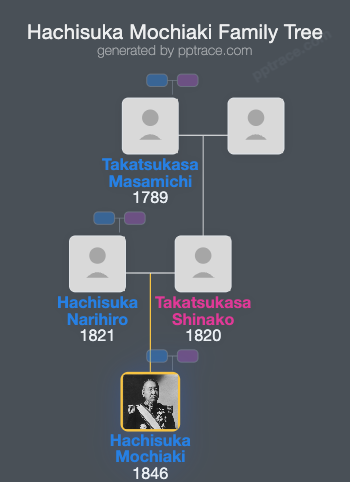
Family Tree
Tap  to expand more relatives
Introduction
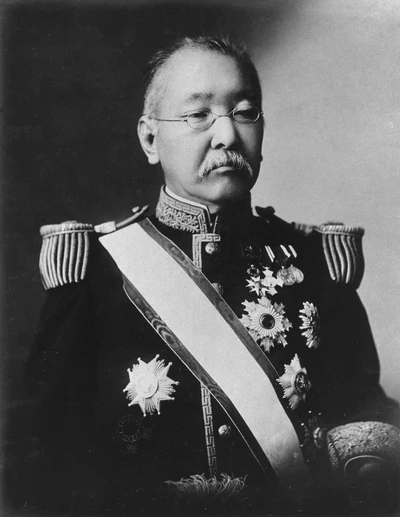
Marquess Hachisuka Mochiaki (蜂須賀 茂韶; born September 28, 1846, died February 10, 1918) was a Japanese nobleman and politician during the Meiji period. He served as the 14th and final daimyō of Tokushima Domain in Awa Province and held various governmental and legislative positions, including the second President of the House of Peers.
Early Life
Hachisuka Mochiaki was born in Edo (modern-day Tokyo) at the Hachisuka domain residence. He was the eldest son of Hachisuka Narihiro (1821–1868), the 13th daimyō of Tokushima. His father was the 22nd child of Tokugawa Ienari, the 11th shōgun, and was adopted into the Hachisuka clan to succeed as daimyō, as the previous head, Hachisuka Narimasa, was childless. As a grandson of Tokugawa Ienari, Mochiaki was a nephew of Tokugawa Ieyoshi and a cousin of Tokugawa Iesada and Iemochi.
During his early years, the political landscape of Japan was shifting dramatically. In 1868, following the death of his father and amidst the Boshin War, Mochiaki pledged loyalty to the Imperial forces, leading troops against Tokugawa loyalists in Mutsu Province. His forces were equipped with western firearms and supported by British military advisors, which augmented their effectiveness despite their small numbers.
Political Career
In 1869, with the abolition of the han system (hanseki hokan), Mochiaki was appointed as the governor of Tokushima Prefecture. In 1872, he traveled to Great Britain to study abroad, enrolling at Balliol College, Oxford University, in 1874. After completing his studies abroad, he returned to Japan and entered government service, including roles as Director of the Customs Bureau within the Ministry of Finance and as a member of the Sanjiin (legislative advisory council).
In 1882, Mochiaki was appointed as envoy extraordinary and minister plenipotentiary to France. Under the new kazoku peerage system established during the Meiji era, he received the title of kōshaku (marquis). Returning to Japan, he served in multiple governmental capacities, including as a member of the House of Peers, Governor of Tokyo Prefecture, President of the House of Peers, Minister of Education, and Privy Councillor.
He was awarded several honors during his lifetime, including the Grand Cordon of the Order of the Sacred Treasure in 1896 and the Grand Cordon of the Order of the Rising Sun in 1903. Posthumously, in 1918, he was also awarded the Grand Cordon of the Order of the Rising Sun with Paulownia Flowers.
Order of Precedence and Titles
Hachisuka Mochiaki's rank and titles evolved over his lifetime: he was initially ranked as Fourth rank in April 1860, advancing to Second rank in April 1868, Senior Second rank in December 1895, and finally First rank posthumously in February 1918. He received the title of marquess on July 7, 1884.
Personal Life
Hachisuka Mochiaki maintained an interest in traditional Japanese arts, including haiku poetry and noh drama. He was also known for his efforts in agricultural experimentation; notably, he operated an experimental farm in Hokkaidō, advocating that nobility engage in practical pursuits beyond government service.
Family
His father was Hachisuka Narihiro, and his mother was Takatsukasa Shinako (1820–1858). He was married to Ayahime Yoriko (1854–1923). He also had a concubine, whose identity is not specified. Their known child was Hachisuka Masaaki (1871–1932).
Ancestry
References and Further Reading
Works cited include W.G. Beasley’s "The Meiji Restoration," Andrew Cobbing’s "The Japanese Discovery of Victorian Britain," Andrew Fraser’s "Japan's Early Parliaments, 1890–1905," and Koyama Noboru’s study on Japanese students at Cambridge University during the Meiji era.
External links provide additional biographical information and photographs, including resources available through the National Diet Library.