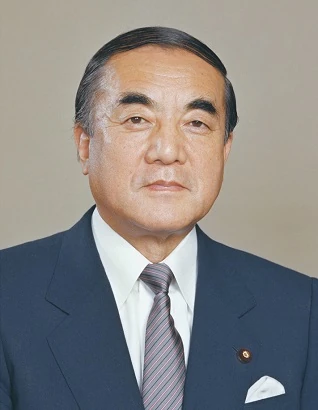
Yasuhiro Nakasone
| Name | Yasuhiro Nakasone |
| Title | Japanese politician (1918-2019) |
| Gender | Male |
| Birthday | 1918-05-27 |
| nationality | Japan |
| Source | https://www.wikidata.org/wiki/Q250828 |
| pptrace | View Family Tree |
| LastUpdate | 2025-11-17T06:47:18.639Z |
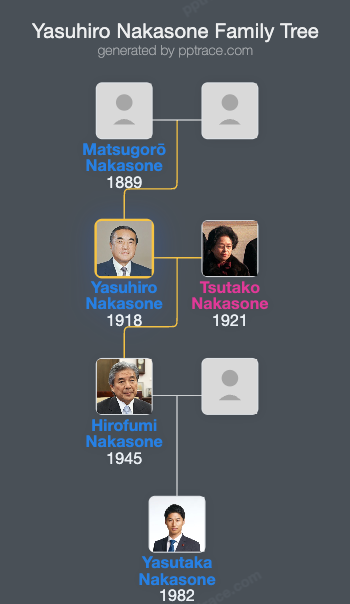
Family Tree
Tap  to expand more relatives
Introduction
Yasuhiro Nakasone (June 27, 1918 – November 29, 2019) was a Japanese politician who served as Prime Minister of Japan from 1982 to 1987. His tenure as prime minister is notable for policies advocating the privatization of state-owned enterprises and for his foreign policy aligned with pro-U.S. and hawkish positions.
**Early Life and Family Background**
Nakasone was born in Takasaki, Gunma Prefecture, Japan. He was the second son of Nakasone Matsugoro II, a lumber dealer, and Nakamura Yuku. The Nakasone family held samurai status during the Edo period and claimed descent from the Minamoto clan, specifically through Minamoto no Yoshimitsu and his son Minamoto no Yoshikiyo (died 1149). Family records indicate that Tsunayoshi (d. 1417), a vassal of the Takeda clan and a descendant of Yoshikiyo, adopted the name Nakasone Juro and was killed at the Battle of Sagamigawa. Around 1590, the samurai Nakasone Sōemon Mitsunaga settled in what is now Kōzuke Province. His descendants became silk merchants and pawnbrokers.
Nakasone's father, originally named Nakasone Kanichi, relocated to Takasaki in 1912 and established a timber business, which prospered during the post-World War I building boom.
**Education and Military Service**
He attended primary school in Takasaki, initially performing poorly but later excelling academically. In 1935, he enrolled at Shizuoka High School, where he developed proficiency in history, literature, and French. In 1938, Nakasone entered the Faculty of Law at Tokyo Imperial University. He was influenced by lecturer Teiji Yabe and developed strong anti-communist and anti-Nazi views.
During his university years, he received a call informing him of his mother’s serious illness; she died before he could reach her, which motivated him to work harder academically. Upon graduation, he passed the recruitment exam for high-level bureaucrats and began working at the Home Ministry.
In 1941, Nakasone joined the Imperial Navy through a program that allowed elite university graduates to serve as officers. He trained at the Navy Paymaster's School and was commissioned as a lieutenant. He was involved in building airfields in the Dutch East Indies and experienced combat and logistical challenges during the Pacific War. His service included commanding a team responsible for constructing airfields and organizing the logistics for his unit, which included selecting personnel, including an ex-yakuza, to assist in operations.
He married Tsutako Kobayashi, daughter of geologist Giichiro Kobayashi, in February 1945. During the war, his younger brother Ryosuke died in an air accident.
**Postwar Political Career**
After Japan's surrender in 1945, Nakasone returned to Tokyo and resumed employment at the Home Ministry. He observed the rise of communism in Japan and decided to run for office. He was elected to the House of Representatives in 1947 as a candidate of the Democratic Party, representing Japan in the post-war period.
Nakasone was known for his nationalist stance, advocating for a strengthened Self-Defense Force, constitutional revision of Article 9, and the revival of patriotic sentiments. In 1951, as a new lawmaker, he authored a 28-page letter criticizing the U.S. occupation authorities, establishing his reputation as a right-wing politician. In 1952, he briefly gained attention for blaming Emperor Hirohito for Japan’s wartime defeat.
Throughout the 1950s and 1960s, Nakasone held various ministerial roles, including Minister of Science; Minister of Transport; Director General of the Japan Defense Agency (1970–1971); Minister of International Trade and Industry (1972–1974); and Minister of Administration (1981–1982). As Defense Agency chief, he advocated for increased defense spending and was supportive of Japan developing tactical nuclear weapons.
He was considered a pragmatic politician, switching support among LDP factions to secure leadership positions, earning the nickname "the weathervane."
**Prime Ministership (1982–1987)**
Nakasone became Prime Minister in 1982, aligning closely with U.S. President Ronald Reagan. His foreign policy prioritized strengthening U.S.-Japan relations, exemplified by his description of Japan as "America's unsinkable aircraft carrier." He worked to improve diplomatic relations with the Soviet Union and China, and he supported increased defense budgets, though his attempt to amend Japan's pacifist constitution failed.
His domestic policies focused on privatization, including the privatization of the Japanese National Railways and the telephone system. During his tenure, he visited the controversial Yasukuni Shrine and maintained a hawkish stance on defense issues.
**Later Life and Scandal**
Following his resignation in 1987, Nakasone remained an influential figure in Japanese politics. He was implicated in the Recruit scandal, a political corruption affair, which diminished his influence. He withdrew from the House of Representatives in 2004 and retired from active politics.
**Death**
Yasuhiro Nakasone died on November 29, 2019, at the age of 101.