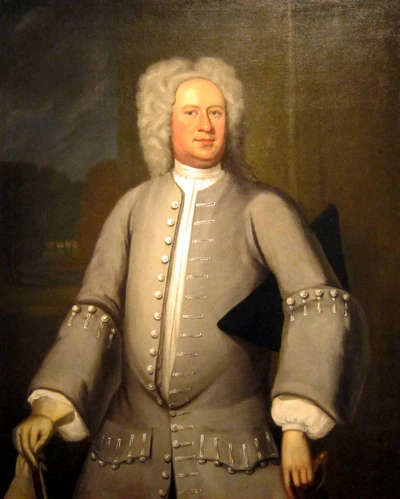
Robert Carter I
| Name | Robert Carter I |
| Title | American politician (1663-1732) |
| Gender | Male |
| Birthday | 1663-01-01 |
| nationality | United States of America |
| Source | https://www.wikidata.org/wiki/Q648281 |
| pptrace | View Family Tree |
| LastUpdate | 2025-11-17T06:38:47.838Z |
Family Tree
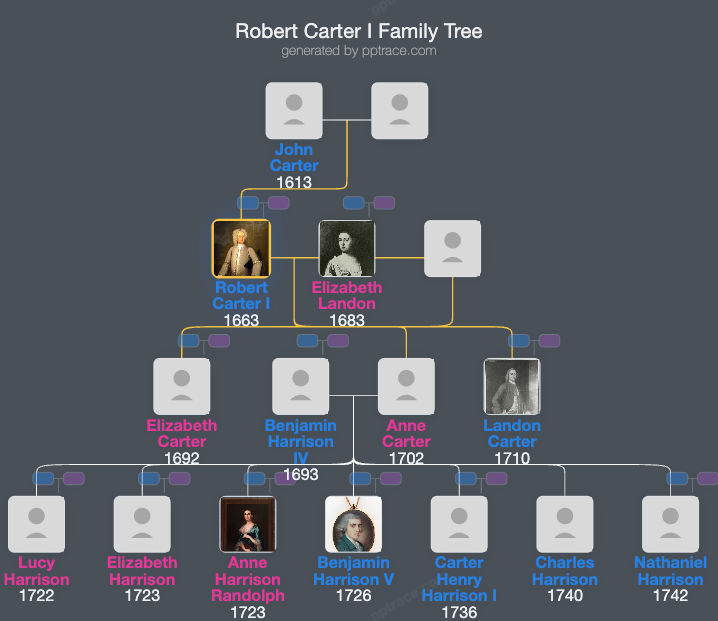
Tap  to expand more relatives
Introduction
Robert Carter I was born around 1664 at Corotoman in Lancaster County, Virginia. His father was John Carter Sr., a merchant, councillor, and burgess who emigrated from London in 1635 and settled in Upper Norfolk County by 1640. His mother was Sarah Ludlow Carter, John Carter Sr.'s fourth wife, who died in 1668. Upon his father's death in 1669, most of his landholdings were inherited by his elder half-brother, John Carter Jr., under primogeniture. Robert Carter I was allocated one thousand acres in Lancaster County and a share of his father's theological books.
His father arranged for a formal education, emphasizing Latin studies with private tutors, and noted that he should study in London. Around 1673, Carter was sent to London under the guidance of Arthur Bailey, a tobacco merchant and John Carter Sr.'s agent. Carter received a classical education in London, gained familiarity with the tobacco trade, and observed architectural developments following the Great Fire of 1666. He lived in London for approximately six years, returning to Virginia between 1678 and 1679.
After his elder half-brother's death in 1690, Carter inherited additional land, managed properties belonging to his niece, and obtained a share from a younger half-brother. He became justice of the peace for Lancaster County on June 10, 1690, and was elected a vestryman of Christ Church Parish in November of the same year. He engaged actively in the church and served as churchwarden from around 1691 until his death.
In marriage, Carter first wed Judith Armistead of Hesse in 1688; she was the daughter of planter and councillor John Armistead and Judith Hone. They had five children, three of whom survived infancy, including a son named John. Following Judith Armistead's death in 1699, Carter married Elizabeth "Betty" Landon Willis in 1701, with whom he had five daughters and five sons, seven of whom reached adulthood.
Carter's political career began shortly after his brother's death, when he became a burgess representing Lancaster County in 1690. He served in the Virginia General Assembly during 1690–1691 and then continuously from 1695 through 1699. During this period, he held important roles, including serving as Speaker of the House of Burgesses in 1696 and 1697. In 1699, he was appointed treasurer of Virginia, a position he held until 1705.
He was appointed to the Governor's Council in 1699 by Governor Francis Nicholson and became influential within colonial governance. Carter opposed Nicholson's policies in 1704, which contributed to Nicholson's removal in 1705. He also was involved in land acquisition as the agent for Thomas Fairfax, 5th Lord Fairfax, in the Northern Neck Proprietary. Carter served as Fairfax's land agent in two terms, beginning in 1702 and later from 1722 to 1732, accumulating extensive land holdings.
In 1709, Carter purchased approximately 20,000 acres, including the Nomini Hall Plantation. His landholdings eventually encompassed at least 295,000 acres, much of which was cultivated using enslaved labor, and primarily used for tobacco and other crops. He engaged in various enterprises, including shipping and acting as an agent for slave traders.
Carter became involved in provincial politics and land management, serving as president of the Governor's Council after the death of Edmund Jenings in 1726. He served as acting governor from 1726 to 1727 following the death of Governor Hugh Drysdale, until Lieutenant Governor William Gooch assumed office on September 11, 1727. He continued to participate in council meetings until shortly before his death.
Carter constructed a large house at Corotoman in 1725, which burned in 1729. He suffered from gout later in life. He died on August 4, 1732, at Corotoman and was buried at Christ Church in Lancaster County. His estate included about 300,000 acres of land, 3,000 slaves, and £10,000 in cash.
Carter's impact was notable in Virginia's colonial history, particularly through his landholdings, political influence, and role in colonial governance. His descendants continued to be influential in Virginia society.