John Carter
| Name | John Carter |
| Title | Abt 1613 - 10 Jun 1669 'Corotoman', Virginia |
| Gender | Male |
| Birthday | 1613-00-00 |
| nationality | — |
| Source | https://www.wikidata.org/wiki/Q96198876 |
| pptrace | View Family Tree |
| LastUpdate | 2025-11-16T10:07:54.473Z |
Family Tree
Tap  to expand more relatives
Introduction
John Carter (circa 1613 – January 10, 1670) was an English merchant and landholder who emigrated to the Virginia Colony in the mid-17th century. He played a significant role in the development of early Virginia society, engaging in land speculation, plantation establishment, and holding various political offices.
Born probably in 1613, Carter was the son of Bridget Benion Carter and John Carter, a London merchant and vintner. His christening took place on December 18, 1614, at Christ Church Parish of Newgate Street in London, near St. Paul’s Cathedral. He had at least two brothers, Thomas and William, and maintained kinship ties to members of the Virginia Company of London through his family, although the company's charter had been revoked by 1624.
In 1635, at approximately 22 years old, Carter emigrated to the Virginia Colony aboard the ship Safety with his elder brother Thomas. However, he returned to England within the same year to marry Jane Glyn, whose father owned land in Middlesex, England, and in Wales (Llanidloes and Montgomeryshire). During this period, Carter engaged in business arrangements with his maternal uncle Gabriel Benion, whose son Daniel was in Virginia. His attempt to return to Virginia in 1636 was thwarted when his ship, Elizabeth, was captured by the Spanish fleet en route to Cadiz, and he was taken to Spain.
Carter testified in the High Court of Admiralty regarding the value of goods lost during this incident and married Jane Glyn in London after returning there in 1638. By 1640, he had emigrated again, this time permanently, with his wife, and they settled in Upper Norfolk County, present-day Nansemond County. In August 1642, Carter acquired 1,300 acres on Cossotomen Creek (later known as Carters Creek), north of the Rappahannock River, from Daniel Gookin. This land became the core of his plantation, known as Corotoman.
In December 1643, Carter patented an additional 300 acres in Nansemond County for transporting indentured servants. The Powhatan uprising under Opechancanough in 1644 impacted the region, leading Carter to lead a militia expedition against the Rappahannock tribe in 1645. This military action contributed to the eventual restriction of white settlement to lands south of the York River, though Carter's land was located north of that boundary at the time.
Throughout the 1640s and 1650s, Carter acquired further land, including 2,160 acres in 1663 and a large 4,000-acre grant in October 1665, the largest of his landholdings. In 1652, Carter settled on his plantation in Corotoman, employing both indentured and enslaved labor.
Carter held multiple political positions in Virginia. He served as a member of the House of Burgesses representing Upper Norfolk County from 1642, and later from Lancaster County starting in 1652. By 1652, he was colonel of the Lancaster County militia, and in 1654, he was one of Lancaster County’s taxpayers and a justice of the peace for Northumberland County. In 1655, he was appointed as tax collector for ships entering the Rappahannock River. He contributed to civic infrastructure by building the lower courthouse for Lancaster County.
In 1658, Carter was elected to the Virginia Governor’s Council. His tenure was interrupted due to his Royalist sympathies during the English Civil War; the election was postponed in 1659 amid political upheaval. He strongly opposed Oliver Cromwell’s regime, resulting in an arrest warrant issued by the Cromwellian Governor Samuel Mathews. Upon the restoration of King Charles II in 1660, Carter’s political standing was restored, and he received reappointment to the Governor’s Council.
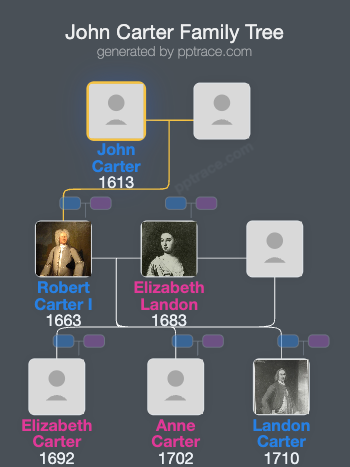
Carter was married five times. His first wife, Jane Glynn, bore two sons, George and John Jr., and a daughter, Elizabeth. Elizabeth married Nathaniel Utie and later Captain Henry Johnson. His second wife was Eleanor Eltonhead Brocas, and his third wife, Anne Carter, died soon after their marriage. His fourth wife, Sarah Ludlow, was the mother of Robert Carter I, known as "King Carter," a prominent Virginia landowner and politician. His fifth wife was Elizabeth Sherley, to whom he was married at the time of his death.
Carter died on January 10, 1670. At his death, he owned approximately 2,600 acres in Lancaster County. He was buried in Christ Church at Lancaster County, where he had contributed to its construction. An inventory of his estate listed contracts for 34 indentured servants and 42 enslaved Africans or people of African descent. His will and codicil were executed shortly before his death and recorded in 1722 by his son Robert Carter.