Landon Carter
| Name | Landon Carter |
| Title | American planter (1710-1778) |
| Gender | Male |
| Birthday | 1710-08-01 |
| nationality | United States of America |
| Source | https://www.wikidata.org/wiki/Q6484876 |
| pptrace | View Family Tree |
| LastUpdate | 2025-11-29T01:00:18.594Z |
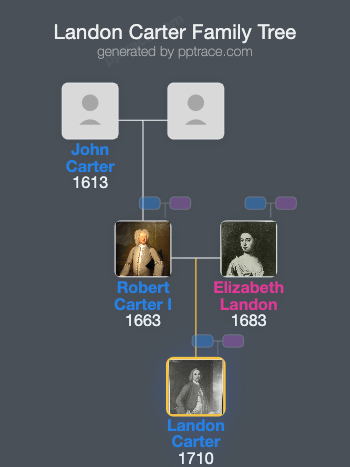
Family Tree
Tap  to expand more relatives
Introduction
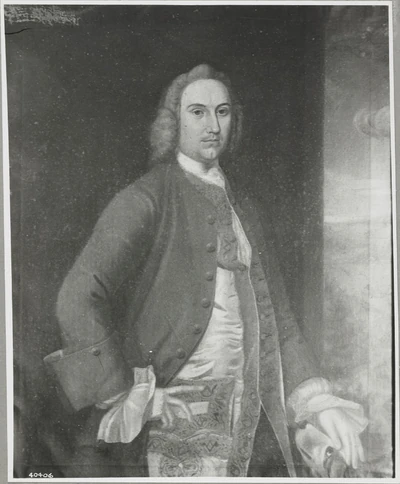
Landon Carter was born on August 18, 1710, and died on December 22, 1778. He was an American planter and politician based in Lancaster County, Virginia. He is recognized for his contributions as a patriotic writer and pamphleteer during the pre-Revolutionary period in Virginia. Additionally, his personal journal, titled The Diary of Colonel Landon Carter, provides detailed accounts of colonial life prior to the American War of Independence.
Carter was the son of Robert Carter, a Virginia-born merchant planter who was influential enough to be nicknamed "King" Carter, and his second wife, Elizabeth Landon Willis. His mother passed away in 1719, when Carter was approximately nine years old. Following her death, his elder half-brother, John Carter, became the guardian for Landon and his under-aged half-siblings. In the same year, Carter was sent to England for schooling under the linguist Solomon Lowe. He completed four additional years of education there. Upon returning to Virginia in 1727, Carter continued his studies at the College of William and Mary and assisted his father in managing plantations and various business interests.
Following the death of Robert Carter in 1732, Landon Carter inherited a portion of the estate upon reaching legal age. Throughout his life, he married three times, each marriage within the First Families of Virginia. His first wife was Elizabeth Wormeley, daughter of Ralph Wormeley; she died in 1740, leaving behind a son, Robert Wormeley Carter. His second marriage was to Maria Byrd in 1742, the daughter of William Byrd II; she died two years later. In 1746, Carter married Elizabeth Beale. After her death, he did not remarry. His marriages were often arranged among prominent Virginia families, and he focused on increasing his landholdings and plantation operations, which utilized enslaved labor. His daughter Maria married Robert Beverley, son of Colonel William Beverley and Elizabeth Bland.
Landon Carter established his residence on inherited lands in Richmond County, where he owned properties across eight counties in Virginia. He built a mansion known as Sabine Hall around 1734, which served as the center of his plantation management. His activities included producing tobacco and engaging in more scientific farming practices, which he documented in his diary. Politically, Carter was active in local affairs and served as a member of the House of Burgesses from 1752 until 1768, after two unsuccessful earlier attempts. Following the death of his brother Charles Carter of Cleve, who represented King George County, Carter helped raise his under-aged nephews.
In the late 1760s, amid increased British taxation following the French and Indian War, Carter became active as a pamphleteer and correspondent with others interested in scientific agriculture. He was elected as a member of the American Philosophical Society in Philadelphia in 1769.
Carter's estate included more than 400 slaves across Virginia counties, and his wealth made him one of the richest men in the Commonwealth. Records indicate he owned over 50,000 acres of land and as many as 500 slaves. His papers and personal documents are preserved at the Special Collections Research Center at the College of William and Mary.
He was buried at the Lower Lunenburg Parish Church cemetery in Warsaw, Virginia. His legacy includes several descendants named after him, and his family played significant roles in Virginia and early American history. His eldest son, Robert Wormeley Carter, continued his legislative and planter pursuits, and other relatives named sons in his honor who participated in the American Revolutionary War and colonial governance.