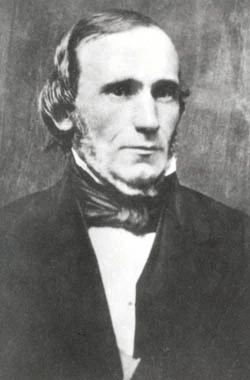
John Scott Harrison
| Name | John Scott Harrison |
| Title | American politician (1804–1878) |
| Gender | Male |
| Birthday | 1804-10-04 |
| nationality | United States of America |
| Source | https://www.wikidata.org/wiki/Q1701703 |
| pptrace | View Family Tree |
| LastUpdate | 2025-11-17T06:38:39.077Z |
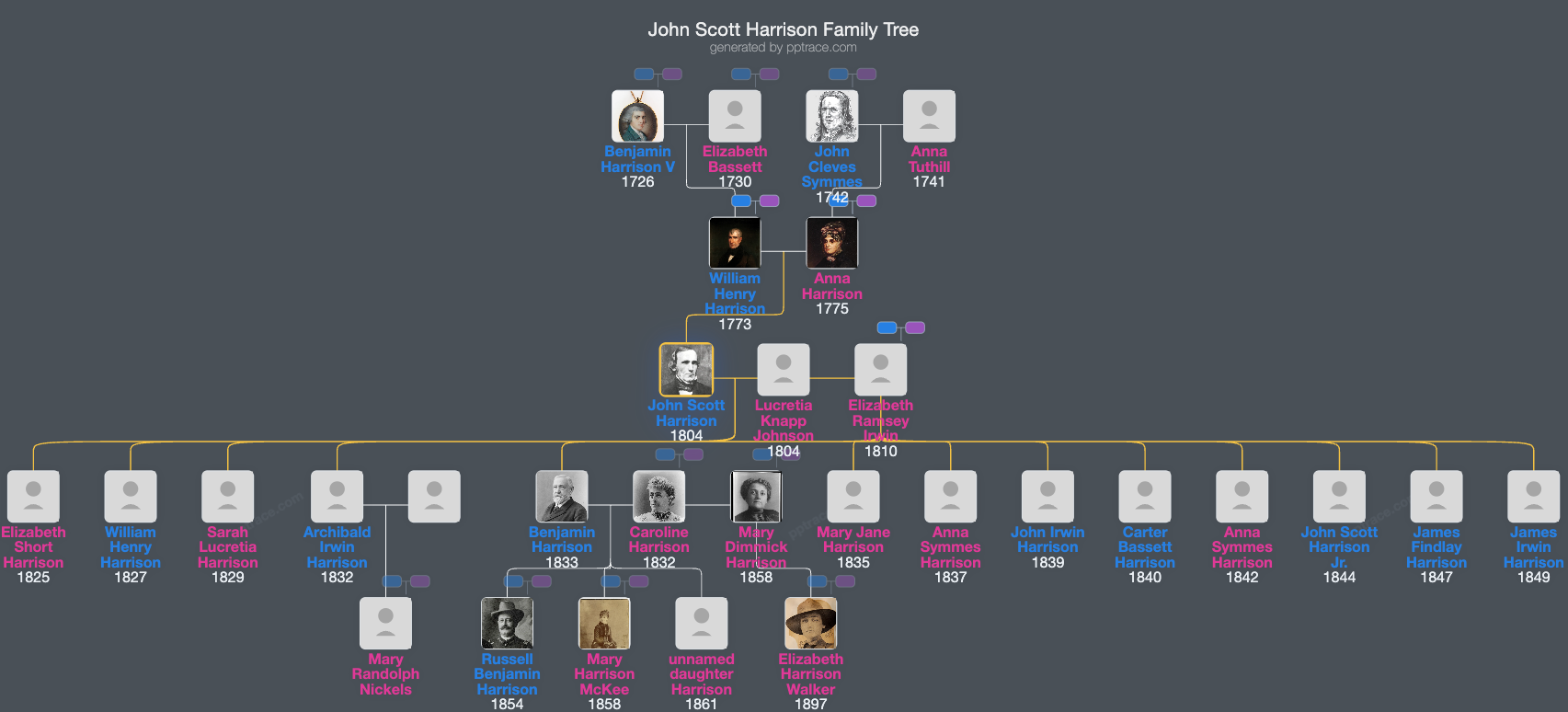
Family Tree
Tap  to expand more relatives
Introduction
John Scott Harrison was born on October 4, 1804, in Vincennes, Indiana, at the family residence known as Grouseland. He was one of ten children of William Henry Harrison, who served as the Governor of the Indiana Territory and later became the 9th President of the United States, and Anna Tuthill Symmes Harrison. Harrison’s paternal grandparents were Elizabeth Bassett Harrison and Benjamin Harrison V, a signer of the Declaration of Independence, associated with the Harrison family of Virginia. His maternal grandparents were Anna Symmes and John Cleves Symmes, who served as an associate justice on the Supreme Court of New Jersey.
Harrison pursued preparatory studies and studied law before abandoning the legal profession to engage in farming.
In his political career, Harrison was elected as a member of the Whig Party to the United States House of Representatives representing Ohio, serving from 1853 to 1857. He was reelected in 1854 as an Oppositionist. In 1855, he declined the use of his name for the gubernatorial election in Ohio. After an unsuccessful bid for a third term in 1856, he retired to his estate named "Point Farm" located in North Bend, Ohio.
In August 1860, Harrison was nominated as a Constitutional Union Party candidate for the second district, alongside Larz Anderson, at the Bell and Everett Convention. The Constitutional Union Party was organized primarily by former Southern Whigs opposed to secession.
In 1861, Harrison was nominated on the Democratic ticket as Lieutenant Governor of Ohio, running with Hugh J. Jewett, who was elected as Governor.
Regarding his personal life, Harrison first married Lucretia Knapp Johnson in 1824. She was born in 1804 and died in 1830. They had three children: Elizabeth Short Harrison (1825–1904), who married George Coleman Eaton; William Henry Harrison (1827–1829), who died young; and Sarah Lucretia Harrison (1829–1917), who married Thomas Jefferson Devin.
He married Elizabeth Ramsey Irwin on August 12, 1831, in Cincinnati, Ohio. She was born in 1810 and died in 1850; they had ten children together. Their children included Archibald Harrison (1832–1870), a Lieutenant Colonel in the 27th Indiana Infantry Regiment; Benjamin Harrison (1833–1901), who served as a U.S. Senator and was elected the 23rd President of the United States; Mary Jane Harrison (1835–1867), who married Samuel Vance Morris; Anna Symmes Harrison (1837–1838); John Irwin Harrison (1839), who died young; Carter Bassett Harrison (1840–1905), a Captain in the 51st Ohio Infantry Regiment; Anna Symmes Harrison (1842–1926), who married her sister’s widower Samuel Vance Morris; John Scott Harrison Jr. (1844–1926); and James Findlay Harrison (1847–1848), who died young. Austin Harrison (not listed in the original details) is not noted, but the focus remains on the confirmed children.
After William Henry Harrison’s death in 1841, his widow Elizabeth moved in with Harrison’s family to help raise the children.
John Scott Harrison died on May 25, 1878, in North Bend, Ohio, at the age of 73. He was the last surviving child of William Henry Harrison. He was interred in the family tomb at North Bend, now known as the William Henry Harrison Tomb State Memorial. His remains were subject to grave robbing, a common occurrence at the time for bodies used in dissection and anatomical study. To prevent theft, Harrison’s grave was secured with a cemented brick vault and other precautions. Nevertheless, on the day of his funeral, it was discovered that the body of Augustus Devin, buried in an adjoining grave, had been stolen. Investigations led to the discovery that Harrison’s body had been hanged in a chute at the Ohio Medical College, mistaken for Devin’s body. Devin’s body was later found preserved at the University of Michigan’s medical college.
The incident contributed to the passage of the Ohio Anatomy Law of 1881, which provided unclaimed bodies to medical schools to discourage grave robbing. Civil suits were filed against the Ohio Medical College for the theft, but the outcome of these suits is not documented.
References and external links include the biographical records of John Scott Harrison, his profile on the United States Congress website, and the Find a Grave memorial.