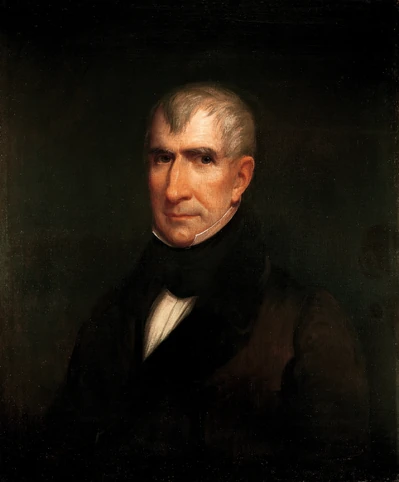
William Henry Harrison
| Name | William Henry Harrison |
| Title | president of the United States in 1841 |
| Gender | Male |
| Birthday | 1773-02-09 |
| nationality | United States of America |
| Source | https://www.wikidata.org/wiki/Q11869 |
| pptrace | View Family Tree |
| LastUpdate | 2025-11-17T06:38:38.203Z |
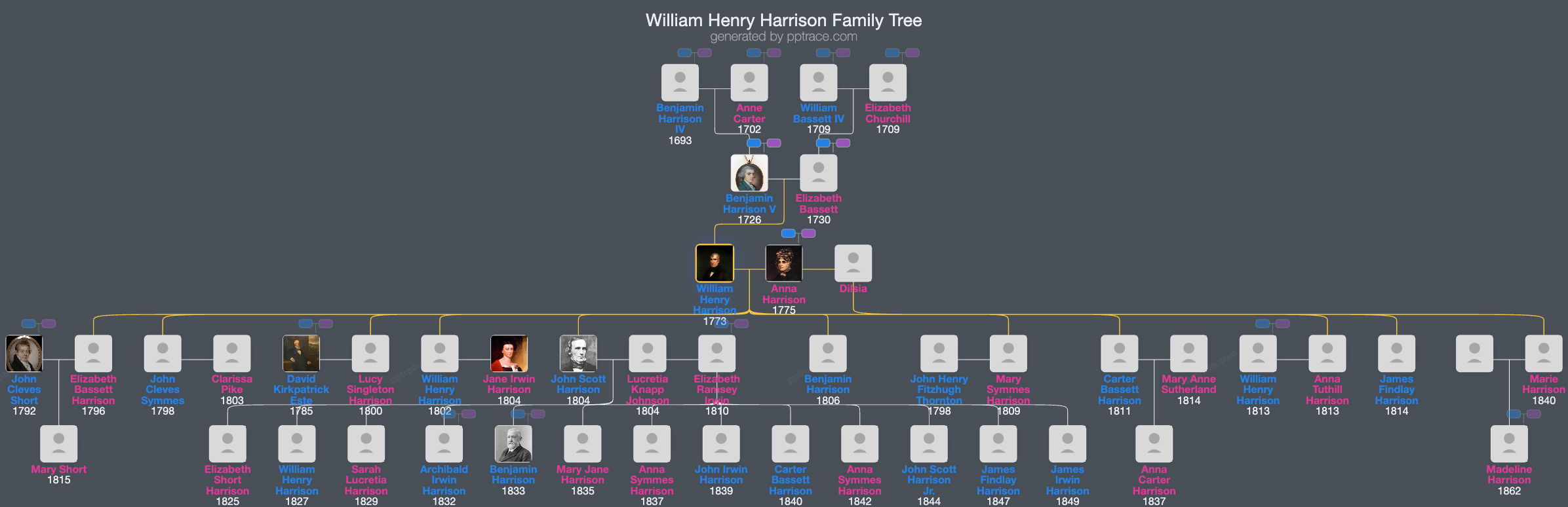
Family Tree
Tap  to expand more relatives
Introduction
William Henry Harrison (February 9, 1773 – April 4, 1841) was the ninth president of the United States, serving from March 4, 1841, until his death on April 4, 1841. His tenure in office was the shortest in U.S. history, lasting only just over a month. Harrison was also the first U.S. president to die while in office, leading to an early constitutional question regarding presidential succession, which was subsequently clarified.
Harrison was born in Charles City County, Virginia, at Berkeley Plantation, a family estate situated along the James River. He was a member of the Harrison family of Virginia, a prominent political lineage. His father, Benjamin Harrison V, was a signatory of the Declaration of Independence and served as a delegate to the Continental Congress and as governor of Virginia. William Harrison was the seventh and youngest child of Benjamin Harrison V and Elizabeth Bassett Harrison. His older brother, Carter Bassett Harrison, served in the U.S. House of Representatives, representing Virginia.
Harrison's early life was rooted in a family with deep political involvement and plantation holdings, including land and slaves inherited from his family. He was initially educated at home by private tutors and later attended Hampden–Sydney College in Virginia for three years, pursuing classical studies. Following this, he studied medicine at the University of Pennsylvania under Benjamin Rush, a founding father and renowned physician, but did not complete his medical degree due to financial constraints and a lack of interest in the field.
At age 18, in 1791, Harrison was commissioned as an ensign in the U.S. Army. His military career was notably marked by participation in the Northwest Indian War, including the Battle of Fallen Timbers in 1794, where he served as aide-de-camp to Major General "Mad Anthony" Wayne. He played a role in the negotiation of the Treaty of Greenville in 1795, which resulted in Native American tribes ceding large portions of land in Ohio to the U.S. government.
Harrison married Anna Tuthill Symmes in 1795 after eloping due to her family's initial disapproval. They maintained a relationship characterized by a large family, producing ten children, including John Scott Harrison, who was the father of Benjamin Harrison, the 23rd president of the United States. Their marriage was occasionally challenged by Anna's health issues, which were often related to pregnancy.
Professionally, Harrison's political career began with appointments in the early territorial governments. He served as secretary of the Northwest Territory in 1798, was elected as a non-voting delegate to the U.S. House of Representatives from the territory in 1799, and became governor of Indiana Territory in 1801. In that role, he negotiated multiple treaties with Native American tribes, acquiring significant land for the United States.
Following the War of 1812, Harrison moved to Ohio, where he represented Ohio’s 1st congressional district in the House of Representatives starting in 1816. He was elected to the U.S. Senate in 1824 but served only briefly before being appointed as minister plenipotentiary to Gran Colombia in 1828. After returning to Ohio, he remained involved in politics and was the Whig Party nominee for president in 1836, but lost to Martin Van Buren.
Harrison secured the presidency in the 1840 election as the Whig candidate, with John Tyler as his running mate. His campaign was known for its slogans and elaborate election tactics. However, he fell ill shortly after his inauguration and died just one month into his term. Following his death, John Tyler assumed the presidency after the constitutional clarification of succession.
References in historical assessments of Harrison often focus on his contributions to Native American treaties and his role in early American electoral strategies. Due to his brief time in office, he is frequently omitted from rankings of U.S. presidents in historical evaluations.