Benjamin Harrison
| Name | Benjamin Harrison |
| Title | American politician (1833–1901); President of the United States from 1889 to 1893 |
| Gender | Male |
| Birthday | 1833-08-20 |
| nationality | United States of America |
| Source | https://www.wikidata.org/wiki/Q35678 |
| pptrace | View Family Tree |
| LastUpdate | 2025-11-17T06:38:41.642Z |
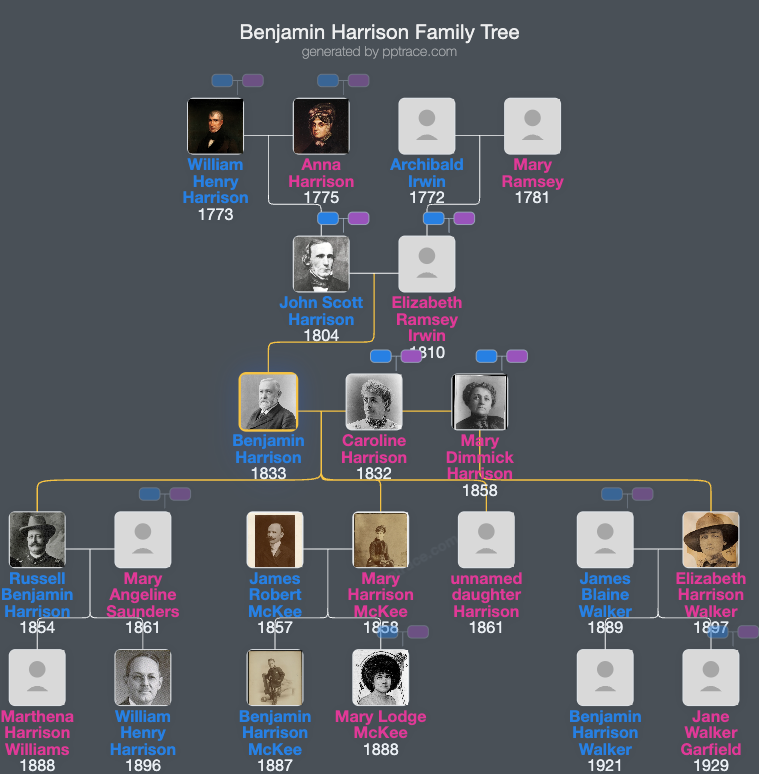
Family Tree
Tap  to expand more relatives
Introduction
Benjamin Harrison was born on August 20, 1833, in North Bend, Ohio, the second of ten children of Elizabeth Ramsey (Irwin) and John Scott Harrison. His paternal grandfather was William Henry Harrison, the ninth President of the United States, and his great-grandfather was Benjamin Harrison V, a Virginia planter who signed the Declaration of Independence and served as governor of Virginia. Harrison's ancestors arrived in America from England during the early colonial period, and his family was of entirely English descent.
Harrison received early education in a log cabin near his home and later studied with a private tutor. At age fourteen, in 1847, he enrolled at Farmer's College near Cincinnati, Ohio, where he met his future wife, Caroline "Carrie" Lavinia Scott, daughter of a Presbyterian minister and science professor. In 1850, he transferred to Miami University in Oxford, Ohio, graduating in 1852. During his university years, Harrison was a member of the Phi Delta Theta fraternity and the Delta Chi law fraternity. His influences included history and political economy professor Robert Hamilton Bishop, and he became a lifelong Presbyterian after joining a church during college.
After graduation, Harrison studied law under Judge Bellamy Storer in Cincinnati but returned to Oxford to marry Caroline Scott on October 20, 1853, before completing his law studies. The couple had two children: Russell Benjamin Harrison and Mary "Mamie" Scott Harrison. They initially resided on Harrison's family farm in Ohio before moving to Indianapolis, Indiana, in 1854, where Harrison established himself as a lawyer. He was admitted to the Ohio bar in 1854 and began practicing law in Indianapolis, working with John H. Ray and later forming a law partnership with William Wallace.
Harrison became active in local politics and civic organizations, serving as Indianapolis city attorney in 1857, and was involved with the Republican Party after its formation in 1856. He also served as reporter for the Indiana Supreme Court in 1860.
During the American Civil War, Harrison enlisted in the Union Army, motivated by a desire to serve despite initial concerns about supporting his family. Commissioned as a captain in July 1862 and promoted to colonel in August 1862, he commanded the 70th Indiana regiment. His regiment participated in reconnaissance, guard duty, and significant campaigns, including the Atlanta campaign in 1864 under Major General William T. Sherman. Harrison commanded a brigade during key battles such as Resaca, Kennesaw Mountain, and Atlanta, earning recognition for leadership and concern for his soldiers' welfare. He was brevetted as a brigadier general of volunteers in 1865.
Following his military service, Harrison entered politics and was elected to the Indiana Senate, serving from 1881 to 1887. He was a member of the Republican Party and sought the governorship of Indiana in 1876 but was unsuccessful. In 1888, he was elected President of the United States, defeating incumbent Grover Cleveland in the Electoral College despite losing the popular vote. His presidency lasted from 1889 to 1893, marked by significant legislation including the McKinley Tariff and the Sherman Antitrust Act. His administration facilitated the creation of national forest reserves, admitted six western states to the Union, and modernized the U.S. Navy. His foreign policy was active, but efforts to improve federal education funding and voting rights for African Americans remained unsuccessful. Surplus revenues from tariffs led to federal spending reaching $1 billion during his term.
In the 1892 election, Cleveland defeated Harrison for reelection. Harrison then returned to Indianapolis, practicing law privately. In 1899, he represented Venezuela in the boundary dispute with the United Kingdom before a court in Paris. He died on March 13, 1901, at his home in Indianapolis from complications related to influenza.
Harrison's legacy includes recognition for his commitment to African American voting rights, work ethic, and integrity. However, scholars typically rank his presidency as average, citing the lack of major events during his term.