Tokugawa Iesato
| Name | Tokugawa Iesato |
| Title | Japanese politician (1863-1940) |
| Gender | Male |
| Birthday | 1863-08-24 |
| nationality | Japan |
| Source | https://www.wikidata.org/wiki/Q672741 |
| pptrace | View Family Tree |
| LastUpdate | 2025-11-29T01:01:21.698Z |
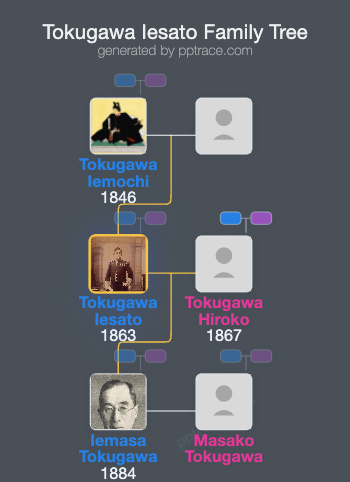
Family Tree
Tap  to expand more relatives
Introduction
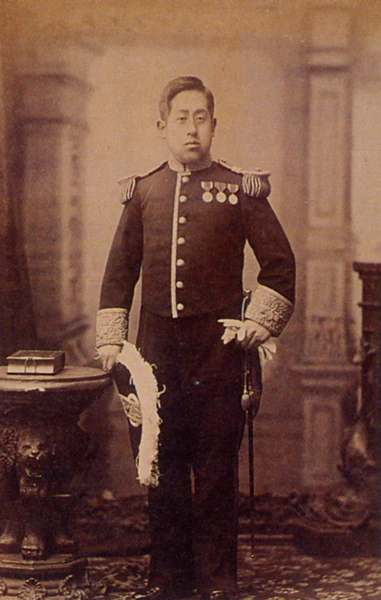
Prince Tokugawa Iesato (徳川 家達; August 24, 1863 – June 5, 1940) was a Japanese aristocrat and politician. He was the first head of the Tokugawa clan following the overthrow of the Tokugawa shogunate in 1868. He served as President of the House of Peers from 1903 to 1933.
Born into the Tayasu branch of the Tokugawa clan, he was originally named Kamenosuke. He became the sixteenth head of the Tayasu Tokugawa family on June 19, 1868, succeeding following the resignation of Tokugawa Yoshinobu, the last shōgun. His brothers included Tokugawa Satotaka and Tokugawa Takachiyo, each of whom held the headship of the Tayasu family at different times.
His early life included a brief tenure as daimyō of the Shizuoka Domain before the abolition of the han system in the early 1870s. His guardian was Matsudaira Naritami, a former lord of Tsuyama Domain. He was also adopted by the fourteenth shogun, Tokugawa Iemochi, and his wife, Kazu-no-Miya Chikako (also known as Seikan'in no Miya). Although Iemochi was his adoptive father, the two only met once. Later, Iemochi's foster mother, Tenshō-in, raised him.
In 1866, he was sent to Edo Castle as Iemochi’s son. In 1868, he was sent to Kyoto by his mother and met Emperor Meiji. He married Konoe Hiroko, daughter of Konoe Tadafusa, and they had several children, including Tokugawa Iemasa, who became the seventeenth family head; Tokugawa Yasuko, who married Nobusuke Takatsukasa; Tokugawa Ryōko; and Tokugawa Toshiko.
He studied at Eton College in Great Britain starting in 1877, with aspirations to attend either the University of Cambridge or Oxford. However, in 1882, on the request of Tenshō-in, he returned to Japan and did not pursue further studies abroad.
In 1884, with the reorganization of the nobility system, he was granted the title of kōshaku (prince or duke) in the newly established kazoku peerage. He served as a member of the House of Peers from its inception in 1890 and became its president in 1903, a position he held until 1933.
His political activities included a potential appointment as Prime Minister after the fall of Prime Minister Yamamoto Gonnohyōe's administration, which was brought down by the Siemens scandal. During World War I, he, along with Baron Shibusawa Eiichi, published a condolence booklet supporting the Allied powers and established a fund to aid war victims. The booklet, titled "Japan to her Allies," was published in 1917 in both French and English editions.
He played a role in promoting international goodwill and democracy, notably through his alliance with Baron Eiichi Shibusawa. He also headed the Japanese delegation to the Washington Naval Conference after World War I, where his support for the U.S. position on naval ratios faced opposition from ultra-nationalist factions.
Throughout his career, he held multiple senior positions, including President of the Japanese Red Cross Society (from 1928), head of the Japan-America Society, and president of the organizing committee for the 1940 Olympics.
In recognition of his work in promoting international relations, Rotary International selected him as the keynote speaker at their 25th anniversary celebration in 1930. He was honored with an honorary Doctor of Laws degree from the University of Southern California in 1934 during a visit to Los Angeles, the award given in recognition of his contributions to international diplomacy and philanthropy.
In the late 1930s, he toured the United States and Europe, primarily to strengthen diplomatic ties amidst rising militarism globally. During his stay in the U.S., he met President Franklin D. Roosevelt and delivered a radio address emphasizing the long-standing friendly relations between the United States and Japan.
Prince Iesato Tokugawa died on June 5, 1940, in Tokyo at the age of 76. His remains are interred at the Tokugawa family cemetery at Kan'ei-ji in Ueno, Tokyo. He was succeeded by his son, Tokugawa Iemasa.
Family details include his father, Tokugawa Yoshiyori; mother, Takai Takeko; wife, Konoe Hiroko; and children Tokugawa Iemasa, Tokugawa Yasuko, Tokugawa Ryōko, and Tokugawa Toshiko.