Iemasa Tokugawa
| Name | Iemasa Tokugawa |
| Title | Japanese politician (1884-1963) |
| Gender | Male |
| Birthday | 1884-03-23 |
| nationality | Japan |
| Source | https://www.wikidata.org/wiki/Q277171 |
| pptrace | View Family Tree |
| LastUpdate | 2025-11-17T06:48:06.912Z |
Family Tree
Tap  to expand more relatives
Introduction
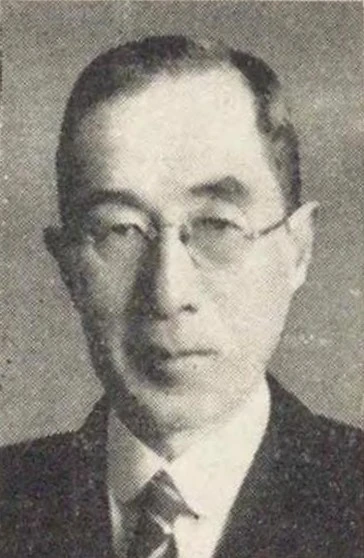
Prince Iemasa Tokugawa (徳川 家正, Tokugawa Iemasa), also known as Iyemasa, was born on March 23, 1884, and died on February 18, 1963. He was a Japanese political figure during the Taishō and early Shōwa periods. He held the position of the 17th hereditary head of the former shogunal branch of the Tokugawa clan and served as the final President of the House of Peers in the Imperial Diet of Japan.
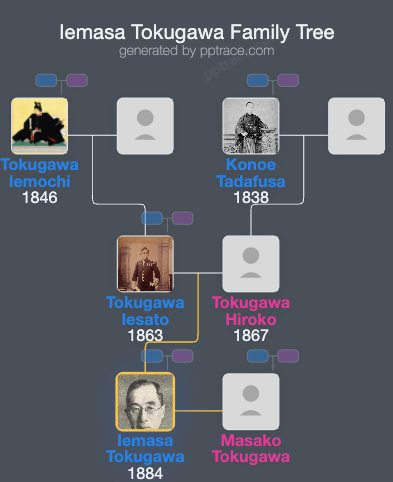
Biographically, Iemasa Tokugawa was born in the Sendagaya district of Tokyo. He was the eldest son of Tokugawa Iesato and his wife, Konoe Hiroko, who was the daughter of Konoe Tadafusa. He completed his higher education at Tokyo Imperial University, now known as the University of Tokyo, graduating from the Faculty of Law in 1909.
Following his graduation, he entered the diplomatic service of the Japanese Foreign Ministry. His diplomatic career included appointments as Consul-General in Sydney, Australia, in 1924; Envoy to Canada in 1929; and diplomatic postings including Ambassador to Turkey from 1937 to 1939. Throughout his diplomatic career, Iemasa often collaborated with his father, Tokugawa Iesato, in efforts aimed at fostering international goodwill between Japan and countries in Europe, North America, and elsewhere. In 1934, he was pictured accompanying his father during the latter’s receipt of an honorary Doctor of Laws degree from the University of Southern California. That same year, he received an honorary Doctor of Laws degree from the University of British Columbia in Canada, in recognition of his humanitarian and diplomatic contributions.
In 1940, upon the death of his father, he inherited the title of kōshaku (prince/duke) within the kazoku peerage system and assumed a seat in the House of Peers of the Imperial Diet. He served as the President of the House of Peers from June 19, 1946, until May 2, 1947. His tenure concluded when the Allied occupation authorities authorized the promulgation of Japan’s new constitution, which abolished the House of Peers and the noble class.
Prince Iemasa Tokugawa died due to heart disease at his residence in Shibuya, Tokyo, on February 18, 1963. Posthumously, he was awarded the Order of the Rising Sun with Paulownia Flowers, 1st class. His burial site is located at Yanaka Cemetery in Tokyo.
He was succeeded as head of the Tokugawa clan by his grandson, Tsunenari Tokugawa, who was born from Toyoko Tokugawa and Matsudaira Ichiro, the son of Tsuneo Matsudaira.
His familial relationships included his father, Tokugawa Iesato; his mother, Konoe Hiroko (1867–1944); his wife, Naoko Tokugawa, a marriage decided by the will of Tenshō-in; and children Iehide Tokugawa (1912–1936), Toyoko Tokugawa (who married Ichiro Matsudaira), Toshiko Tokugawa (married Uesugi Takanori), and Junko Tokugawa (married Hoshina Mitsumasa). His grandson, Tsunenari Tokugawa, was derived from Toyoko.
In terms of honors, he received the Medal with Dark Blue Ribbon in August 1942 and the Grand Cordon of the Order of the Rising Sun, first class, at his death in 1963. His foreign awards included the King George V Coronation Medal (1911), being named an Officer of the Most Excellent Order of the British Empire (OBE) in 1919, the Order of the Precious Brilliant Golden Grain from the Republic of China in 1921, and being made a Knight Commander of the Royal Victorian Order (KCVO) in 1929.