Tokugawa Iemochi
| Name | Tokugawa Iemochi |
| Title | Japanese shogun |
| Gender | Male |
| Birthday | 1846-07-17 |
| nationality | Tokugawa shogunate |
| Source | https://www.wikidata.org/wiki/Q348466 |
| pptrace | View Family Tree |
| LastUpdate | 2025-11-29T01:01:23.480Z |
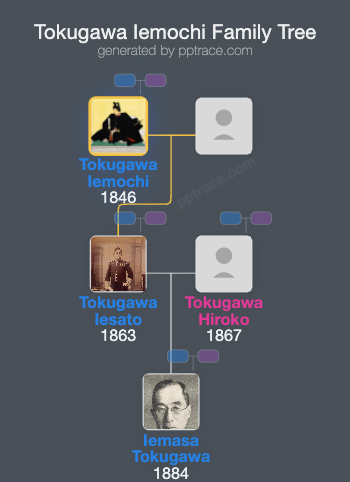
Family Tree
Tap  to expand more relatives
Introduction
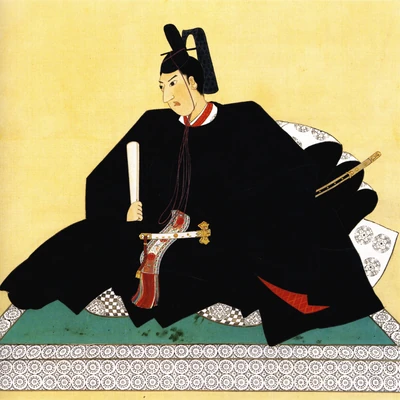
Tokugawa Iemochi (徳川 家茂) was born on July 17, 1846, and died on August 29, 1866. He was the 14th shōgun of the Tokugawa shogunate of Japan, serving from 1858 until his death in 1866.
He was the eldest son of Tokugawa Nariyuki, the 11th-generation lord of the Wakayama Domain, and his concubine, Jitsujoin. Nariyuki was a younger son of the 11th shōgun Tokugawa Ienari. Iemochi was born in Edo (present-day Minato-ku, Tokyo). In 1847, at the age of one, he was adopted as the heir to Tokugawa Narikatsu, the 12th-generation daimyō, and succeeded him in 1850. Following his coming of age in 1851, he took the name Tokugawa Yoshitomi.
In 1858, he had an audience with the shōgun Iesada and his wife Atsuhime. Subsequently, he was adopted as their son and named as the successor to the main Tokugawa house. His selection was contested by factions within the government who supported Tokugawa Yoshinobu and Matsudaira Naritami, both of whom were adults at that time. Upon assuming the office of shōgun, Yoshitomi changed his name to Iemochi.
Before Iesada’s death, he entrusted Ii Naosuke with assisting Iemochi in administrative matters until Iemochi reached maturity. He was also expected to consult with Tenshoin, his mother, on political issues. As part of the kōbu gattai ("Union of Court and Bakufu") movement, Iemochi married Princess Kazu, daughter of Emperor Ninko, on February 11, 1862. Princess Kazu refused the traditional title "Midaidokoro" and instead used "Miya."
On April 22, 1863, Iemochi traveled in a grand procession to Kyoto upon a summons from the emperor. He was escorted by 3,000 retainers. This visit marked the first time a shōgun had traveled to Kyoto since the visit of Tokugawa Iemitsu during the Kan'ei era, approximately 230 years earlier. His early death at age 20 ended his brief marriage to Princess Kazu-no-Miya. Before dying, he adopted a young heir, Tayasu Kamenosuke (later Tokugawa Iesato), who was only three years old at the time. Due to the ongoing conflict with Chōshū Domain, Tokugawa Yoshinobu was appointed the fifteenth shōgun. Yoshinobu later adopted Iemochi's adopted son, Tayasu Kamenosuke.
Iemochi’s cause of death is widely reported as heart failure resulting from beriberi, a disease caused by thiamine deficiency. After his death, Princess Kazu-no-Miya changed her name to Seikan'in no Miya.
His successor, Tokugawa Yoshinobu, became the last Tokugawa shōgun. His tenure witnessed the end of the shogunate and the onset of the Meiji Restoration.
Family details include his father Tokugawa Nariyuki, mother Jitsujoin, adoptive fathers Tokugawa Narikatsu and Tokugawa Iesada, and his wife Kazu-no-Miya Chikako. His concubine was Oyuri no Kata, and his adopted son was Tokugawa Mochitsugu, known as Tokugawa Iesato.
The eras of his bakufu spanned several nengō: Ansei (1854–1860), Man’en (1860–1861), Bunkyū (1861–1864), Genji (1864–1865), and Keiō (1865–1868).