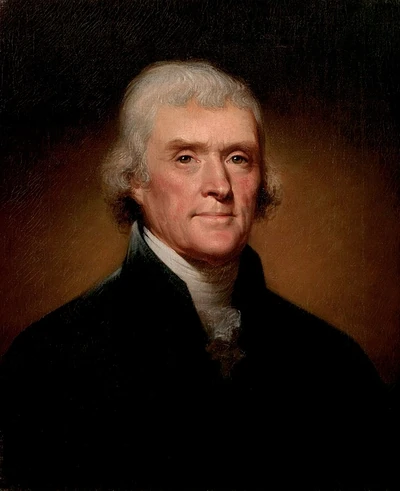
Thomas Jefferson
| Name | Thomas Jefferson |
| Title | president of the United States from 1801 to 1809 |
| Gender | Male |
| Birthday | 1743-04-13 |
| nationality | United States of America |
| Source | https://www.wikidata.org/wiki/Q11812 |
| pptrace | View Family Tree |
| LastUpdate | 2025-11-17T06:37:22.945Z |
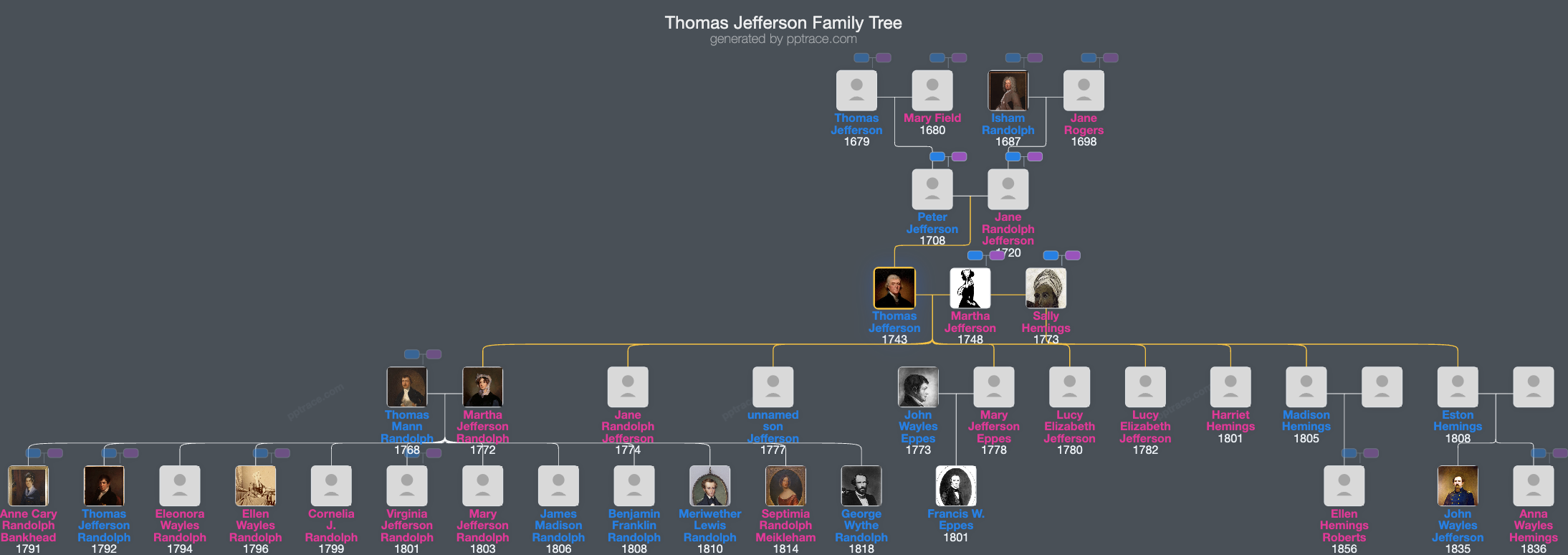
Family Tree
Tap  to expand more relatives
Introduction
Thomas Jefferson (April 13 [O.S. April 2], 1743 – July 4, 1826) was an American statesman and Founding Father who served as the third president of the United States from 1801 to 1809. He was the principal author of the Declaration of Independence and played a significant role in early American political development. Jefferson held various government positions, including the nation's first secretary of state under President George Washington and the second vice president under President John Adams.
Born in the Colony of Virginia, Jefferson was a member of the planter class and reliant on enslaved labor. His early life began at Shadwell Plantation, where he was born and raised. His parents were Peter Jefferson, a planter and surveyor, and Jane Randolph. Following the death of William Randolph III, Jefferson's family moved to Tuckahoe Plantation in 1745 before returning to Shadwell in 1753. Jefferson received his early education from tutors and at local schools, studying Latin, Greek, French, history, and science. He learned riding horses and developed an interest in the natural world.
At age nine, Jefferson attended a school run by a Presbyterian minister and later studied under Reverend James Maury near Gordonsville, Virginia, from 1758 to 1760. During this period, he met and admired Patrick Henry and interacted with American Indian tribes, including Cherokee chief Ostenaco. His father died in 1757, and Jefferson inherited approximately 5,000 acres of land, later developing Monticello on this estate.
In 1761, Jefferson enrolled at the College of William & Mary in Williamsburg, where he studied mathematics and philosophy under William Small. His education included exposure to the ideas of British empiricists such as John Locke, Francis Bacon, and Isaac Newton. Jefferson later considered William & Mary to be an influential part of his intellectual development. He graduated in April 1762, then studied law under George Wythe while working as a law clerk. Throughout his life, Jefferson amassed a large personal library, which grew to nearly 6,500 volumes by 1814. After the British burning of the Library of Congress in 1814, he sold his collection to help rebuild it.
Jefferson began his professional career as a lawyer in 1767 after gaining admission to the Virginia bar. Between 1769 and 1775, he represented Albemarle County in the Virginia House of Burgesses. During this period, he advocated for reforms related to slavery, proposing legislation to limit the power of colonial authorities and support emancipation, though such efforts faced opposition. Jefferson's legal work included representing enslaved individuals seeking freedom, but his views on slavery and personal ownership remained complex.
In 1776, Jefferson represented Virginia at the Second Continental Congress, where he drafted the Declaration of Independence, emphasizing natural rights and individual liberty. He served as the governor of Virginia from 1779 to 1781. In 1785, Jefferson was appointed as the U.S. Minister to France, serving from 1785 to 1789. Under President George Washington, he was appointed the first Secretary of State (1790–1793). Jefferson and James Madison founded the Democratic-Republican Party in 1792 to oppose Federalist policies.
In the 1796 presidential election, Jefferson placed second and became vice president under John Adams. Four years later, Jefferson defeated Adams in the 1800 election and assumed the presidency. He was re-elected in 1804 with a significant majority. During his presidency, Jefferson emphasized western expansion, notably through the Louisiana Purchase in 1803, which doubled the nation's territory. His administration also defended maritime interests against Barbary pirates and British trade policies. He reduced the military's size and expenditures following negotiations with France. Domestic challenges included the trial of his vice president, Aaron Burr, and economic measures such as the Embargo Act of 1807, designed to protect U.S. shipping from British threats.
Jefferson is included among the upper tier of U.S. presidents in scholarly rankings. Historians have commended his advocacy for religious freedom, the peaceful acquisition of Louisiana, and his support for the Lewis and Clark Expedition. His ownership of a large number of slaves has been a subject of analysis, with interpretations varying regarding his personal views on slavery and his actions concerning slavery.
In his personal life, Jefferson was married to Martha Wayles Skelton in 1772, with whom he had children, though only two daughters survived to adulthood. Jefferson died on July 4, 1826, the 50th anniversary of American independence.