George Nugent-Temple-Grenville, 1st Marquess Of Buckingham
| Name | George Nugent-Temple-Grenville, 1st Marquess Of Buckingham |
| Title | British politician (1753-1813) |
| Gender | Male |
| Birthday | 1753-06-17 |
| nationality | Great Britain |
| Source | https://www.wikidata.org/wiki/Q333744 |
| pptrace | View Family Tree |
| LastUpdate | 2025-11-26T23:23:13.736Z |
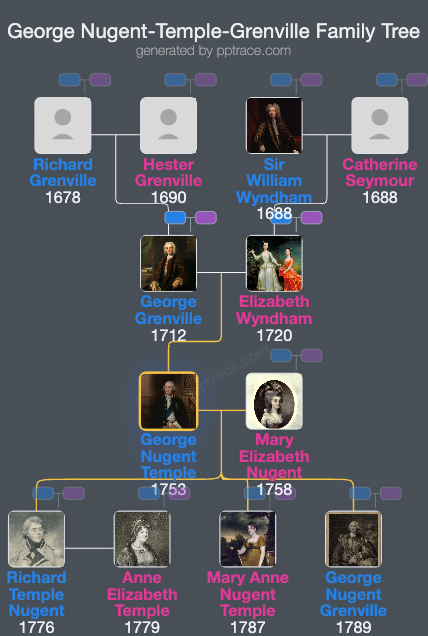
Family Tree
Tap  to expand more relatives
Introduction
George Nugent-Temple-Grenville, 1st Marquess of Buckingham (17 June 1753 – 11 February 1813), was a British statesman. He was born in 1753 as the eldest son of George Grenville, who served as Prime Minister of Great Britain, and Elizabeth Wyndham, daughter of Sir William Wyndham, 3rd Baronet. His family included notable relatives such as Richard Grenville-Temple, 2nd Earl Temple, his uncle, and brothers Thomas Grenville and William Grenville, who both held political office, with William becoming Prime Minister.
In 1764, Nugent-Temple-Grenville was appointed a Teller of the Exchequer. He attended Eton College from 1764 to 1770, and in 1770, he matriculated at Christ Church, Oxford. In 1774, he undertook a Grand Tour of Italy and Austria.
In 1775, he married the Hon. Mary Nugent, daughter of Robert Nugent, 1st Viscount Clare. The following year, Nugent's father-in-law was created Earl Nugent with a special remainder to Nugent-Temple-Grenville if he had no male heirs.
Politically, Nugent-Temple-Grenville was elected Member of Parliament for Buckinghamshire in the 1774 general election, serving in the House of Commons. He was known as a critic of the American policy of Prime Minister Lord North. In 1779, he succeeded his uncle as the 3rd Earl Temple and entered the House of Lords. On 4 December 1779, he added the family names Nugent and Temple, becoming Nugent-Temple-Grenville.
In 1782, he was appointed Lord Lieutenant of Buckinghamshire and became a member of the Privy Council. That same year, he served as Lord Lieutenant of Ireland in the Ministry of Lord Shelburne, where he played a role in the passage of the Renunciation Act 1783, which granted legislative independence to Ireland. He created the Order of St Patrick in February 1783, serving as its first Grand Master.
After leaving Ireland in 1783, Nugent-Temple-Grenville aligned with King George III's support, notably opposing Fox's East India Bill, which contributed to its defeat. He was briefly appointed Secretary of State in December 1783 under Prime Minister William Pitt the Younger but resigned after three days, marking one of the shortest cabinet tenures in British history.
In December 1784, he was elevated to Marquess of Buckingham. He served again as Lord Lieutenant of Ireland from 1787 to 1789 under Pitt's government. His second tenure was marked by unpopularity due to accusations of extravagance and corruption; he refused to transmit an address calling for Prince of Wales to assume regency and resorted to bribery to maintain his position. Upon his father-in-law’s death in 1788, he succeeded as the 2nd Earl Nugent, although he was generally known by his marquessate.
He resigned as Lord Lieutenant of Ireland in September 1789 amid mounting unpopularity. Later in life, he largely withdrew from politics but expressed support for the Act of Union of 1800. His wife died in 1812, and Nugent-Temple-Grenville died at his residence in Stowe, Buckinghamshire, on 11 February 1813. He was buried at Wotton, his ancestral home.
He was succeeded by his sons: Richard Nugent-Temple-Grenville, who became the 2nd Marquess of Buckingham and later Duke of Buckingham and Chandos, and George Nugent, who succeeded his mother as the 2nd Baron Nugent. Several streets in Dublin, including Buckingham Street, Temple Street, and Grenville Street, are named after him.