George Grenville
| Name | George Grenville |
| Title | Prime Minister of Great Britain (1712-1770) |
| Gender | Male |
| Birthday | 1712-10-14 |
| nationality | Great Britain |
| Source | https://www.wikidata.org/wiki/Q244616 |
| pptrace | View Family Tree |
| LastUpdate | 2025-11-26T23:23:11.142Z |
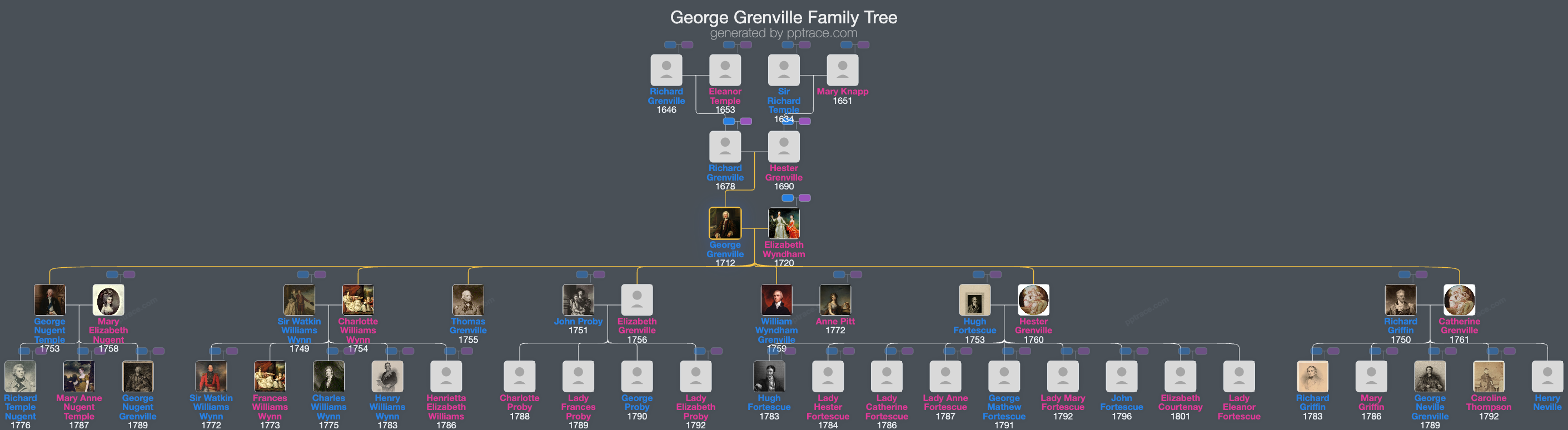
Family Tree
Tap  to expand more relatives
Introduction
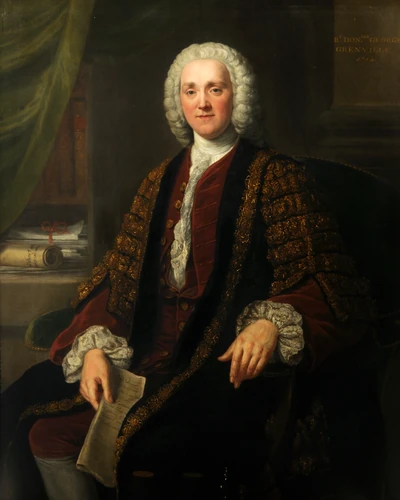
George Grenville (14 October 1712 – 13 November 1770) was a British politician and statesman. He served as Prime Minister of Great Britain from April 1763 to July 1765 during the early reign of King George III.
Born in Wotton House in 1712, Grenville was the second son of Sir Richard Grenville and Hester Temple, who later became the 1st Countess Temple. His family was prominent in political circles, with his sister Hester Grenville marrying William Pitt, 1st Earl of Chatham, a notable political figure. Grenville had four brothers, all of whom became Members of Parliament (MPs). His elder brother was Richard Grenville, later the 2nd Earl Temple. The family intended for George Grenville to pursue a career in law; he was educated at Eton College and Christ Church, Oxford, although he did not graduate.
In 1741, Grenville was elected as MP for Buckingham, a seat he held until his death in 1770. Early in his political career, he aligned with the Cobhamite faction, a group opposing Sir Robert Walpole's government. Grenville held various governmental roles, including Lord of the Admiralty in 1744 and Lord of the Treasury in 1747. In 1754, he was appointed Treasurer of the Navy and became a Privy Councillor.
Grenville's opposition to the government peaked in 1755 when he, along with William Pitt, opposed a subsidy treaty with Russia, criticizing the expense and potential for entanglements in European conflicts. This opposition contributed to the fall of the government in 1756. Following this, Grenville served in the government of the Duke of Devonshire as Treasurer of the Navy, a position he held until 1761. During this period, he contributed to reforms such as establishing a more equitable system of wages for sailors.
In 1761, as Pitt resigned over disagreements related to the Seven Years' War, Grenville became the Leader of the House of Commons and was subsequently appointed Northern Secretary. His foreign policy stance was increasingly assertive towards France and Spain, advocating for stricter negotiations to end the war.
Grenville's tenure as Prime Minister began on 16 April 1763 after the resignation of Lord Bute, largely due to Bute's unpopularity and political pressures. As Prime Minister, Grenville attempted to address Britain's financial difficulties stemming from the costs of the Seven Years' War by instituting measures to increase revenue, including new taxes and stricter enforcement. He is most known for extending the Stamp Act to the American colonies, which aimed to raise revenue but was met with widespread opposition in the colonies and later repealed.
His government faced various challenges, including tensions with colleagues and the King. In 1765, Grenville was dismissed by King George III and replaced by Lord Rockingham. Following his resignation, Grenville led a faction in opposition for the remaining years of his life, including a public reconciliation with William Pitt.
Grenville married Elizabeth Wyndham, who was the granddaughter of Charles Seymour, 6th Duke of Somerset, and a descendant of Lady Katherine Grey, establishing a lineage linked to royal bloodlines of the Tudor era.
George Grenville died in 1770 at the age of 58. His political career was marked by efforts to reform fiscal policy and colonial relations during a period of significant transition for Britain.