George Nugent-Grenville, 2nd Baron Nugent
| Name | George Nugent-Grenville, 2nd Baron Nugent |
| Title | British politician |
| Gender | Male |
| Birthday | 1789-12-31 |
| nationality | United Kingdom of Great Britain and Ireland |
| Source | https://www.wikidata.org/wiki/Q3101799 |
| pptrace | View Family Tree |
| LastUpdate | 2025-11-27T10:44:39.364Z |
Family Tree
Tap  to expand more relatives
Introduction
George Nugent-Grenville, 2nd Baron Nugent of Carlanstown, GCMG, was born on December 31, 1788, and died on November 26, 1850. He was an Irish politician and held the peerage title following his mother's death in 1813.
Family Background and Early Life
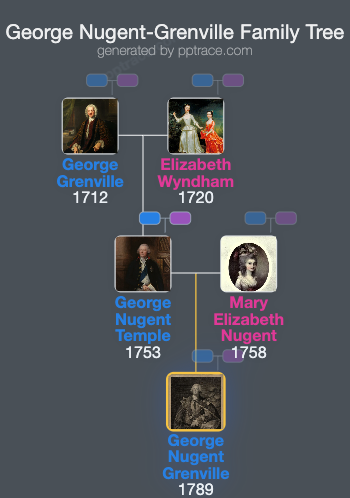
Nugent-Grenville was a younger son of George Nugent-Temple, 1st Marquess of Buckingham. His mother was Lady Mary Elizabeth Nugent, the only daughter and heiress of Robert Nugent, 1st Earl Nugent. She was created a baroness of Ireland in 1800, with a remainder passing to her second son, George Nugent-Grenville. Upon her death on March 16, 1813, Nugent-Grenville succeeded to the peerage.
Education
He attended Brasenose College, Oxford, and received the honorary degree of Doctor of Civil Law (D.C.L.) from Oxford in 1810.
Political Career
Nugent-Grenville served as a Whig Member of Parliament for Buckingham from 1810 to 1812. This seat was considered a "rotten borough" under the control of the Grenville family. In the general election of 1812, he was elected as MP for Aylesbury. Despite political complications arising from his brother Richard, who was then known as the Marquess of Buckingham and had joined the ministry, Nugent-Grenville was able to secure and hold his seat in 1818.
He was re-elected in 1831 and served as a member for Aylesbury until the dissolution in 1832. In November 1830, he was appointed as a Lord of the Treasury but resigned this position in August 1832 to become Lord High Commissioner of the Ionian Islands, a role he held for three years. During his tenure, he received the Grand Cross of St. Michael and St. George.
Subsequently, Nugent-Grenville made several unsuccessful attempts to return to Parliament, contesting Aylesbury in 1837 and 1839, and Southampton in 1843 with reformer George Thompson, but was defeated each time. He was elected again for Aylesbury in 1847.
Political Views and Activities
Nugent-Grenville was known for his extreme Whig or whig-radical political stance. He supported Queen Caroline of Brunswick and engaged in foreign political sympathies, notably visiting Spain as a supporter of the Spanish Liberals against the Carlists.
In legislative matters, he moved in 1848 for the introduction of a bill to abolish the separate imprisonment of persons accused in trials, which was defeated. During the same session, he advocated for the abolition of capital punishment. In 1849, he voted in favor of limiting the powers granted by the Ireland (Habeas Corpus Suspension) Bill and supported the further repeal of Penal Laws.
Associations
He was a member of the Reform Club and the Athenaeum Club.
Death
Nugent-Grenville died at his residence in Buckinghamshire on November 26, 1850.
Published Works
His literary output included "Portugal, a Poem" (1812), "Oxford and Locke" (1829), defending John Locke from censure, and "Memorials of John Hampden" (1832), which received mixed reviews from prominent critics. He authored "Legends of the Library at Lillies" (1832), a collection of local stories, and the two-volume travelogue "Lands Classical and Sacred" (1845–6). Nugent-Grenville also wrote various pamphlets on political, social, and ecclesiastical topics.
Family
He married Anne Lucy on September 6, 1813. She was the second daughter of Major-General the Honorable Vere Poulett. They had no children, and she died in 1848. Following her death, the barony became extinct.
References
This biography incorporates text from the 1890 edition of the "Dictionary of National Biography" by George Barnett Smith.