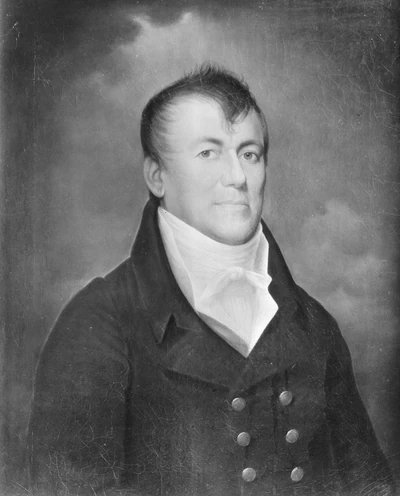
George Hay
| Name | George Hay |
| Title | United States federal judge |
| Gender | Male |
| Birthday | 1765-12-17 |
| nationality | United States of America |
| Source | https://www.wikidata.org/wiki/Q5540334 |
| pptrace | View Family Tree |
| LastUpdate | 2025-11-17T06:37:59.138Z |
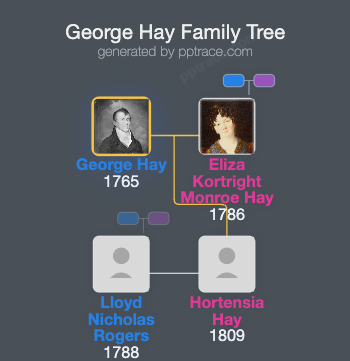
Family Tree
Tap  to expand more relatives
Introduction
George Hay (December 17, 1765 – September 21, 1830) was an American jurist and legal professional who served as a United States district judge for the Eastern District of Virginia. He was born in Williamsburg, in the Colony of Virginia, which was part of British America, on December 17, 1765.
Hay pursued his legal education by reading law, a common method of legal study during his time. His early career involved private legal practice, beginning in Petersburg, Virginia, from 1787 to 1801. Subsequently, he practiced in Richmond, Virginia, from 1801 to 1803. In 1803, he was appointed as the United States Attorney for the District of Virginia, a position he held until 1816.
From 1816 to 1822, Hay was a member of the Virginia House of Delegates. After serving in the state legislature, he resumed private legal practice in Washington, D.C., from 1822 to 1825. During this period, he was closely associated with James Monroe, his father-in-law, particularly during the Missouri Crisis. During the crisis, Hay anonymously authored pro-slavery essays published in the South's leading newspaper under the pseudonym "An American," including a series titled "For the Enquirer. Missouri Question."
Hay’s notable legal activity includes serving as a prosecutor during the trial of Aaron Burr. He was also an advocate for freedom of the press, notably defending James T. Callender during his sedition trial. Additionally, Hay was an outspoken supporter of slavery and authored pro-slavery writings advocating this stance during the Missouri Crisis.
On July 5, 1825, Hay received a recess appointment from President John Quincy Adams to serve on the United States District Court for the Eastern District of Virginia, filling the vacancy left by Judge St. George Tucker. His appointment was formally nominated on December 13, 1825, and the United States Senate confirmed him on March 31, 1826, at which point he received his commission. He served on the federal bench until his death on September 21, 1830, in Richmond, Virginia.
In his personal life, Hay married Eliza Kortright Monroe in 1808. She was the daughter of President James Monroe. The couple had one child, Hortensia, who survived to adulthood.
Hay is noted for his writings on civil liberties, including a quotation asserting the broad scope of freedom of speech and freedom of the press in the United States. He articulated that freedom of speech encompasses the right to speak any truth or falsehood without legal restraint, provided no other individual is harmed, and emphasized that freedom of the press allows individuals to publish content without interference.
**References**
- Biographical Directory of Federal Judges, Federal Judicial Center
**Sources**
- An essay on the liberty of the press: respectfully inscribed to the republican printers throughout the United States, 1799
- "O Say Can You See: Early Washington, DC Law & Family Project," Center for Digital Research in the Humanities