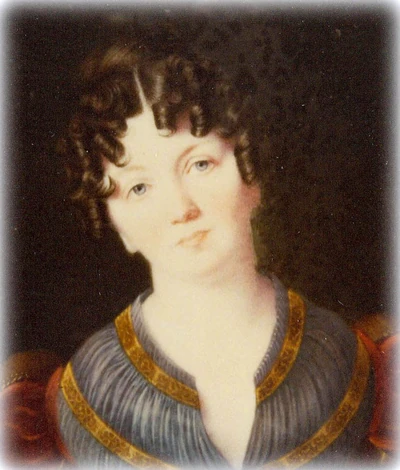
Eliza Kortright Monroe Hay
| Name | Eliza Kortright Monroe Hay |
| Title | American socialite who acted as unofficial First Lady during her father James Monroe's presidency |
| Gender | Female |
| Birthday | 1786-00-00 |
| nationality | United States of America |
| Source | https://www.wikidata.org/wiki/Q21009915 |
| pptrace | View Family Tree |
| LastUpdate | 2025-11-17T06:37:56.778Z |
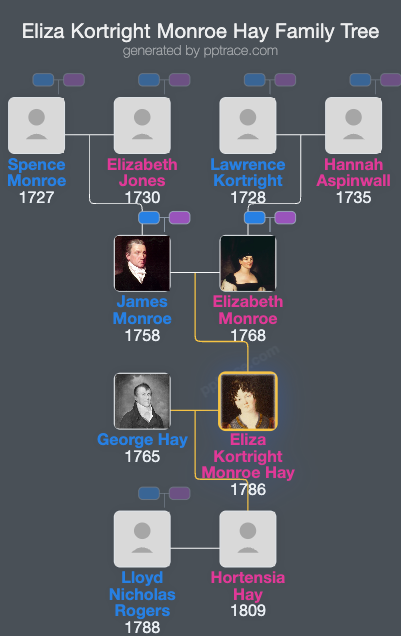
Family Tree
Tap  to expand more relatives
Introduction
Elizabeth Kortright Monroe Hay (December 1786 – January 27, 1840) was an American individual known for her role in the social sphere during her father's presidency. She was born in Virginia to James Monroe, the fifth President of the United States, and Elizabeth Monroe (née Kortright). During her childhood, she resided in Paris, where her father served as the American minister to France amid the French Revolution. She attended the Maison d'éducation de la Légion d'honneur, an educational institution established by Henriette Campan, a former lady-in-waiting to Marie Antoinette. During her time at the school, she formed acquaintances with several European royal family members, including Hortense de Beauharnais, daughter of Josephine de Beauharnais and future mother of Napoleon III.
In 1803, at age 17, Hay returned with her family to the United States, by which time she was fluent in French and English. In 1808, she married George Hay, a Virginia-born attorney and judge. She became associated with the Monroe presidency in 1817 when her father assumed office. During James Monroe’s presidency, she frequently fulfilled unofficial First Lady duties in place of her mother, who often was unwell. Contemporary accounts describe her as having a controlling manner and insisting on strict adherence to social protocol, with some critics noting a tendency toward snobbery and high self-regard. Louisa Adams, wife of John Quincy Adams, characterized her as "so accomplished and ill bred," "so proud and mean," and noted her fondness for scandal. Jack Mitchell, in his book "Executive Privilege: Two Centuries of White House Scandals," describes her as a "snob" and "a bit of a society bitch."
Elizabeth Hay and her husband had a daughter named Hortensia. Her godmother was Hortense de Beauharnais, who was then Queen Consort of the Netherlands. Hortense sent her daughter various gifts, including oil portraits of herself and her family. Despite her friendship with Hortense, Hay was not invited to events such as a ball at Caroline Bonaparte’s Château de Neuilly, owing to her status as the daughter of an "honest republican." Hortensia later married Lloyd Nicholas Rogers of Baltimore, with whom she had three daughters and whom she married as his second wife.
Following her husband George Hay’s death in September 1830 and the death of her mother two days later, Hay’s father James Monroe died in July 1831. After these losses, she moved back to Paris. There, she converted to Catholicism and joined a convent. While living in Paris, she engaged in correspondence with monarchs and church officials, including Louis Philippe I of France—requesting a room in his palace—and received a bracelet blessed by Pope Gregory XVI, crafted from French silver-gilt with a cameo of Christ. She also authored an unsent letter to the czar of Russia, alleging financial misconduct by her brother-in-law Samuel Gouverneur concerning the sale of Monroe’s presidential papers.
Elizabeth Hay died in Paris on January 27, 1840, and was interred in Père Lachaise Cemetery. Her burial was organized by Daniel Brent, the U.S. consul general in Paris. In May 2025, her remains were repatriated to the United States after a project led by Barbara Vorndick, with assistance from Virginia senator Bryce Reeves and the American Embassy in Paris. She was reburied in the Hollywood Cemetery in Richmond, Virginia, alongside her relatives, during a Catholic service on October 23, 2025.