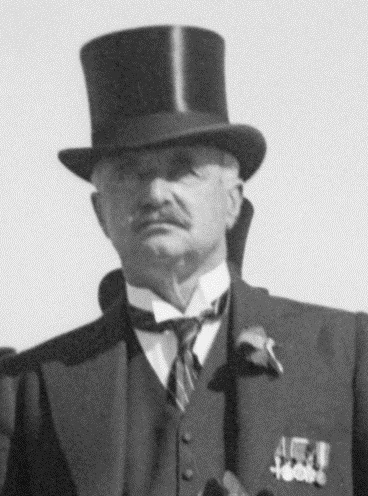
William Peel, 1st Earl Peel
| Name | William Peel, 1st Earl Peel |
| Title | British politician (1867-1937) |
| Gender | Male |
| Birthday | 1867-01-07 |
| nationality | United Kingdom |
| Source | https://www.wikidata.org/wiki/Q2920090 |
| pptrace | View Family Tree |
| LastUpdate | 2025-11-26T23:28:35.123Z |
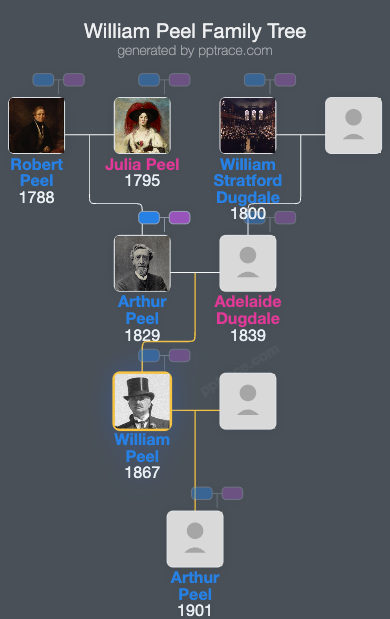
Family Tree
Tap  to expand more relatives
Introduction
William Robert Wellesley Peel, 1st Earl Peel (7 January 1867 – 28 September 1937), was a British politician and member of the House of Lords. He was born in London as the eldest son of Arthur Peel, 1st Viscount Peel, and Adelaide Dugdale. His paternal grandfather was Sir Robert Peel, Prime Minister of the United Kingdom.
Education for Peel included attendance at Harrow School and Balliol College, Oxford, where he served as secretary of the Oxford Union. In 1893, he was called to the bar at the Inner Temple and practiced as a barrister. During the Greco-Turkish War of 1897, he worked as a special correspondent for the Daily Telegraph.
Peel's early political involvement included appointment to the Royal Commission in 1900 to investigate the operation of the Port of London. That year, he was elected to the London County Council representing Woolwich, initially as a member of the Moderate Party, which later became the Municipal Reform Party. He served as leader of the party from 1908 to 1910 and was chairman of the county council from 1914 to 1916.
He entered the UK Parliament in 1900 as a Liberal Unionist MP for Manchester South, winning a by-election. In 1906, he unsuccessfully contested Harrow. He returned to the House of Commons in 1909 as Conservative MP for Taunton after winning a by-election. In 1912, Peel inherited the viscountcy from his father, which caused him to move from the House of Commons to the House of Lords. That same year, he was appointed a deputy lieutenant of Bedfordshire and became lieutenant-colonel of the Bedfordshire Yeomanry.
During the First World War, Peel served in France with his regiment but returned to Britain in 1915 due to health issues. In 1918, he began his governmental career as Joint Parliamentary Secretary at the Department of National Service in Lloyd George’s coalition government. In 1919, Peel was appointed Under-Secretary of State for War and was sworn into the Privy Council. He later held the positions of Chancellor of the Duchy of Lancaster and Minister for Transport.
In 1922, Peel became Secretary of State for India, maintaining this position through the governments of Andrew Bonar Law and Stanley Baldwin until 1924. After Baldwin's government fell, the Conservatives returned to power, and Peel was appointed First Commissioner of Works. Briefly in 1928, he returned to the India Office. The Conservatives lost power in 1929, and Peel was created Viscount Clanfield and Earl Peel in that year's Dissolution Honours.
Following the formation of a Conservative-dominated National Government after 1931, Peel held the office of Lord Privy Seal for a short period before leaving government in November of that year. In the subsequent years, he served as chairman of the Wheat Commission and the Royal Commission on the Common Law. Notably, he chaired the Peel Commission (1936–1937), which first recommended partitioning the British Mandate of Palestine into separate Jewish and Arab states.
In his personal life, Peel married Honourable Eleanor Williamson in 1899, with whom he had two children: Lady Doris Peel and Arthur Peel, 2nd Earl Peel. Lady Doris married Colonel Stewart Blacker and had four children.
Peel died at his residence in East Meon, Hampshire, in 1937 after a prolonged illness. His son succeeded him as the 2nd Earl Peel.