Sir Cecil Bishopp, 6th Baronet
| Name | Sir Cecil Bishopp, 6th Baronet |
| Title | British politician (1700-1778) |
| Gender | Male |
| Birthday | 1700-10-30 |
| nationality | Great Britain |
| Source | https://www.wikidata.org/wiki/Q7526160 |
| pptrace | View Family Tree |
| LastUpdate | 2025-11-26T12:33:20.611Z |
Family Tree
Tap  to expand more relatives
Introduction
Sir Cecil Bishopp, 6th Baronet (30 October 1700 – 15 June 1778), was a British politician and aristocrat. He succeeded to the baronetcy of Bishopp, of Parham in Sussex, on 25 October 1725. His parliamentary career included representing Penryn from 1727 to 1734 and Boroughbridge from 1755 to 1768.
Bishopp was married in 1726 to Hon. Anne Boscawen, the daughter of Hugh Boscawen, 1st Viscount Falmouth, and Charlotte Godfrey. The marriage linked him to the Boscawen family. He owned Parham Park in Sussex and also possessed a residence at 11 Berkeley Square in London. This London house was purchased by Horace Walpole from Bishopp's heirs in 1779; Walpole resided there until his death in 1797.
Bishopp died on 15 June 1778 at the age of 77. He was known for having a substantial number of children; at least thirteen legitimate offspring were recorded, which was notable for the period. Contemporary society remarked on the large family, with Horace Walpole noting Bishopp's "endless hoard of beautiful daughters" in June 1760.
Throughout his life, Bishopp sought political appointments and sinecures, citing his large family as a motivation. In 1748, he requested reversion of the controllership of army accounts or a position on the revenue commission, explaining that his sizable family limited his financial capacity. He was appointed Superintendent of H.M.'s Founderies at Woolwich in August 1751, a sinecure with an annual salary of £500. The Duke of Newcastle, a prominent political figure, facilitated several of Bishopp's appointments and ensured his second son served as a page to the Prince of Wales. Bishopp's daughter Frances was appointed Maid of Honour to Queen Charlotte.
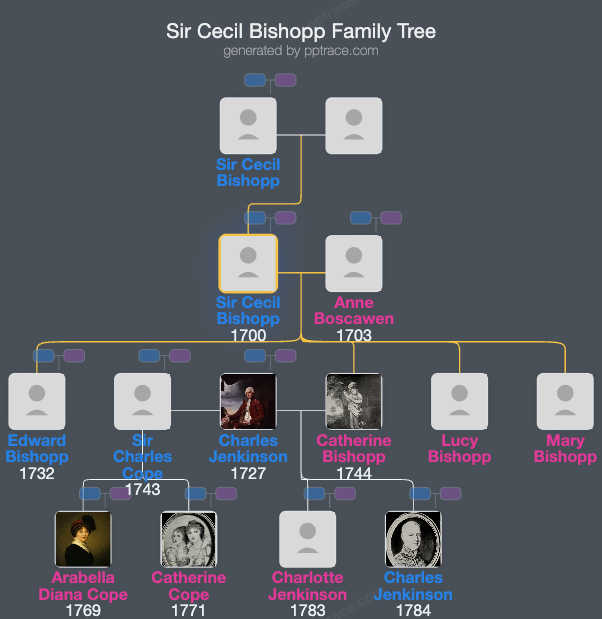
Bishopp's offspring included four sons and eight daughters. His eldest son, Sir Cecil Bishopp, 7th Baronet, inherited the title after Bishopp's death but died in September 1779. His descendants continued to be involved in the aristocracy and public service, with subsequent baronets and connections to notable families such as the Brudenells, Earls of Cardigan.
His children included Harriet Bishopp (married Thomas Dummer and Nathaniel Dance), Lucy Bishopp, Elizabeth Bishopp, Frances Bishopp (married Sir George Warren), Catherine Bishopp (married Sir Charles Cope and Charles Jenkinson), Colonel Henry Bishopp, Mary Owen (married Thomas Lillywhite), and Charlotte Bishopp (married Sir William Maynard). Another son, Edward Bishopp, established wealth as a regimental army agent, and his descendants held titles and positions of prominence.
Bishopp's connection to smuggling issues is documented through his associations with individuals involved in smuggling activities. In 1747, his relative Thomas Lillywhite was accused of smuggling, and Bishopp intervened publicly on Lillywhite's behalf, writing letters to the Duke of Richmond to seek clemency. Despite opposition from authorities, Bishopp appeared as a character witness at Lillywhite's trial in 1749. Historical analyses suggest that Lillywhite's involvement may have been incidental, with some arguments positing he was an unwitting participant. His associations with smuggling activities, including involvement in the 1747 Poole Raid, have been noted in historical studies.
During this period, smuggling was often linked with Jacobitism, partly due to the involvement of exiled Jacobites in France. In January 1745, Bishopp's younger brother James was arrested as a Jacobite attempting to cross into France.