Jōji Oka
| Name | Jōji Oka |
| Title | Japanese actor |
| Gender | Male |
| Birthday | 1902-05-25 |
| nationality | Japan |
| Source | https://www.wikidata.org/wiki/Q11473776 |
| pptrace | View Family Tree |
| LastUpdate | 2025-11-17T10:08:56.889Z |
Family Tree
Tap  to expand more relatives
Introduction
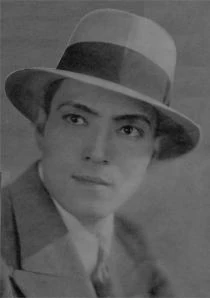
Joji Oka (May 25, 1902 – December 17, 1970) was a Japanese actor. His real name was Katsuzo Nakamizo, and his former stage names included Minobe Susumu and also Joji Oka.
Life and Career
He was born on May 25, 1902, in Shinagawa, Chuo City, Tokyo (then Tokyo Prefecture, Kyōbashi Ward, Echizenbori). He was the second son of Heizo Nakamizo, who operated a glass corrosion factory in Fukagawa Ward. His grandfather served as an accounting officer for the Saga Domain. His adoptive father was Hidetomo Nakamizo, president and chairman of the Sanshō Bank. His stepmother was Uki, the eldest daughter of Masakazu Umekawa, a subordinate of Shinoe Eto. His sister-in-law Mii was the wife of forestry engineer Go Yoshioka.
Initially aspiring to be a painter, Oka went on to attend and graduate from the Department of Commerce at Rikkyo University. Afterwards, he joined the Advertising Department of Nippon Chikuonki Shōkai (now Nippon Columbia), eventually being promoted to department head. However, he was persuaded by a friend in the publicity department of Nikkatsu to resign and, in early 1929, joined the Gendaigeki Art Department at Nikkatsu's Uzumasa Studio.
Oka made his film debut with "Kyōraku no Ishin: Ryu no Maki, Tora no Maki," released on September 27, 1928. The year before, he appeared in the epic "Ishino Kyōraku: Ryu no Maki, Tora no Maki" directed by Tomoyasu Ikeda, and was credited under the name Minobe Susumu as playing Shintomo Satsuma. In 1929, he appeared in contemporary dramas at Uzumasa Studio, and was cast as the lead in the film "Akai Hi Aoi Hi," directed by Frank Toku Nagao, released on July 6.
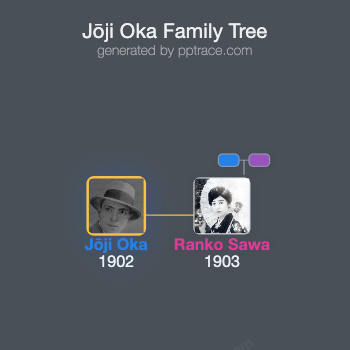
In 1931, he became involved in a romantic relationship and elopement with Ranko Sawā, an actress from the Takarazuka Revue. That same year, on October 1, he appeared in "Junkei Ketsu-shi: Nihon Nijūroku Seijin," directed by Tomoyasu Ikeda. This was their last collaboration, and Oka left Nikkatsu within the year. Sawā had transferred to Shochiku Kamata Studio in Tokyo in April of that year.
Upon joining Kamata Studio, he changed his stage initials to "Joji Oka" (岡 譲二). The source of the name "Joji" is said to have been inspired by the Western liquor "Johnnie Walker," which studio director Shiro Kido liked. At this company, he acted alongside Kinuyo Tanaka and Yaeko Mizuki (the first). During the transition from silent films to talkies, Oka's smooth voice was highly appreciated. He was especially favored by director Yoshitei Nomura. However, after the release of "Machino Bōfū" on August 15, 1934, which was Nomura's last film before his sudden death, Oka left the company on the 23rd of the same month and co-founded Kyōdō Eiga.
In 1935, Kyodō Eiga disbanded, and Oka then joined Nikkatsu Tamagawa Studio. On January 30, 1936, he appeared in "Hakui no Kaju". That same month, he was conscripted into the Imperial Japanese Army as a second lieutenant and served for three weeks. Afterwards, he appeared in "Koi wa Ame ni Nurete" (released April 8, 1936) and "Kenji to Sono Imōto" (released January 14, 1937). After these roles, he left Nikkatsu.
He subsequently transferred to Zeo Studio in Kyoto and P.C.L. Film Studio, and participated in the founding of Toho Studios in September 1937, becoming part of Toho's Tokyo studio. After ending his common-law relationship with Ranko Sawā, he is also said to have been involved romantically with the famous courtesan Hidegi (Shūkiku) in 1938.
The last available information about his character is that he died on December 17, 1970.