Osachi Hamaguchi
| Name | Osachi Hamaguchi |
| Title | Japanese politician (1870-1931) |
| Gender | Male |
| Birthday | 1870-05-01 |
| nationality | Japan |
| Source | https://www.wikidata.org/wiki/Q351661 |
| pptrace | View Family Tree |
| LastUpdate | 2025-11-17T10:08:40.589Z |
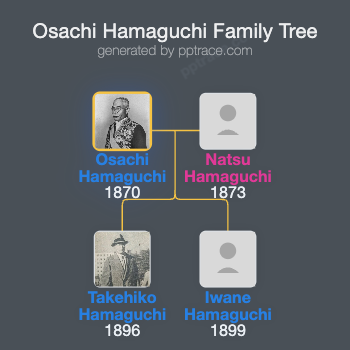
Family Tree
Tap  to expand more relatives
Introduction
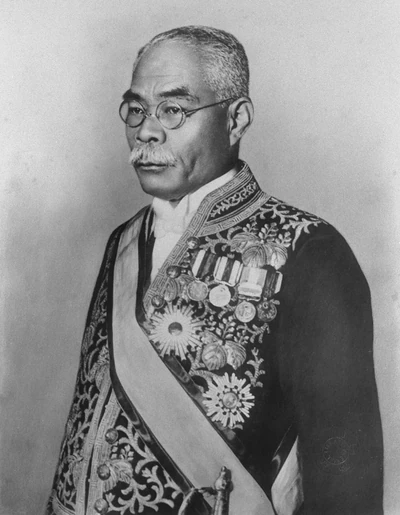
Hamaguchi Osachi (Japanese: 濱口 雄幸; also written as 濱口 雄幸 in traditional characters, born April 1, 1870 – August 26, 1931) was a Japanese politician who served as the Prime Minister of Japan from 1929 to 1931. He was known by the nickname the "Lion Prime Minister" (ライオン宰相, Raion Saishō) due to his dignified appearance and mane-like hair. Hamaguchi was a prominent member of the Rikken Minseitō (Constitutional Democratic Party), a leading group during the Taishō Democracy period in interwar Japan. He was continuously a member of the House of Representatives from 1915 until his death.
Early Life and Education:
Hamaguchi was born in Nagaoka District, Tosa Province, which is now part of Kōchi city in Kōchi Prefecture on Shikoku Island. He was the third son of Minaguchi Tanehira, an official in the local forestry department. He adopted the surname Hamaguchi after marrying Hamaguchi Natsuko in 1889. Hamaguchi graduated from the Law College of Tokyo Imperial University in 1895.
Early Career:
Following his graduation, Hamaguchi began his career as a bureaucrat within the Ministry of Finance. By 1907, he became the Director of the Monopoly Bureau. He later served as Vice Communications Minister in 1912, and Vice Finance Minister in 1914.
Political Career:
Hamaguchi joined the political party Rikken Dōshikai, led by Katō Takaaki, in 1915, which later became the Kenseikai in 1916. Elected to the lower house of Japan’s Diet representing the Kōchi Second District in 1915, he held this seat until his death. In June 1924, he was appointed as Finance Minister under Prime Minister Katō Takaaki’s Cabinet. He held the same position briefly in the First Wakatsuki Cabinet in 1926. As Finance Minister, he advocated for fiscal retrenchment, proposing reductions in government spending and layoffs, though his policies faced resistance from bureaucrats.
He also served as Home Minister from June 1926 to April 1927, promoting moral campaigns emphasizing thrift through motion picture sponsorships to help reduce Japan’s trade deficit. In 1927, Hamaguchi became the chairman of the newly formed Rikken Minseitō, a merger of the Kenseikai and Seiyūhontō parties.
Prime Ministership (1929–1931):
Following the collapse of Tanaka Giichi’s administration in June 1929, Hamaguchi was appointed Prime Minister. His cabinet was primarily composed of Minseitō members, with a policy focus on domestic economic reforms. Hamaguchi prioritized economic stability, advocating retrenchment, deflation, and industrial rationalization. His tenure coincided with the onset of the Great Depression, which further strained Japan’s economy.
His government initially enjoyed support from Emperor Hirohito and the genrō Saionji Kinmochi, allowing him to implement austerity measures, including Japan’s ratification of the London Naval Treaty of 1930, which aimed to limit military expenditure. His attempt to restore Japan to the gold standard to stimulate exports proved problematic and contributed to economic difficulties.
Assassination Attempt and Death:
Hamaguchi’s economic policies and foreign policy positions led to increasing opposition from right-wing factions. On November 14, 1930, he was shot at Tokyo Station by Tomeo Sagôya, a member of the ultranationalist secret society Aikokusha, an attack reminiscent of the assassination of Prime Minister Hara Takashi in the same location nine years earlier. Hamaguchi was hospitalized for several months due to his wounds.
Despite health issues, Hamaguchi was re-elected as Prime Minister in March 1931. His health continued to decline, preventing him from attending sessions of the Imperial Diet. The opposition Seiyūkai party criticized his absence and questioned the legitimacy of the acting Prime Minister, Foreign Minister Kijūrō Shidehara. Hamaguchi resigned from his position a month later and died on August 26, 1931. He was buried at Aoyama Cemetery in Tokyo.
Legal Proceedings:
Tomeo Sagôya was convicted of attempted murder; initially sentenced to death in 1932, his sentence was later commuted to life imprisonment in 1934. He was released in 1940 and remained active in far-right movements until his death in 1972.
Honors:
Hamaguchi received several honors, including the Grand Cordon of the Order of the Sacred Treasure in July 1926, the Grand Cordon of the Order of the Rising Sun in April 1927, and the Grand Cordon of the Order of the Rising Sun with Paulownia Flowers in April 1931.