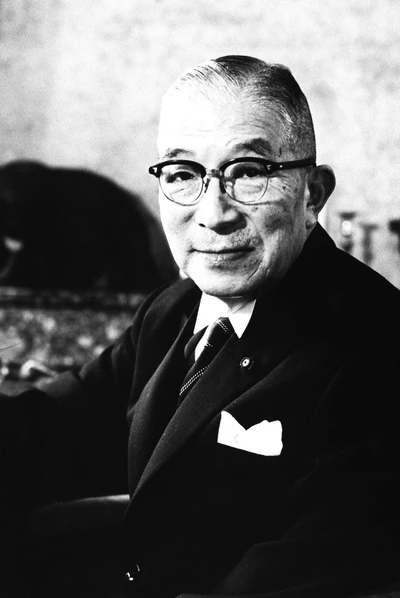
Ichirō Hatoyama
| Name | Ichirō Hatoyama |
| Title | Prime Minister of Japan from 1954 to 1956 |
| Gender | Male |
| Birthday | 1883-01-01 |
| nationality | Japan |
| Source | https://www.wikidata.org/wiki/Q333589 |
| pptrace | View Family Tree |
| LastUpdate | 2025-11-17T06:46:14.487Z |
Family Tree
Tap  to expand more relatives
Introduction
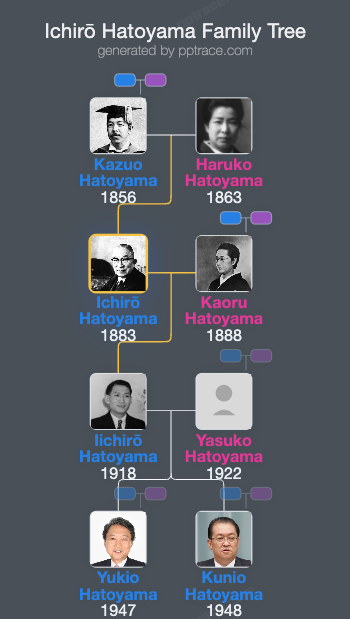
Ichirō Hatoyama (鳩山 一郎, Hatoyama Ichirō) was born on January 1, 1883, in Tokyo, Japan. He was the eldest son of Kazuo Hatoyama and Haruko Hatoyama. His family background included samurai ancestors who were sworn to the Miura clan prior to the Meiji Restoration. Kazuo Hatoyama was among the students selected by the Japanese government to study abroad in America in 1875, and he graduated from Columbia University and Yale Law School. After returning to Japan, Kazuo became a lawyer, educator, and politician. Haruko Hatoyama was involved in founding Kyoritsu Women's Vocational School in 1886.
Ichirō Hatoyama received his early education from his mother and attended First Higher School. He then studied law at Tokyo Imperial University, graduating in 1907. In 1908, he married Kaoru Terada, the daughter of judge and politician Sakae Terada.
Following the death of his father in 1911, Hatoyama was elected in a 1912 by-election to the Tokyo City Council, succeeding his father's seat. In 1915, he was elected to the House of Representatives as a member of the Rikken Seiyūkai party, representing Tokyo. Throughout his early political career, he served in various roles, including Chief Cabinet Secretary under Prime Minister Giichi Tanaka from 1927 to 1929 and Minister of Education under Prime Ministers Tsuyoshi Inukai and Makoto Saitō from 1931 to 1934.
Hatoyama was a prominent figure within the Seiyūkai party prior to its dissolution in 1940. During this period, he opposed the cabinet of Prime Minister Hideki Tōjō and was active in political debates regarding Japan's military expansion and governance. He was involved in the political turmoil leading up to and during World War II, including running in the 1942 general election as a "non-endorsed" candidate—meaning he was not officially supported by the Imperial Rule Assistance Political Association—but he was elected and continued to resist from within the system.
After Japan’s surrender in 1945, Hatoyama was called upon to re-engage in politics. He was a founding member of the Liberal Party in 1945, which became the largest party in Japan's first post-war election. However, he was purged by the American occupation authorities and was unable to assume office immediately, with the post going to Shigeru Yoshida. He was de-purged in 1951, which allowed him to participate in politics again, though his conflicts with Yoshida caused divisions within the Liberal Party. In 1954, Hatoyama founded the Democratic Party and succeeded Yoshida as Prime Minister in 1954.
During his tenure as Prime Minister from 1954 to 1956, Hatoyama oversaw the formation of the Liberal Democratic Party (LDP) through the merger of his Democratic Party and Yoshida's Liberal Party. The LDP became a dominant force in Japanese politics. His government attempted unsuccessful electoral reforms to support a two-party system and aimed to revise Japan’s pacifist Article 9 of the constitution. In 1956, he restored diplomatic relations with the Soviet Union, ending the state of war that had existed since 1945, and secured Japan's entry into the United Nations before resigning from office.
Ichirō Hatoyama passed away on March 7, 1959. He was the grandfather of Yukio Hatoyama, who served as Prime Minister of Japan from 2009 to 2010.