Kazuo Hatoyama
| Name | Kazuo Hatoyama |
| Title | Japanese politician |
| Gender | Male |
| Birthday | 1856-05-06 |
| nationality | Japan |
| Source | https://www.wikidata.org/wiki/Q289116 |
| pptrace | View Family Tree |
| LastUpdate | 2025-11-17T06:46:16.202Z |
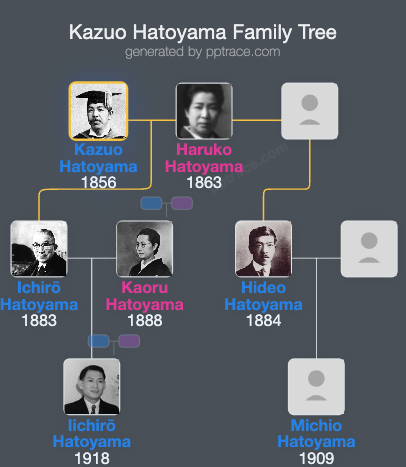
Family Tree
Tap  to expand more relatives
Introduction
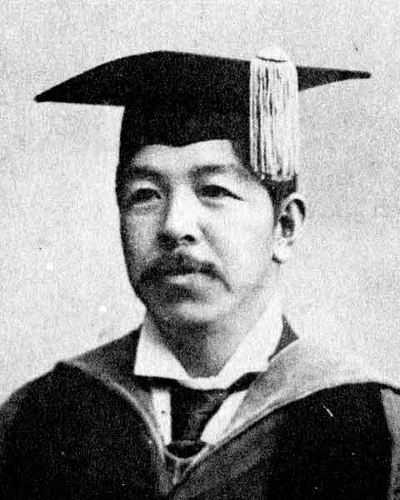
Kazuo Hatoyama (鳩山 和夫, Hatoyama Kazuo) was born on May 6, 1856, and died on October 3, 1911. He was a Japanese lawyer and politician who served as the Speaker of the House of Representatives from 1896 to 1897. Hatoyama was the patriarch of the Hatoyama family, which has been prominent in Japanese politics, being the father of Prime Minister Ichiro Hatoyama and the great-grandfather of Prime Minister Yukio Hatoyama.
Early Life and Education:
Kazuo Hatoyama was born in Minato, Tokyo, into a samurai family belonging to the Katsuyama clan. He graduated from Tokyo Kaisei School in 1875. Following his graduation, he was selected for a government-sponsored study abroad program, allowing him to study in the United States. He attended Columbia University, where he earned a Bachelor of Laws (B.L.) in 1877. He continued his education at Yale Law School, earning a Master of Laws (M.L.) in 1878 and a Doctor of Civil Law (D.C.L.) in 1880.
Career:
After returning to Tokyo in 1880, Hatoyama established a law practice and became a lecturer at the University of Tokyo, an institution formed in 1877 through the merger of his former school and two other academies. He became actively involved in politics, joining the Rikken Kaishintō (Progressive Party), founded by Ōkuma Shigenobu.
In 1890, at Ōkuma's urging, Hatoyama was appointed president of the Tokyo Semmon Gakko, which later became Waseda University. He served as its head until 1907; however, his role was mostly honorary. In 1901, he was invited to Yale University for its 200th anniversary celebration and was honored with an honorary Doctor of Law degree.
Hatoyama was elected to Japan's House of Representatives in the 1892 general election and was re-elected eight times. He served as the Speaker of the House of Representatives from 1896 to 1897. Despite his political prominence, a rift developed between Hatoyama and Ōkuma Shigenobu. While he aspired to become foreign minister in Okuma’s first cabinet, he was not appointed to the position and only served as Vice Minister in 1898.
In April 1907, Hatoyama was removed from his position at Waseda University and demoted to a board member. He left the Rikken Kaishintō party in January 1908 to join the rival Rikken Seiyūkai. That same year, he was elected to the Tokyo City Assembly. In 1910, he was elected President of the Tokyo Bar Association.
Family:
Kazuo Hatoyama's wife was Haruko Hatoyama, a co-founder of what is now Kyoritsu Women's University. Their son, Ichirō Hatoyama, became a Prime Minister of Japan and founded the Liberal Democratic Party (LDP), serving as its first president. Their grandson, Iichirō Hatoyama, served as Foreign Minister. His younger great-grandson, Kunio Hatoyama, was Minister of Internal Affairs and Communications under Prime Minister Taro Aso until June 12, 2009. Another great-grandson, Yukio Hatoyama, served as Prime Minister beginning September 16, 2009, and was a representative of Hokkaidō’s 9th district in the House of Representatives.
Kazuo Hatoyama’s son-in-law was Suzuki Kisaburō, a judge, prosecutor, and politician who served as Minister of Justice and Home Minister.
Residence:
In 1891, Kazuo Hatoyama and his family resided in the Otowa neighborhood of Bunkyo, Tokyo. Following the Great Kanto Earthquake, his son Ichiro commissioned a Western-style mansion on the site, which is now known as Hatoyama Hall (鳩山会館, Hatoyama Kaikan).
References:
- Itoh, Mayumi (2003). The Hatoyama Dynasty: Japanese Political Leadership through the Generations. Palgrave Macmillan.