Winston Churchill
| Name | Winston Churchill |
| Title | British statesman, soldier and writer (1874–1965) |
| Gender | Male |
| Birthday | 1874-11-30 |
| nationality | United Kingdom |
| Source | https://www.wikidata.org/wiki/Q8016 |
| pptrace | View Family Tree |
| LastUpdate | 2025-11-26T23:32:28.451Z |
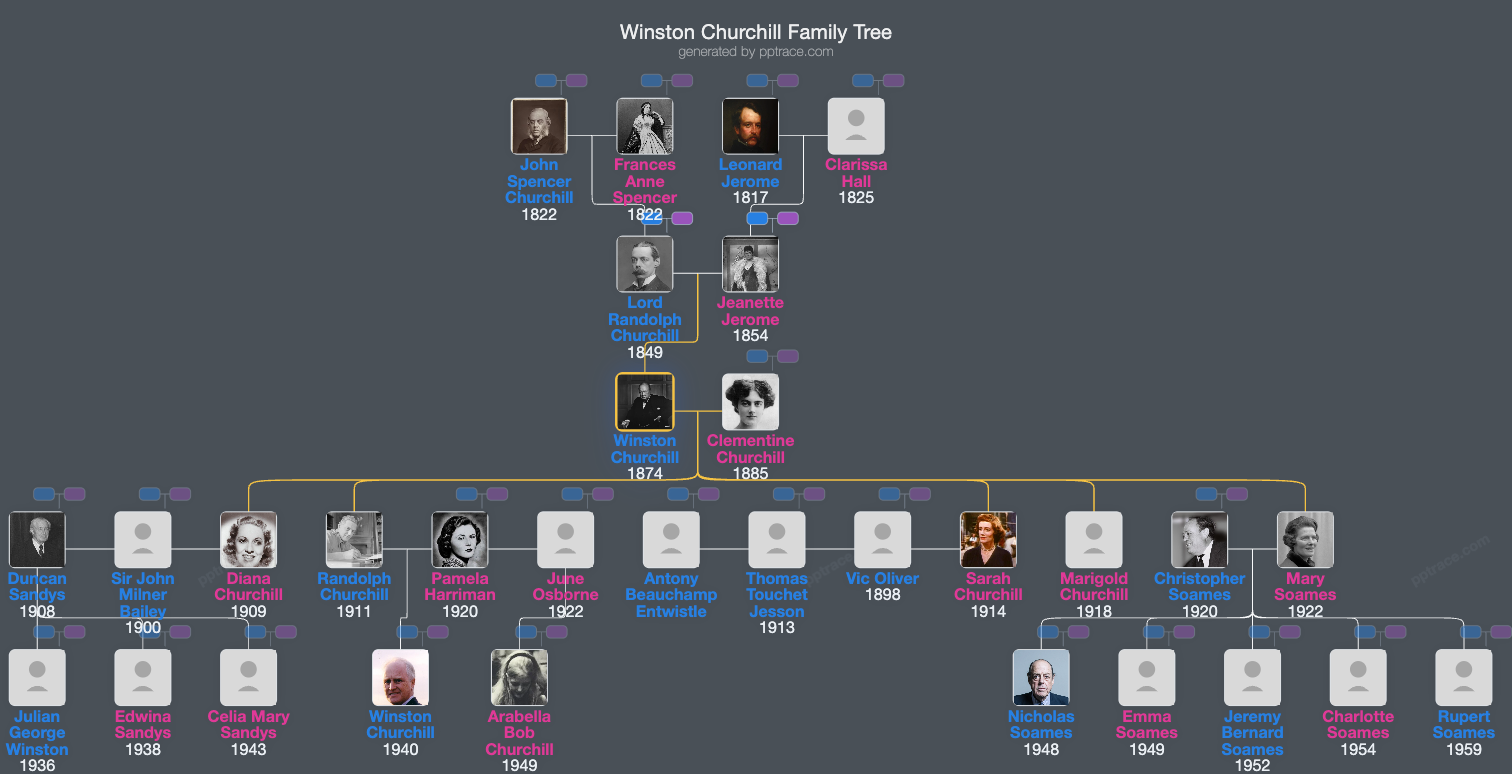
Family Tree
Tap  to expand more relatives
Introduction
Sir Winston Leonard Spencer Churchill was born on 30 November 1874 at Blenheim Palace in Oxfordshire, England. He was the son of Lord Randolph Churchill, a Conservative Member of Parliament, and Jennie, Lady Randolph Churchill, a daughter of American businessman Leonard Jerome. Churchill's paternal grandfather was John Spencer-Churchill, the 7th Duke of Marlborough. The family moved to Dublin in 1876 when Lord Randolph became private secretary to the Viceroy of Ireland. Churchill had a brother named Jack, born in 1880.
Churchill attended St George's School in Ascot beginning at age 7, transferred to Brunswick School in Hove, and later entered Harrow School in 1888. He was admitted to the Royal Military College, Sandhurst, after two attempts, and started as a cadet in September 1893. His father passed away in January 1895, and Churchill received a commission as a second lieutenant in the 4th Queen's Own Hussars in February 1895.
He sought active military service and was posted to different regions, including Cuba, India, and Sudan, between 1895 and 1899. Churchill became involved in the Cuban War of Independence as a correspondent and participated in expeditions in India, including in Bangalore, Hyderabad, and the North West Frontier. He read extensively during this period, developing his knowledge of history, philosophy, and science. Churchill expressed skepticism about religious beliefs in his letters and was an agnostic as an adult.
In India, Churchill volunteered for military campaigns, including the Malakand Frontier, and wrote his first book, "The Story of the Malakand Field Force," in 1898. He also authored "Savrola," a novel set in a fictional Balkan country. During his military service, Churchill participated in the Battle of Omdurman in Sudan in September 1898 and wrote "The River War" based on his experiences. He resigned from the army in 1899 to pursue a political career.
Churchill's early political involvement included speaking at Conservative Party meetings. He was elected as a Member of Parliament in 1900, representing Oldham as a Conservative. In 1904, he switched allegiance to the Liberal Party and served in H. H. Asquith's government as President of the Board of Trade and later as Home Secretary, where he advocated for prison reform and social security measures.
During the First World War, Churchill served as First Lord of the Admiralty and was responsible for the naval attack on the Dardanelles, which resulted in a disastrous campaign. He was demoted in 1915 and briefly served on the Western Front with the Royal Scots Fusiliers. In 1917, Churchill returned to government roles, including Minister of Munitions, Secretary of State for War, Secretary of State for Air, and Secretary of State for the Colonies, where he oversaw the Anglo-Irish Treaty and British foreign policy in the Middle East.
After a period out of Parliament, Churchill returned as Chancellor of the Exchequer in 1924 under Stanley Baldwin's government. He influenced economic policy by returning the British pound to the gold standard in 1925. During the 1930s, he was out of government but emerged as a vocal advocate for rearmament against Nazi Germany.
At the onset of the Second World War, Churchill was reappointed First Lord of the Admiralty. On 10 May 1940, he became Prime Minister, succeeding Neville Chamberlain. Churchill led Britain through the war, forming a national government and coordinating the Allied efforts, culminating in victory in 1945. Following the war, he served as Leader of the Opposition. During the early Cold War period, Churchill warned of Soviet influence in Europe and promoted European unity.
Churchill was awarded the Nobel Prize in Literature in 1953. He was elected Prime Minister again in 1951 and served until he resigned in 1955 due to health reasons. He remained a Member of Parliament until 1964 and died on 24 January 1965. Churchill was granted a state funeral and was a prominent figure in 20th-century British history, recognized for his leadership during wartime and his influence on political and literary fields.