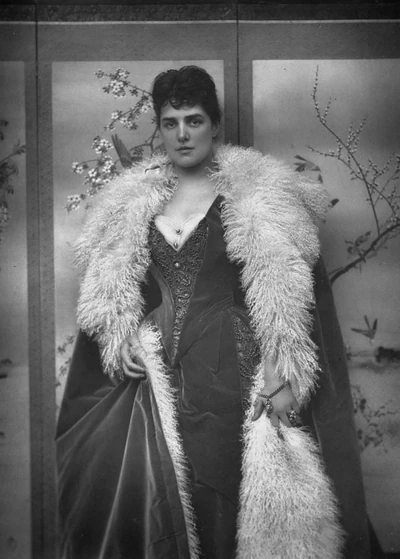
Jeanette Jerome
| Name | Jeanette Jerome |
| Title | American-born British mother of Winston Churchill (1854–1921) |
| Gender | Female |
| Birthday | 1854-01-09 |
| nationality | United States of America |
| Source | https://www.wikidata.org/wiki/Q243011 |
| pptrace | View Family Tree |
| LastUpdate | 2025-11-26T23:32:33.660Z |
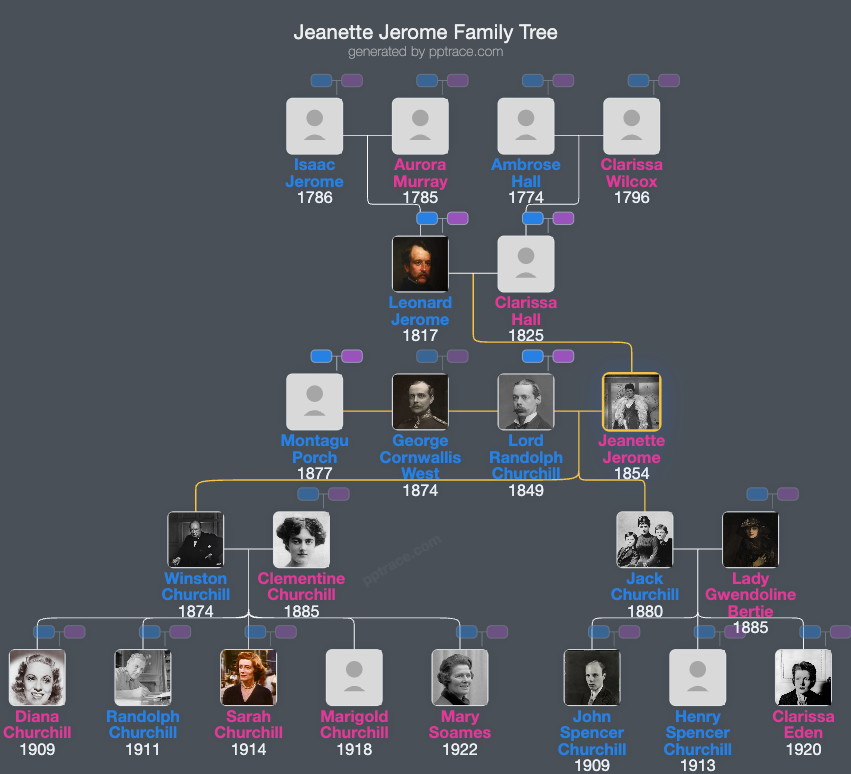
Family Tree
Tap  to expand more relatives
Introduction
Jennie Jerome Churchill was born Jeanette Jerome on January 9, 1854, in the Brooklyn neighborhood of Cobble Hill. She was the second of four daughters of Leonard Jerome, a financier, sportsman, and speculator, and his wife Clarissa "Clara" Hall. Her father was of Huguenot descent, having emigrated from the Isle of Wight in 1710. There is no verified evidence to support claims of Iroquois ancestry through her maternal grandmother. She was raised across multiple locations, including Brooklyn, Manhattan, Paris, and London. Her siblings included Clarita (1851–1935) and Leonie (1859–1943), while another sister, Camille, died in childhood in 1863.
There are discrepancies regarding her birth details; some sources suggest she was born in 1850 at 426 Henry Street, Brooklyn, but official records from January 1854 indicate her birth occurred at 8 Amity Street during a snowstorm. Her father, Leonard Jerome, was a talented amateur pianist tutored by Stephen Heller, a friend of Chopin, though Heller doubted her potential to perform at a concert level.
Jenette Jerome married Lord Randolph Churchill on April 15, 1874, at the British Embassy in Paris. The engagement followed a rapid courtship initiated at a sailing regatta on the Isle of Wight, introduced by the Prince of Wales. Their marriage was delayed due to disputes over settlements. By this marriage, she was styled as Lady Randolph Churchill and was addressed accordingly. The couple had two sons: Winston Churchill, born in 1874, and John Churchill, born in 1880. Winston Churchill became a prominent British politician and Prime Minister. There is historic debate on whether Winston was conceived before the marriage or born prematurely after Lady Randolph experienced a fall. Rumors also questioned the parentage of John, suggesting possible involvement with Evelyn Boscawen, 7th Viscount Falmouth, though these were largely discredited given the likeness of the children to Lord Randolph.
Lady Randolph was noted for her beauty and social presence. During her marriage, she was reputed to have had extramarital affairs with figures including the Prince of Wales, Milan I of Serbia, Prince Karl Kinsky, and Herbert von Bismarck. As was customary for her social class, her role in her sons' upbringing was limited, with nannies like Elizabeth Everest playing substantial roles. Winston Churchill later expressed a loving yet distanced regard for his mother, describing her as shining "like the evening star" and loving her "at a distance." She became an influential figure within British high society and supported her husband's political career, leveraging her family connections and relationships. Lady Randolph's husband, Lord Randolph Churchill, died in 1895 at age 45.
After Lord Randolph's death, Jennie renewed her social activities and moved in London's elite circles. She met George Cornwallis-West, a captain in the Scots Guards, in 1898, and they married on July 28, 1900, at St. Paul's Church, Knightsbridge. She authored her memoirs, "The Reminiscences of Lady Randolph Churchill," in 1908. She also wrote plays, including "His Borrowed Plumes" (1909), which featured Mrs. Patrick Campbell in the lead role but was a commercial failure. During this period, Mrs. Campbell had an affair with Cornwallis-West, leading to Jennie's separation from him in 1912 and their divorce in 1914. Following her divorce, she reverted to the name Lady Randolph Churchill.
Her third marriage took place on June 1, 1918, to Montagu Phippen Porch, a British Civil Service officer in Nigeria. They married when Porch was younger than Winston Churchill by three years. Porch left colonial service after World War I, and after Jennie's death in 1921, he returned to West Africa, where his business endeavors were successful.
In her philanthropic efforts, Jennie chartered the hospital ship Maine during the Second Boer War, assisting wounded soldiers. She served as chair of the hospital committee for the American Women's War Relief Fund starting in 1914, which supported two hospitals during World War I. In May 1921, she suffered an injury from a fall, leading to gangrene and the amputation of her left leg above the knee on June 10, 1921. She died on June 29, 1921, at her home at 8 Westbourne Street, London, due to a hemorrhage following the amputation. She was interred in the Churchill family plot at St Martin's Church, Bladon, Oxfordshire.
There is a popular but disputed attribution that she inspired the invention of the Manhattan cocktail during a 1874 election celebration, although the origin of this story remains uncertain.
Throughout her life, she was at the center of social and political circles, with her activities and relationships influencing both her family's standing and her personal trajectory.