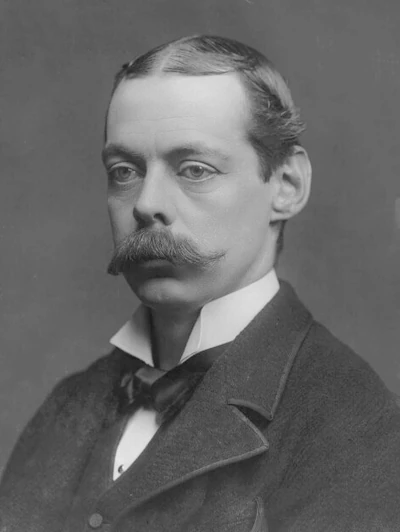
Lord Randolph Churchill
| Name | Lord Randolph Churchill |
| Title | British politician, father of Winston Churchill (1849-1895) |
| Gender | Male |
| Birthday | 1849-02-13 |
| nationality | United Kingdom of Great Britain and Ireland |
| Source | https://www.wikidata.org/wiki/Q314773 |
| pptrace | View Family Tree |
| LastUpdate | 2025-11-26T23:32:31.900Z |
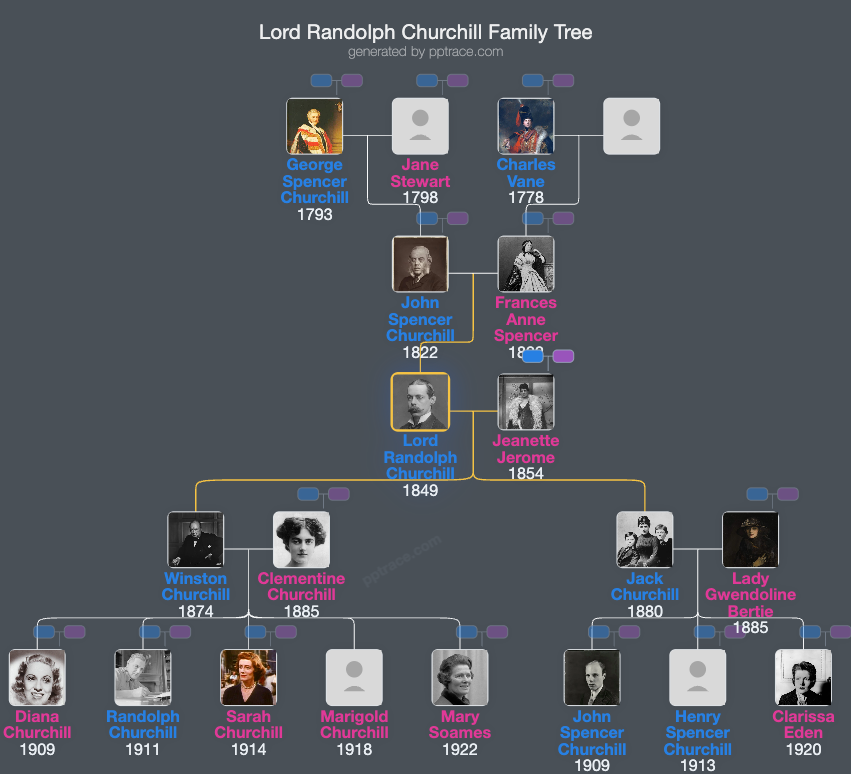
Family Tree
Tap  to expand more relatives
Introduction
Lord Randolph Henry Spencer-Churchill was born on 13 February 1849 at 3 Wilton Terrace in Belgravia, London. He was the third son of John Spencer-Churchill, Marquess of Blandford, and Lady Frances Vane, who was later known as the Marchioness of Blandford. His father became the (seventh) Duke of Marlborough upon the death of his grandfather in 1857. Churchill's family architecture placed him as a younger son of a marquess, bestowing him the courtesy title "Lord," while he was eligible to sit in the House of Commons as a commoner.
He was educated at Tabor's Preparatory School in Cheam before attending Eton College from 1863 until 1865. During his time at Eton, he was described as vivacious and unruly, not excelling academically or in sports. His contemporaries included Arthur Balfour and Archibald Primrose, who later became Lord Rosebery. In October 1867, Churchill enrolled at Merton College, Oxford, where he joined the Bullingdon Club and developed a reputation for rowdiness, including drunkenness, smoking in academic dress, and vandalism, such as smashing windows at the Randolph Hotel. He earned a second in jurisprudence and modern history in 1870.
Churchill married Jennie Jerome, the daughter of American businessman Leonard Jerome, at the British Embassy in Paris on 15 April 1874. The couple had two sons, Winston Churchill and Jack Churchill. Winston Churchill would later serve as the British Prime Minister during World War II. In January 1875, shortly after Winston's birth, Churchill sought medical attention from Dr. Oscar Clayton, who was known for treating syphilis. Churchill suffered from a chronic illness that persisted into his later years, with theories suggesting secondary or tertiary syphilis, brain tumor, or multiple sclerosis as possible causes. He received treatments involving mercury and potassium iodide, which were common at the time for syphilis. Some biographers speculate he may have been suffering from the effects of medication rather than the disease itself.
Churchill's early political career began when he was elected to Parliament in 1874 as the Conservative member for Woodstock, defeating George Brodrick. His maiden speech garnered praise from William Harcourt and Benjamin Disraeli. He maintained connections with Nathan Rothschild and was involved in reporting on the South African mining industry, which intersected with Cecil Rhodes's activities.
Churchill's political stance evolved over the years, particularly around 1878 when he gained public notice as an advocate of independent conservatism. He criticized prominent Conservative figures, such as Sir Stafford Northcote and R. A. Cross. Churchill was known for his outspoken opposition to the "old gang" within the Conservative Party and for promoting the concept of "Tory democracy" or "progressive Conservatism," which he first articulated during the National Union of Conservative Associations conference in 1884. His efforts contributed to the rise of the Conservatives' electoral success in English boroughs in 1885.
In 1884, Churchill was nominated as chairman of the National Union of Conservative Associations, despite opposition from parliamentary leaders. During this period, he played a key role in reinforcing the Conservative presence in towns and gaining political momentum. In 1885, Churchill was appointed Secretary of State for India under Prime Minister Lord Salisbury. His tenure was marked by policies viewed as reactionary, including the invasion and annexation of Burma during the Third Anglo-Burmese War, a costly military campaign. His approach to Indian administration was considered illiberal.
Churchill was appointed Chancellor of the Exchequer and Leader of the House of Commons in 1886. As Chancellor, he proposed a budget that met with both admiration and criticism, leading to increased tensions within the cabinet. His efforts to influence military expenditure ultimately resulted in his resignation, which effectively ended his political career at that time.
In health, Churchill experienced a decline in the 1890s and died in late January 1895, leaving a substantial personal estate. His son, Winston Churchill, would go on to serve as British Prime Minister during World War II.