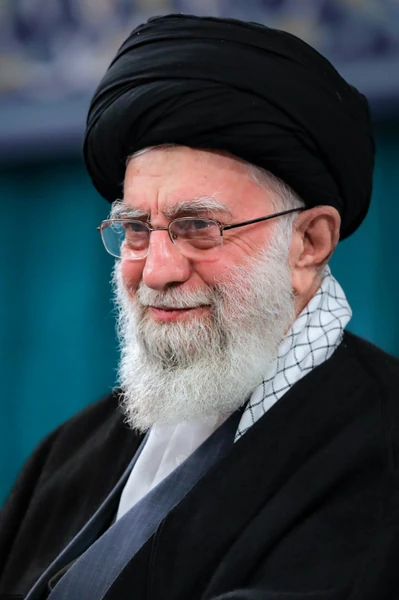
Ali Khamenei
| Name | Ali Khamenei |
| Title | Supreme Leader of Iran since 1989 |
| Gender | Male |
| Birthday | 1939-04-19 |
| nationality | Q107258515 |
| Source | https://www.wikidata.org/wiki/Q57336 |
| pptrace | View Family Tree |
| LastUpdate | 2026-05-07T09:15:43.371Z |
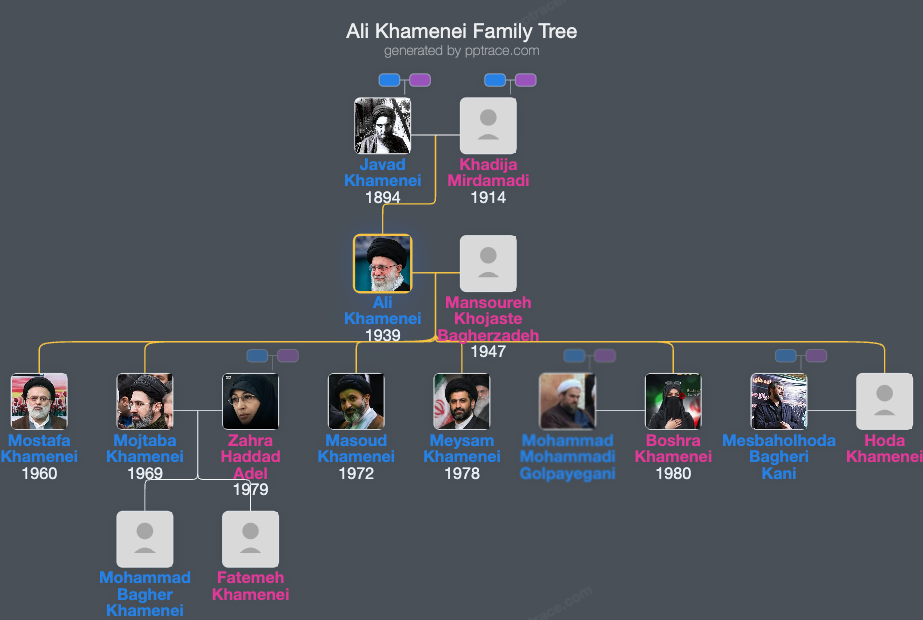
Family Tree
Tap  to expand more relatives
Introduction
Ali Hosseini Khamenei was an Iranian politician and Shia cleric born on 19 April 1939 in Mashhad, Iran, and died on 28 February 2026. He served as the second supreme leader of Iran from 1989 until his assassination in the 2026 Iran war. Khamenei was a member of the Khamenei family and held the clerical title Grand Ayatollah. His tenure as supreme leader lasted approximately 36 years and 9 months, making him the longest-serving head of state in West Asia at the time of his death.
Khamenei’s early life began in Mashhad, where his father, Javad Khamenei, was an alim and mujtahid originally from Najaf, Iraq. His mother, Khadijeh Mirdamadi, was from Yazd. His paternal lineage included Azerbaijani Turk ancestors from Khamaneh near Tabriz, while his mother was ethnically Persian. His family was relatively poor, and he was raised in a deeply religious household. His early education involved learning the Quran at Maktab, and he later studied at the hawza in Mashhad, where he was mentored by Sheikh Hashem Qazvini and Ayatollah Milani. In 1958, he moved to Qom and attended classes of Ruhollah Khomeini.
Khamenei attended religious seminaries and was involved in political activism from a young age. During the 1960s and 70s, he opposed the reign of Mohammad Reza Pahlavi and was arrested six times by SAVAK, the Shah's intelligence agency. His activism led to restrictions on his public activities, and he was exiled for three years in 1976. He played a significant role in the Iranian Revolution and was a close confidant of Ruhollah Khomeini.
Following the establishment of the Islamic Republic in 1979, Khamenei held various governmental positions. He was the head of the servants of Astan Quds Razavi from April 1979 and served as deputy defense minister in the provisional government. He also briefly served as Tehran’s Friday Prayers Imam and was a supervisor of the Islamic Revolutionary Guards (IRGC). During this period, he was involved in the Iran–Iraq War and developed close ties with the IRGC.
On 27 June 1981, Khamenei narrowly escaped an assassination attempt by the Mujahedin-e Khalq when a bomb concealed in a tape recorder exploded beside him. The attack resulted in injuries and sedation of his right arm. The incident underscored the ongoing violent confrontations in early post-revolution Iran.
After the death of Ruhollah Khomeini in 1989, Khamenei was elected as the supreme leader by the Assembly of Experts. During the leadership deliberations, he expressed reservations about his qualifications, as he was a mid-ranking cleric and did not meet the constitutional requirement of being a marja’. The requirement was later amended, and he was reaffirmed as supreme leader later that year.
As supreme leader, Khamenei supported Iran’s civilian nuclear program, supported economic privatization, and sought regional influence through backing groups aligned with Shia Islamism. His foreign policy involved support for the Axis of Resistance, including involvement in conflicts in Syria, Iraq, Yemen, and Gaza. He was a critic of Israel, advocating for its destruction, and supported Palestinian resistance. His tenure saw increased militarization and consolidation of power, with a notable suppression of political dissent, including restrictions and persecution of journalists, activists, and opposition figures.
Khamenei's leadership faced multiple protests, notably in 1999, 2009, 2017–2018, 2018–2019, 2022–2023, and 2025–26. In his final years, tensions with Israel and the United States escalated into the Twelve-Day War and ongoing conflicts. Following his assassination in 2026, his son Mojtaba was elected as his successor by the Assembly of Experts on 8 March 2026.
Khamenei's personal background included a complex family history, with scholarly and religious influence from his family and upbringing in a religious household. His education combined religious studies with an interest in broader intellectual pursuits such as literature, poetry, history, and politics.