Augustus Clifford
| Name | Augustus Clifford |
| Title | British Royal Navy admiral (1788-1877) |
| Gender | Male |
| Birthday | 1788-05-26 |
| nationality | United Kingdom of Great Britain and Ireland |
| Source | https://www.wikidata.org/wiki/Q4821399 |
| pptrace | View Family Tree |
| LastUpdate | 2025-11-26T23:22:10.722Z |
Family Tree
Tap  to expand more relatives
Introduction
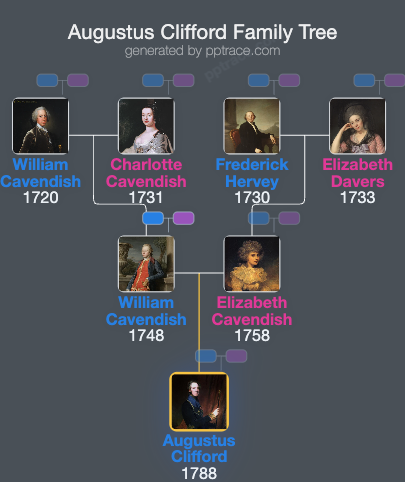
Admiral Sir Augustus William James Clifford, 1st Baronet, was born on 26 May 1788 in France. He was the illegitimate son of William Cavendish, 5th Duke of Devonshire, and Lady Elizabeth Foster. Shortly after his birth, his mother relocated to England with him, where he was wet-nursed by Louisa Augusta Marshall, wife of Reverend John Marshall, curate at Clewer near Windsor, Berkshire.
Clifford received his education at Harrow School from 1796 to 1799. His parents married in 1809 after both had been widowed. On 20 October 1813, he married Lady Elizabeth Frances Townshend, who was born on 2 August 1789 and died on 10 April 1862 in Nice. She was the sister of John Townshend, 4th Marquess Townshend. Clifford had at least three sons—William, Robert, and Charles—each of whom succeeded him as the second, third, and fourth baronets respectively.
Throughout his life, Clifford was a collector of art, assembling a collection that included paintings, sculptures, etchings, engravings, and bijouterie. He died in 1877 at his residence in the House of Lords.
In his naval career, Clifford joined the Royal Navy as a midshipman in May 1800. He was promoted to lieutenant in 1806. His early service included participation in the reduction of Saint Lucia and Tobago in 1803, operations in Egypt in 1807, the capture of a convoy in the Bay of Rosas in 1809, and actions along the coast of Italy during 1811–12. As a captain, he was actively engaged in naval duties and was mentioned multiple times in the London Gazette for his bravery in cutting-out expeditions and other operations. He also served as an attendant to the Lord High Admiral, the Duke of Clarence (later King William IV).
In 1826, Clifford recommissioned the HMS Herald to carry the Duke of Devonshire on an embassy to Russia. In 1828, he transported Lord William Bentinck to India as governor-general. After 1831, he was no longer actively employed afloat. His promotions included ranks of rear-admiral (23 March 1848), vice-admiral (27 September 1855), admiral of the blue (7 November 1860), and admiral of the red (1864). He retired from active service on 31 March 1866.
Clifford also served in political roles. He was a Member of Parliament for Bandon from 1818 to 1820 and from July 1831 to December 1832. He also represented Dungarvan from 1820 to 1822. He was appointed a Companion of the Order of the Bath on 8 December 1815, received a knighthood on 4 August 1830, and was created a baronet on 4 August 1838.
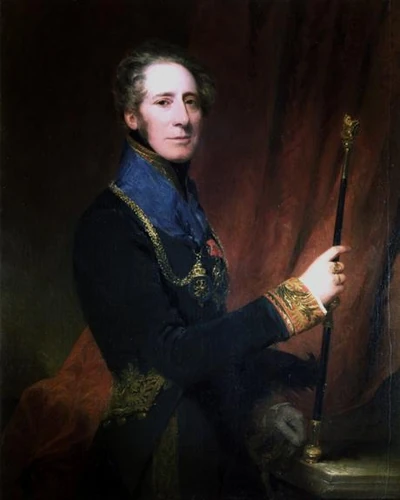
His half-brother, the 6th Duke of Devonshire, who was then Lord Chamberlain, appointed Clifford as Gentleman Usher of the Black Rod on 25 July 1832, a position he held until his death. Between 1843 and 1866, he sometimes served as deputy lord great chamberlain of England in the absence of Lord Willoughby d'Eresby.
Clifford passed away on 8 February 1877.