Gerald Valerian Wellesley
| Name | Gerald Valerian Wellesley |
| Title | court preacher and dean of Durham (1770-1848) |
| Gender | Male |
| Birthday | 1770-12-07 |
| nationality | Great Britain |
| Source | https://www.wikidata.org/wiki/Q22340338 |
| pptrace | View Family Tree |
| LastUpdate | 2025-11-26T23:27:25.492Z |
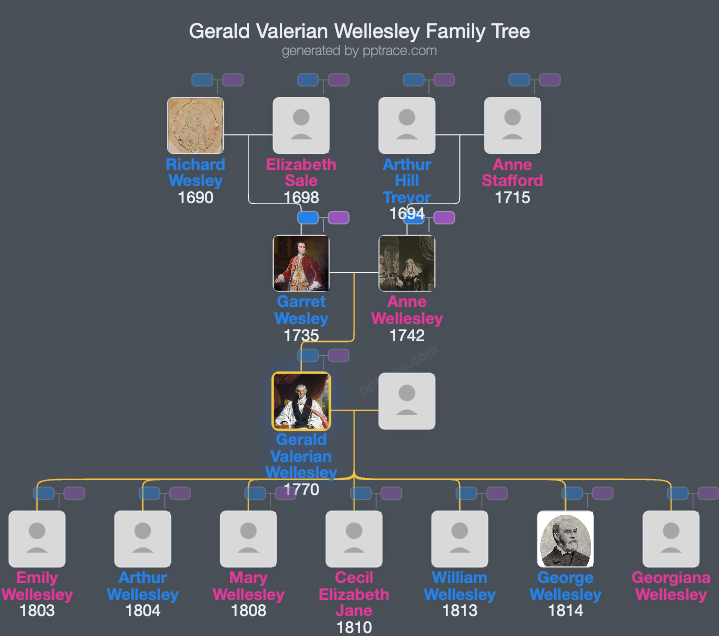
Family Tree
Tap  to expand more relatives
Introduction
Gerald Valerian Wellesley (1770–1848) was a cleric within the Church of Ireland. He was the fourth surviving son of Garret Wesley, 1st Earl of Mornington, and Anne Hill-Trevor. Wellesley's siblings included Richard Wellesley, 1st Marquess Wellesley; Arthur Wellesley, 1st Duke of Wellington; and Henry Wellesley, 1st Baron Cowley.
Born into the Anglo-Irish Protestant Ascendancy residing in Trim, County Meath, Wellesley's family was influential in Ireland. In 1806, he officiated the wedding of his brother Arthur Wellesley and Catherine Pakenham in Dublin.
Wellesley held the position of Prebendary of Durham during his ecclesiastical career. However, his advancement was curtailed due to a strained personal relationship with his wife, Lady Emily Cadogan. Wellesley had married Lady Emily when he was serving as a rector in Chelsea. They had a son, Sir George Wellesley, who later became an admiral in the Royal Navy.
In 1826, Wellesley's relationship with his family became publicly notable when it was a source of conflict involving his brother, the Duke of Wellington, and the Prime Minister, Lord Liverpool. Wellington advocated for Wellesley's appointment to a vacant Irish bishopric. Richard Wellesley, then serving as the Viceroy of Ireland, supported this proposal. Conversely, Lord Liverpool objected due to Wellesley's living arrangements with a woman outside of wedlock. The dispute contributed to tension between Wellington and Liverpool. The disagreement was eventually resolved when Liverpool gained support from the Chief Secretary for Ireland and the Archbishop of Canterbury to justify his stance against Wellesley's appointment.
References and bibliographical sources include works by Norman Gash and Rory Muir, which explore the political landscape of the era, including the careers of Lord Liverpool and the military advancements of the Duke of Wellington.