George Wellesley
| Name | George Wellesley |
| Title | Lord of the Admiralty (1814-1901) |
| Gender | Male |
| Birthday | 1814-08-02 |
| nationality | United Kingdom of Great Britain and Ireland |
| Source | https://www.wikidata.org/wiki/Q5546144 |
| pptrace | View Family Tree |
| LastUpdate | 2025-11-26T23:27:34.153Z |
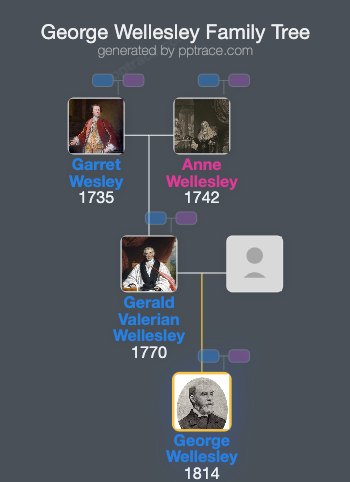
Family Tree
Tap  to expand more relatives
Introduction
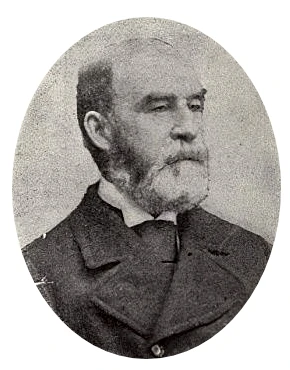
Admiral Sir George Greville Wellesley (2 August 1814 – 6 April 1901) was an officer in the Royal Navy. He was born to Gerald Valerian Wellesley, brother of Arthur Wellesley, 1st Duke of Wellington, and Lady Emily Mary, daughter of Charles Cadogan, 1st Earl Cadogan. Wellesley's naval career began in 1828 when he joined the Royal Navy. He received initial training at the Royal Navy College in Portsmouth and was promoted to lieutenant on 22 April 1838.
Early in his service, Wellesley was assigned to the first-rate HMS Princess Charlotte in the Mediterranean Fleet. He transferred to the fifth-rate HMS Castor in March 1839. During the Oriental Crisis in 1840, he participated in the capture of Acre while operating on the coast of Syria. In November 1841, he joined the fifth-rate HMS Thalia on the East Indies Station. After being promoted to commander on 16 April 1842, Wellesley transferred to the brig HMS Childers, also on the East Indies Station.
He was promoted to captain on 2 December 1844. In July 1849, he commanded the fifth-rate HMS Daedalus on the Pacific Station. During the Crimean War, he served as captain of the HMS Cornwallis in the Baltic Fleet, taking part in the Bombardment of Sveaborg in August 1855. For his service, he was appointed a Companion of the Order of the Bath in February 1856. Wellesley continued in command of HMS Cornwallis when she moved to the North America and West Indies Station in 1856. From 1857 to 1862, he commanded the Indian Navy, which was later renamed the Bombay Marine.
He was promoted to rear admiral on 3 April 1863. In June 1865, he became Admiral Superintendent at Portsmouth. In June 1869, Wellesley was appointed Commander-in-Chief of the North America and West Indies Station, hoisting his flag aboard the ironclad HMS Royal Alfred. He was promoted to vice admiral on 26 July 1869.
In October 1870, he became Commander-in-Chief of the Channel Squadron, flying his flag from the armoured frigate HMS Minotaur. In July 1871, he was relieved of this post after an incident involving the grounding of HMS Agincourt at Pearl Rock off Gibraltar. The grounding was rectified four days later when HMS Hercules, under Captain Lord Gilford, managed to pull HMS Agincourt free using full engines and chains. Following this incident, Wellesley was appointed again as Commander-in-Chief of the North America and West Indies Station in September 1873, now flying his flag from the central battery ironclad HMS Bellerophon.
He was promoted to full admiral on 11 December 1875. In November 1877, Wellesley was appointed First Naval Lord, during which he authorized increased naval construction, including the development of the Colossus-class battleships, though some ships' quality was later questioned. He retired from active service in August 1879. Wellesley was advanced to Knight Commander of the Order of the Bath on 23 April 1880, and subsequently to Knight Grand Cross of the same order on 21 June 1887.
In addition to his naval career, Wellesley served as a Commissioner of the Patriotic Fund beginning in June 1888. He resided at Chester Square in London and died there on 6 April 1901.
In 1853, Wellesley married Elizabeth Doughty Lukin (c. 1816–1906). The couple had one daughter, Olivia Georgiana.