Hideo Hatoyama
| Name | Hideo Hatoyama |
| Title | Japanese lawyer |
| Gender | Male |
| Birthday | 1884-02-04 |
| nationality | Japan |
| Source | https://www.wikidata.org/wiki/Q4477730 |
| pptrace | View Family Tree |
| LastUpdate | 2025-11-17T06:46:19.055Z |
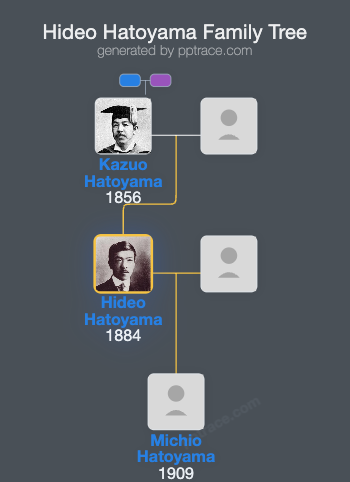
Family Tree
Tap  to expand more relatives
Introduction
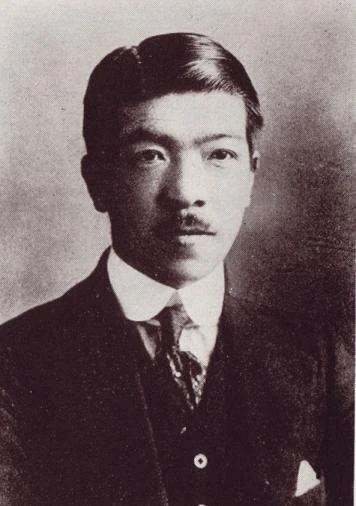
Hideo Hatoyama (2 February 1884 – 29 January 1946) was a Japanese jurist known for his writings on civil law during the pre-World War II period. He was a member of the Hatoyama family, a prominent family in Japan. His father, Kazuo Hatoyama, served as the speaker of the House of Representatives of Japan during the Meiji era. His brother, Ichirō Hatoyama, was a politician and minister involved in Japanese politics during the 1930s and 1940s.
Hideo Hatoyama graduated from Tokyo Imperial University in 1908. Subsequently, he pursued graduate studies in France and Germany. He began teaching law at Tokyo Imperial University in 1916, a position he held until 1926. After his academic career, he worked as a lawyer. He eventually left his professorship to his student, Sakae Wagatsuma.
Hatoyama authored several influential legal works. His treatise on legal transactions was published in 1910, and he wrote a notable textbook on the law of obligations in 1916. His scholarly ideas initially played a significant role in Japanese jurisprudence; however, they later fell out of favor due to critiques from Izotaro Suehiro, who challenged the German-style jurisprudence of concepts that Hatoyama espoused.
In addition to his legal work, Hideo Hatoyama was fluent in English. He was a member of the Anglican Church in Japan and served as the elected warden of St. Barnabas' Church in Ushigome for several years.