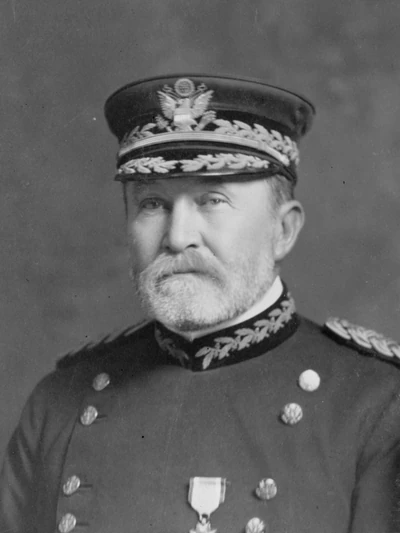
Frederick Dent Grant
| Name | Frederick Dent Grant |
| Title | United States Army general and son of Ulysses S. Grant |
| Gender | Male |
| Birthday | 1850-05-30 |
| nationality | United States of America |
| Source | https://www.wikidata.org/wiki/Q1344993 |
| pptrace | View Family Tree |
| LastUpdate | 2025-11-29T01:00:28.388Z |
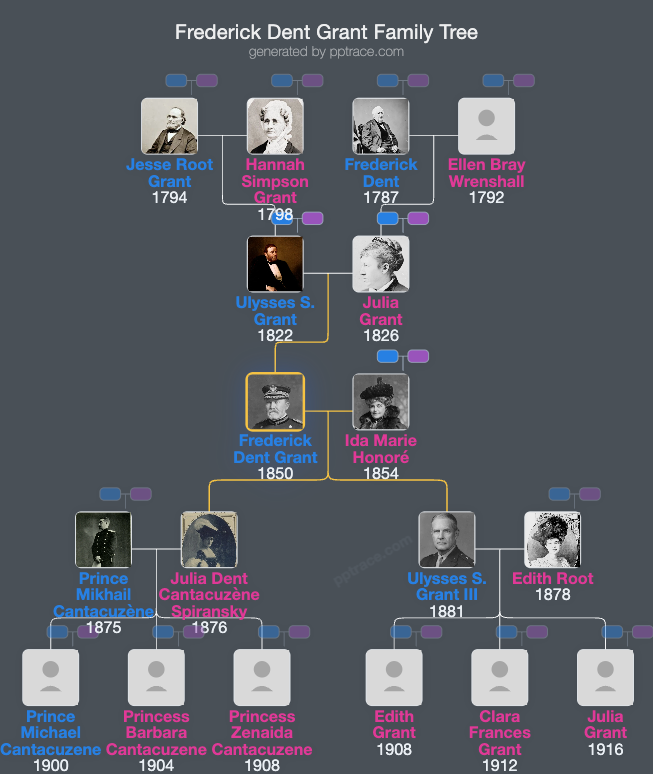
Family Tree
Tap  to expand more relatives
Introduction
Frederick Dent Grant was born on May 30, 1850, in St. Louis, Missouri. He was the first son of Ulysses S. Grant, who served as a Union general during the American Civil War and later as President of the United States, and Julia Grant. Grant was named after his maternal uncle, Frederick Tracy Dent.
During his early childhood, Grant's family moved frequently due to his father's military assignments, residing in Michigan, New York, and the family of his paternal grandparents in Missouri. After his father's resignation from the Army, the family settled in St. Louis and Galena, Illinois. Grant attended public school in Galena until the outbreak of the Civil War in 1861.
Involvement in the Civil War began early for Grant's family; his father organized a volunteer regiment, and Grant accompanied them to northern Missouri as a child, although he was initially sent home before rejoining sometimes during campaigns, following his father. Grant sustained a gunshot wound to the leg during the aftermath of the Battle of Big Black River Bridge, which was successfully treated despite infections, and later contracted typhoid fever during the war.
Grant was appointed to the United States Military Academy at West Point in 1866 and graduated in 1871. His tenure at West Point became the subject of historical scrutiny related to the treatment of James Webster Smith, the first African American cadet admitted to the Academy in 1870. Smith faced significant racism and harassment, and Grant was later accused of involvement in those activities. A 1981 biography by William McFeely alleged Grant's participation, citing a statement reportedly made to his father, then President Ulysses S. Grant, but recent scholarship questions the validity of these sources. Grant testified in 1871 that he supported a hazing prank involving cadets but did not specifically participate in Smith's harassment.
Following graduation, Grant's military career included assignments with the 4th U.S. Cavalry Regiment, service as aide-de-camp to General William T. Sherman in Europe, and participation in the Yellowstone Expedition and Black Hills expedition alongside George Armstrong Custer. He served as a staff officer under General Philip Sheridan. Grant's daughter Julia was born in 1876, and in 1877, he traveled internationally with his family. He also participated in campaigns during the Bannock War and conflicts against Victorio in New Mexico.
Grant resigned from the Army in 1881 and assisted his father with memoirs. He engaged in business activities in New York City and ran unsuccessfully for Secretary of State of New York in 1887.
In 1889, President Benjamin Harrison appointed Grant as the U.S. Minister to Austria-Hungary, a diplomatic position he held until June 1893. He served as a New York City police commissioner from 1894 to 1898, alongside Theodore Roosevelt.
During the Spanish–American War, Grant was commissioned as colonel of the 14th New York Volunteers in May 1898, and shortly thereafter promoted to brigadier general of volunteers. He participated in the occupation of Puerto Rico and was later involved in the Philippine–American War, arriving in Manila in June 1899. He served in various command roles in the Philippines until October 1902 and was appointed brigadier general in the regular army in 1901. Grant was promoted to major general in 1906 and held multiple departmental commands, including the Department of the East and the Eastern Division.
Grant died of cancer and diabetes on April 12, 1912, at the Hotel Buckingham in New York City. His funeral was held at Fort Jay, and he was buried in the West Point Cemetery. At the time of his death, he was the second most senior officer on active duty in the United States Army, following Major General Leonard Wood.
He was a hereditary member of several military and patriotic organizations, including the Military Order of the Loyal Legion of the United States, the Military Order of Foreign Wars, the Aztec Club of 1847, the Sons of the American Revolution, the Society of Colonial Wars, the Order of the Founders and Patriots of America, and the Military Order of the Carabao. Grant served as the first and ninth Governor General of the Order of the Founders and Patriots of America.
In 1874, Grant married Ida Marie Honoré, daughter of real estate businessman Henry Hamilton Honoré. The couple had two children: Julia Dent Grant (1876–1975), who married Prince Mikhail Cantacuzène, and Ulysses S. Grant III (1881–1968), who married Edith Root, daughter of Elihu Root.