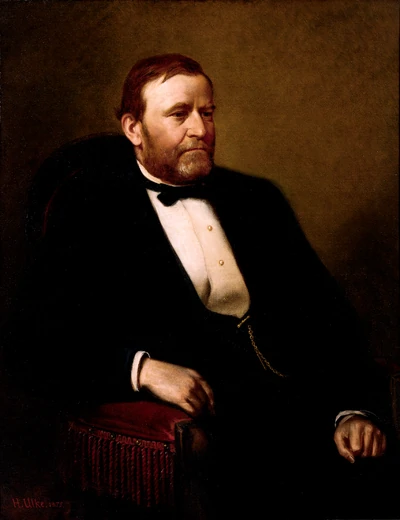
Ulysses S. Grant
| Name | Ulysses S. Grant |
| Title | president of the United States from 1869 to 1877 |
| Gender | Male |
| Birthday | 1822-04-27 |
| nationality | United States of America |
| Source | https://www.wikidata.org/wiki/Q34836 |
| pptrace | View Family Tree |
| LastUpdate | 2025-11-29T01:00:27.446Z |
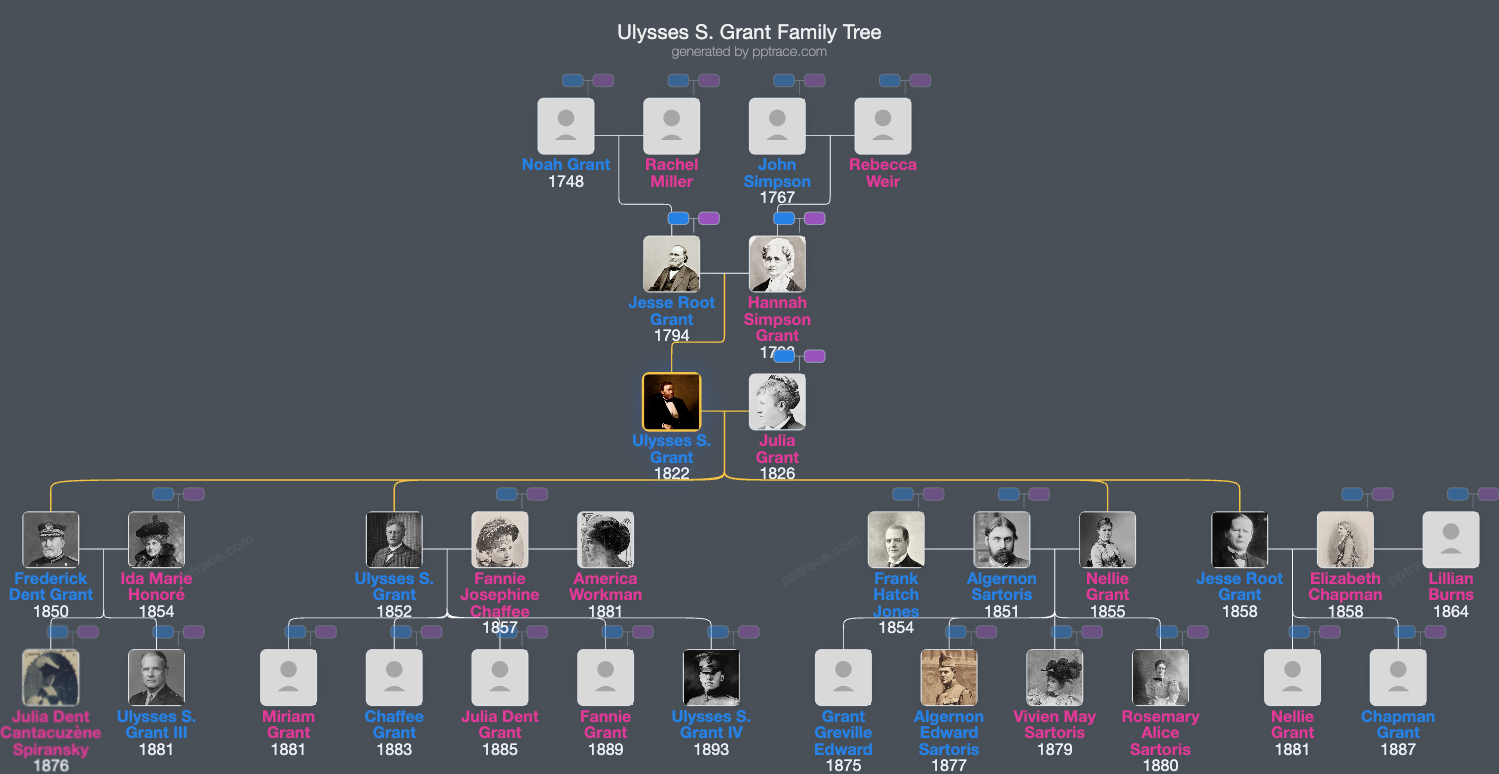
Family Tree
Tap  to expand more relatives
Introduction
Ulysses S. Grant, born Hiram Ulysses Grant on April 27, 1822, in Point Pleasant, Ohio, was the 18th president of the United States, serving from 1869 to 1877. He was the eldest son of Jesse Root Grant, a supporter of the Whig Party and a fervent abolitionist, and Hannah Simpson. In 1823, the family relocated to Georgetown, Ohio, where Grant grew up alongside four siblings: Simpson, Clara, Orvil, Jennie, and Mary.
Grant received early education through subscription schools and private institutions, including Maysville Seminary (1836–1837) and John Rankin's academy (1838). In his youth, he demonstrated notable horsemanship and worked in roles such as driving supply wagons, reflecting his outdoor skills. Although not required to attend church, Grant engaged in private prayer but did not formally affiliate with any religious denomination; he appeared to hold an agnostic worldview later in life.
In 1839, at Jesse Grant’s request, Grant was nominated to the United States Military Academy at West Point by Representative Thomas L. Hamer. He was accepted on July 1, 1839, and entered the academy under the name "U. S. Grant," a modification by Hamer to avoid political complications. Grant graduated on June 30, 1843, ranked 21st out of 39 cadets, and was commissioned as a brevet second lieutenant in the 4th Infantry Regiment. His early military assignments included service at Jefferson Barracks in Missouri.
In 1844, Grant met Julia Dent during a visit to Missouri; the two became engaged and married on August 22, 1848, at Julia's family home in St. Louis. His father disapproved of slavery, which affected family interactions, but Grant prioritized supporting his wife and decided to remain in the military, which he viewed as a stable career.
Grant’s military career encompassed service during the Mexican–American War. He was stationed in Louisiana with the Army of Occupation under Major General Zachary Taylor. Grant saw combat at the Battle of Palo Alto on May 8, 1846, and distinguished himself at Resaca de la Palma and Monterrey through acts of bravery and leadership, such as volunteering to carry dispatches and deploying artillery under fire. His conduct earned him brevet promotions to first lieutenant and subsequently to captain.
After the Mexican–American War, Grant's military service continued until 1854, when he resigned from the army and returned to civilian life in poverty. During the Civil War, he joined the Union Army in 1861, rapidly rising through the ranks. In 1863, he led the Vicksburg campaign, securing control of the Mississippi River and delivering a significant strategic victory to the Union. President Abraham Lincoln appointed Grant as lieutenant general, promoting him to command of all Union forces. His leadership culminated in the surrender of Confederate General Robert E. Lee at Appomattox in 1865.
Following the war, in 1866, President Andrew Johnson promoted Grant to General of the Army. As a supporter of Reconstruction, Grant broke with Johnson over policy disagreements. He was the unanimous Republican nominee and was elected president in 1868. His administration focused on stabilizing the economy, supporting Reconstruction efforts, and enforcing civil rights laws, including campaigning against the Ku Klux Klan. During his presidency, Grant signed legislation establishing the United States Department of Justice and created the first Civil Service Commission in 1871.
Grant was re-elected in 1872 but faced numerous scandals and economic difficulties, such as the Panic of 1873, which contributed to the Long Depression and a Democratic majority in the House of Representatives in 1874. His foreign policy included peacefully resolving the Alabama Claims with Britain and attempting to annex Santo Domingo, a proposal rejected by the Senate. During the 1876 election, Grant maintained efforts to facilitate a peaceful resolution in a contentious electoral outcome.
After leaving office in 1877, Grant embarked on a world tour, becoming the first sitting U.S. president to circumnavigate the globe. In 1880, he sought the Republican nomination for a non-consecutive third term but was unsuccessful. His later years were marked by financial hardship and illness; he was diagnosed with throat cancer. In 1885, Grant authored his memoirs, covering his life up to the Civil War, which were published posthumously and received critical and commercial acclaim. Ulysses S. Grant died on July 23, 1885. His legacy has been subject to varying historical interpretations, with modern scholarship reassessing his achievements in civil rights enforcement, Native American policies, and his appointments of administrative reformers.