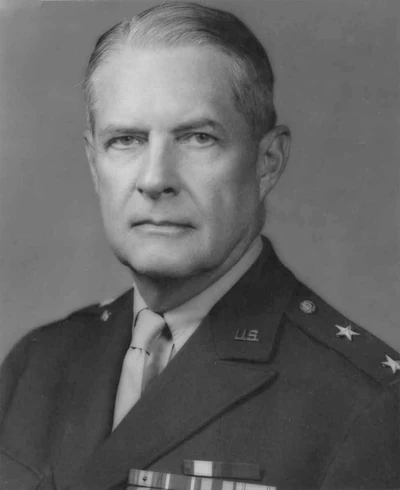
Ulysses S. Grant III
| Name | Ulysses S. Grant III |
| Title | grandson of US President Ulysses S. Grant (1881-1968) |
| Gender | Male |
| Birthday | 1881-07-04 |
| nationality | United States of America |
| Source | https://www.wikidata.org/wiki/Q7880942 |
| pptrace | View Family Tree |
| LastUpdate | 2025-11-17T06:40:27.638Z |
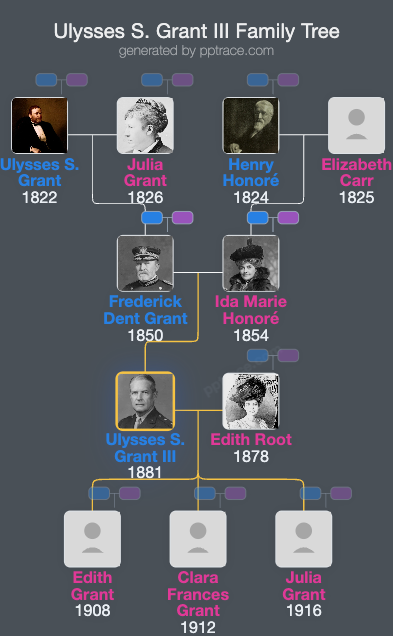
Family Tree
Tap  to expand more relatives
Introduction
Ulysses Simpson Grant III was born on July 4, 1881, in Chicago, Illinois. He was the son of Frederick Dent Grant and the grandson of Ulysses S. Grant, who served as a General of the Armies of the United States and as President of the United States. His early education took place in Austria, where his father was serving as an American diplomat.
Grant attended Columbia University until 1898. In that year, he received an appointment to the United States Military Academy at West Point. During the summer of 1899, both Grant and Douglas MacArthur participated in their first summer camp at West Point, where they were notably subject to hazing by upperclassmen due to their familial connections; Grant was the grandson of President Ulysses S. Grant, and MacArthur was the son of Arthur MacArthur. Grant graduated from West Point in 1903, ranking sixth in his class, with Douglas MacArthur graduating first.
Following his graduation, Grant was commissioned into the Corps of Engineers in the United States Army. He completed training at the U.S. Engineer School in 1908. His military service included postings in the Philippines (1903–1904), Cuba during the Pacification (1906), and along the Mexican border (1913–1917), participating in the Veracruz Expedition in 1914 and the Pancho Villa Expedition in 1916. He also served during both World Wars and held a position on the General Staff Corps from 1917 to 1920 and again from 1936 to 1940.
In 1904, Grant served as an aide to U.S. President Theodore Roosevelt. He married Edith Ruth Root in 1907, the daughter of Elihu Root, who was Secretary of War and Secretary of State. They had three daughters. During World War I, Grant was promoted to the rank of major. Between 1918 and 1919, he served on the staff of General Tasker H. Bliss at the Versailles Peace Conference, acting as the secretary of the American section and assisting in negotiations related to the treatment of prisoners of war. For his service, he received the Army Distinguished Service Medal.
After World War I, Grant served as district engineer for the 2nd Engineer District in San Francisco and was involved with the California Debris Commission. He visited the General Grant Grove and the Giant Sequoia known as the General Grant Tree in Kings Canyon National Park in 1923. He then held various administrative roles in Washington, D.C., including executive officer of the Arlington Memorial Bridge Commission and a member of the National Capital Park and Planning Commission. From 1925 to 1933, he served as the director of the Office of Public Buildings and Public Parks in the national capital.
Grant was promoted to lieutenant colonel in 1927 and was involved in the bicentennial celebrations of George Washington's birth in 1927. As director of parks in Washington, he oversaw the United States Park Police, expanding and modernizing the force and implementing various reforms.
In 1934, Grant graduated from the Army War College. He commanded the 1st Engineer Regiment at Fort DuPont, Delaware, and the Delaware Civilian Conservation Corps District from 1934 to 1936, reaching the rank of full colonel. In 1936, he became chief of staff of the Second Corps Area at Fort Jay, Governors Island, New York. His family was present at the death of his father-in-law, Elihu Root, in 1937.
In 1940, Grant was promoted to division engineer for the Great Lakes Engineer Division, with headquarters in Cleveland, Ohio, and achieved the rank of brigadier general. During World War II, he commanded the Engineer Replacement Training Center at Fort Leonard Wood, Missouri, from 1941 to 1942, and later served as chief of the Protection Branch of the Office of Civilian Defense in 1942, overseeing civil defense efforts nationwide. Promoted to major general in 1943, Grant retired officially in July 1945 at age 64 but was recalled to active duty the following day, serving until his full retirement in July 1946.
Following his military career, Grant returned to public service and held positions such as vice president of George Washington University (1946–1951), president of the American Planning and Civic Association (1947–1949), and served on the National Capital Park and Planning Commission. His opposition to the Echo Park Dam project contributed significantly to the preservation of national park lands.
Grant served as president of the Columbia Historical Society from 1952 until 1968 and was chairman of the Civil War Centennial Commission from 1957 to 1961. He received the Gold Good Citizenship Medal from the Sons of the American Revolution in 1967.
He was a member of numerous patriotic and professional organizations, including the Military Order of the Loyal Legion of the United States, the Sons of Union Veterans of the Civil War, and the Aztec Club of 1847, serving as president or commander-in-chief of some of these organizations at various times. Grant was also affiliated with the Sons of the American Revolution, the Order of the Founders and Patriots of America, and other hereditary societies.
Ulysses Simpson Grant III died on August 29, 1968, in Clinton, New York, and was buried in Hamilton College Cemetery in Clinton. His cousin was Ulysses S. Grant IV, the son of Ulysses S. Grant Jr. His awards and decorations included the Distinguished Service Medal, Legion of Merit, Philippine Campaign Medal, Army of Cuban Pacification Medal, Mexican Service Medal, World War I Victory Medal, and the Army of Defense Service Medal, among others.