James Compton, 3rd Earl Of Northampton
| Name | James Compton, 3rd Earl Of Northampton |
| Title | English politician (1622-1681) |
| Gender | Male |
| Birthday | 1622-08-19 |
| nationality | — |
| Source | https://www.wikidata.org/wiki/Q6131610 |
| pptrace | View Family Tree |
| LastUpdate | 2025-11-26T23:20:45.594Z |
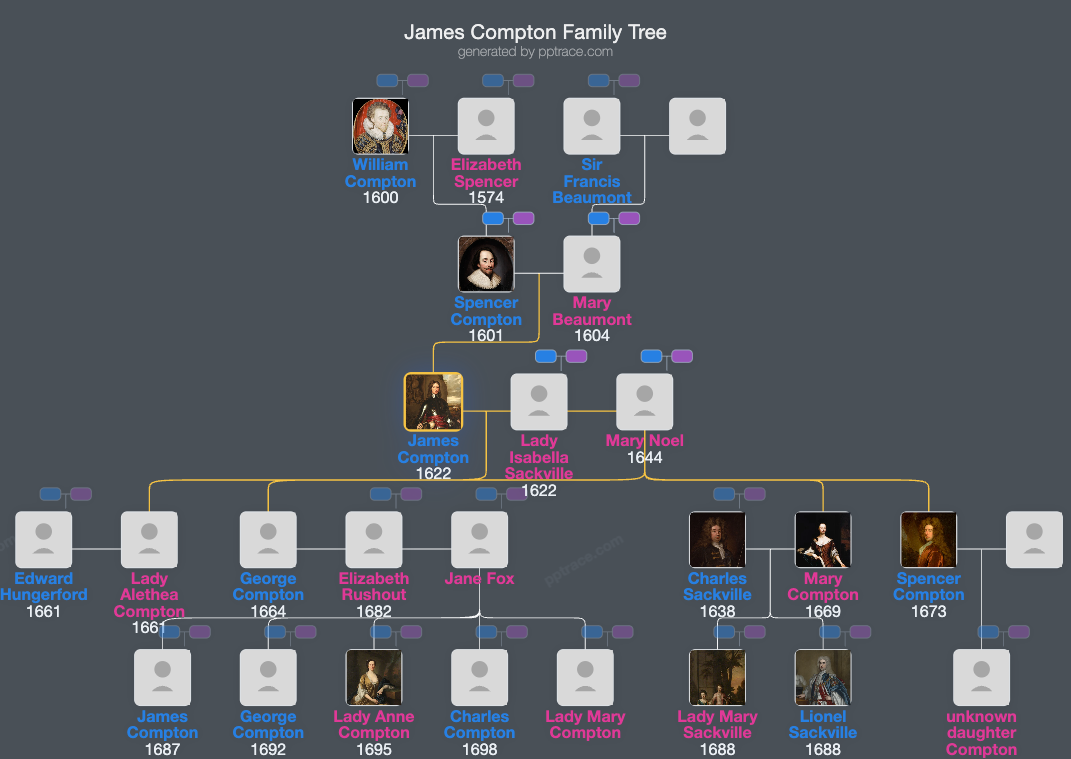
Family Tree
Tap  to expand more relatives
Introduction
James Compton, 3rd Earl of Northampton, FRS, was born on 19 August 1622 and died on 15 December 1681. He was an English peer, politician, and author. His parents were Spencer Compton, 2nd Earl of Northampton (1601–1643), and Mary Beaumont (died 1654). Compton was born in Compton Wynyates, Warwickshire, and was the eldest son in a family that included five brothers and two sisters. His siblings were Charles (1624–1661), William (1625–1663), Spencer (died 1659), Francis (1629–1716), Henry (1632–1713), Anne (1637–1705), and Penelope (1642–1667).
Compton was educated at Eton College and attended Queens' College, Cambridge. In 1638, he traveled to The Hague with his father in the retinue of the Elector Palatine, and spent two years touring in Europe. He returned to England and was elected Member of Parliament for Warwickshire in November 1640. He was one of 53 MPs who voted against the attainder of the Earl of Strafford in 1641.
During the First English Civil War, Compton's father was appointed Commissioner of Array for Warwickshire, Northamptonshire, and Gloucestershire. Compton was slightly wounded during an attack on Warwick Castle in 1642. He and his brothers participated at the Battle of Edgehill in October 1642 and captured Banbury Castle in November of the same year.
On 19 March 1643, Compton's father, the Earl of Northampton, led a Royalist cavalry force during a conflict at Hopton Heath, where he was killed after refusing to surrender. Compton then inherited his father's titles and regiments. He fought at the Battle of Newbury in September 1643, at Cropredy Bridge in June 1644, and was routed by Oliver Cromwell at Islip in April 1645. He was present at the Battle of Naseby in June 1645, a decisive Royalist defeat, and participated in the royalist attempt to link with Montrose in Scotland, which culminated at Rowton Heath in September 1645. Compton surrendered to the Committee of Both Kingdoms in February 1646 and paid a fine to recover his estates.
Following the end of the Civil War, Compton lived quietly on his estates for approximately 14 years. During this period, he engaged in literary pursuits, including writing plays, poems, and translations from French and Italian authors. His involvement with the Royalist underground was limited, although he was briefly arrested in connection with Booth's Uprising in 1659. Compton supported minor poets and playwrights, notably Cosmo Manuche.
After the Restoration of Charles II in 1660, Compton was appointed Lord Lieutenant of Warwickshire and Recorder of Coventry, positions he held until his death. As Lord Lieutenant, he commanded the Warwickshire Militia Horse and utilized the militia to dismantle Coventry's fortifications. He was a regular attendee of the House of Lords and was known for proposing the banishment of Edward Hyde, 1st Earl of Clarendon. Compton was appointed a Privy Councillor in 1673 and was made Constable of the Tower of London in 1675. He was removed from both posts during the Exclusion Crisis in 1679.
Compton married twice; his first wife was Isabella Sackville, daughter of Richard Sackville, 3rd Earl of Dorset, in 1647. They had six children, but only one, Alethea (1661–1678), survived to adulthood. His second wife was Mary Noel, with whom he had three sons and two daughters, including George (1664–1727), Spencer Compton, 1st Earl of Wilmington (who served briefly as Prime Minister from 1742 to 1743), and Mary Sackville, Countess of Dorset.
In 1660, Compton was among the founding members of the Royal Society. His literary works include at least four original plays, translations of Niccolò Machiavelli's "La Mandragola" and Pierre Corneille's works, and various poems. A significant discovery of manuscripts at Castle Ashby in 1977 revealed much of his written output.
He was buried in the family vault at Compton Wynyates. His peerage was succeeded by his son George, the 4th Earl of Northampton.