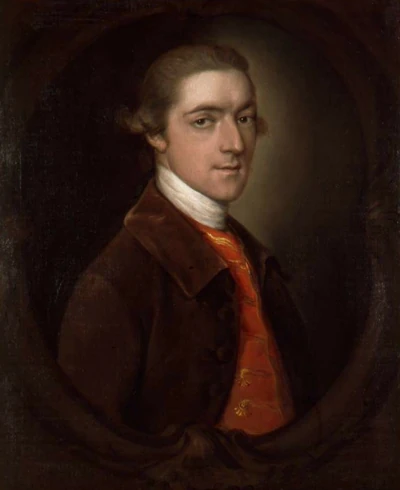
John Spencer, 1st Earl Spencer
| Name | John Spencer, 1st Earl Spencer |
| Title | British peer and politician (1734-1783) |
| Gender | Male |
| Birthday | 1734-12-19 |
| nationality | Great Britain |
| Source | https://www.wikidata.org/wiki/Q304151 |
| pptrace | View Family Tree |
| LastUpdate | 2025-11-26T23:22:40.022Z |
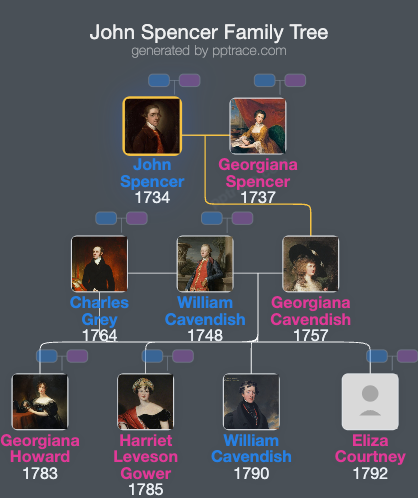
Family Tree
Tap  to expand more relatives
Introduction
John Spencer, 1st Earl Spencer (19 December 1734 – 31 October 1783), was a British peer and politician. He was born at Althorp, Northamptonshire, as the only son of the Hon. John Spencer and Georgiana Caroline Carteret. Spencer had one sibling, a sister named Diana Spencer, who died at the age of eight. Following his father's death in 1746, which was alcohol-related, his mother remarried William Clavering-Cowper, 2nd Earl Cowper.
His paternal lineage connected him to notable British aristocracy, including Charles Spencer, 3rd Earl of Sunderland, who served as First Lord of the Treasury and Lord President of the Council under King George I, and Lady Anne Churchill, his second wife, a daughter of the 1st Duke of Marlborough. Spencer's paternal relatives included Robert Spencer, 4th Earl of Sunderland; Lady Anne Spencer, wife of 1st Viscount Bateman; Charles Spencer, 5th Earl of Sunderland, who became the 3rd Duke of Marlborough; and Lady Diana Spencer, wife of the 4th Duke of Bedford.
His maternal family belonged to the Carteret lineage, with his grandfather being Lord President of the Council John Carteret, 2nd Earl Granville. His maternal aunts included Louisa Carteret, Grace Carteret, Frances Carteret, and Sophia Carteret, all of whom were married to prominent British noble families. Spencer was the principal beneficiary under the will of his great-grandmother, Sarah, Duchess of Marlborough, with a stipulation that acceptance of pensions or offices from the monarchy could forfeit his inheritance.
After completing a Grand Tour, Spencer returned to England. He was too young to stand for Parliament in 1754 but was supported by the Grimston family to be considered for candidacy at St Albans. In 1756, he unsuccessfully contested the Bristol by-election, and subsequently, he was elected as Member of Parliament for Warwick in December 1756, representing the Whig interest alongside Henry Archer. His parliamentary career included support for the monarchy and government ministers, and he sought a peerage, writing to the Duke of Newcastle in 1760 about his ambitions. In 1761, Spencer was created Baron Spencer of Althorp and Viscount Spencer by King George III. He was elevated to Earl Spencer in 1765.
His political alignments shifted over time; he went into opposition with Newcastle in 1762 but joined the Chatham administration subsequently. He served as High Steward of St Albans in 1772 and as Mayor of St Albans in 1779.
In his personal life, Spencer married Margaret Georgiana Poyntz in a secret ceremony at Althorp on 20 December 1755, shortly after his 21st birthday. Margaret was the daughter of diplomat and courtier Stephen Poyntz. The marriage produced five children, three of whom survived infancy: Lady Georgiana Spencer, who married William Cavendish, 5th Duke of Devonshire; George John Spencer, 2nd Earl Spencer; and Lady Henrietta Frances Spencer, who married Frederick Ponsonby, 3rd Earl of Bessborough. Two other children, Lady Charlotte Spencer and Lady Louisa Spencer, died as infants.
The Spencer family resided primarily at Althorp and in London at Spencer House, a grand residence constructed over seven years at a cost of £50,000. John Spencer died at the age of 48 near Bath after suffering a prolonged illness. He was buried in the family vault at St Mary's Church, Great Brington, Northamptonshire. His widow lived until 1814.
His coat of arms and further biographical details are documented in various sources, including publications on the history of Althorp and the Spencer family.