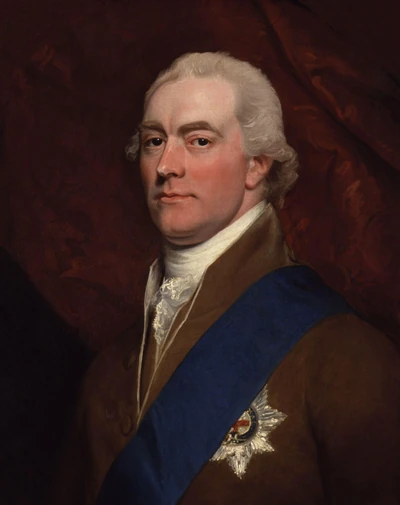
George Spencer, 2nd Earl Spencer
| Name | George Spencer, 2nd Earl Spencer |
| Title | British Whig politician (1758-1834) |
| Gender | Male |
| Birthday | 1758-09-01 |
| nationality | Great Britain |
| Source | https://www.wikidata.org/wiki/Q332521 |
| pptrace | View Family Tree |
| LastUpdate | 2025-11-26T23:28:20.845Z |
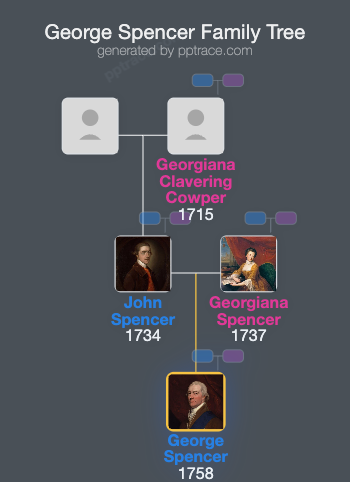
Family Tree
Tap  to expand more relatives
Introduction
George John Spencer, 2nd Earl Spencer, was born on 1 September 1758 at Wimbledon Park House, London. He was the son of John Spencer, 1st Earl Spencer, and Margaret Georgiana Poyntz, daughter of Stephen Poyntz. He was baptized on 16 October 1758 at Wimbledon Park House. His godparents included King George II, the Earl Cowper, and the Dowager Viscountess Bateman.
Spencer's sister was Lady Georgiana Spencer, who married the Duke of Devonshire and became a notable Whig hostess. He received education at Harrow School from 1770 to 1775, winning the Silver Arrow archery prize in 1771. Subsequently, he attended Trinity College, Cambridge, from 1776 to 1778, earning a Master of Arts degree. He succeeded to the earldom in 1783 following the death of his father.
In his political career, Spencer served as a Whig Member of Parliament (MP) representing Northampton from 1780 to 1782, and for Surrey from 1782 to 1783. He was sworn into the Privy Council in 1794. Under William Pitt the Younger, he held the position of Lord Privy Seal in 1794 and was First Lord of the Admiralty from 1794 to 1801. During his tenure as First Lord of the Admiralty, he was involved in managing the response to the mutinies at Spithead and the Nore in 1797.
From 1806 to 1807, Spencer served as Home Secretary in the Ministry of All the Talents under Lord Grenville. He also held other public roles, including High Steward of St Albans from 1783 to 1807, Mayor of St Albans in 1790, and President of the Royal Institution from 1813 to 1825. In 1831, he was appointed as a Commissioner of the Public Records.
Spencer was appointed a Fellow of the Royal Society in 1780 and a Fellow of the Society of Antiquaries of London in 1785. He received the honor of being appointed to the Order of the Garter in 1799. On 18 February 1793, he was designated a deputy lieutenant of Northamptonshire.
He had a notable interest in literature and early printing. Spencer was the founding president of the Roxburghe Club, established in 1812, and amassed a collection consisting of tens of thousands of volumes, including a comprehensive assembly of Aldine editions. His library was purchased in 1892 by Enriqueta Rylands for the John Rylands Library. His bibliographical pursuits were assisted by Rev. Thomas Frognall Dibdin, who authored "Bibliotheca Spenceriana" (1814–1815) and "Aedes Althorpianae," detailing the library and collection.
Spencer married Lady Lavinia Bingham, daughter of Charles Bingham, 1st Earl of Lucan, on 6 March 1781. They had nine children: John Charles Spencer, who became the 3rd Earl Spencer; Lady Sarah Spencer; Hon. Richard Spencer; Captain Hon. Sir Robert Cavendish Spencer; Hon. William Spencer; Lady Harriet Spencer; Lady Georgiana Charlotte Spencer; Vice-Admiral Frederick Spencer, 4th Earl Spencer; and Very Reverend Hon. George Spencer (later known as The Venerable Father Ignatius Spencer).
Lady Lavinia Bingham died in June 1831. George Spencer died on 10 November 1834 at Althorp at the age of 76 and was buried in Great Brington. The "Spencer jacket," a type of short jacket from which the UK military mess jacket is derived, is named after him, purportedly because he adapted a tail-coat after its tails were burned by coals from a fire.
His coat of arms and detailed ancestry complete his profile as a significant figure in British political and social history during his lifetime.