Leopold I Of Belgium
| Name | Leopold I Of Belgium |
| Title | German prince who became the first King of the Belgians (1790–1865) |
| Gender | Male |
| Birthday | 1790-12-16 |
| nationality | Q700663 |
| Source | https://www.wikidata.org/wiki/Q12971 |
| pptrace | View Family Tree |
| LastUpdate | 2025-11-12T01:17:15.324Z |
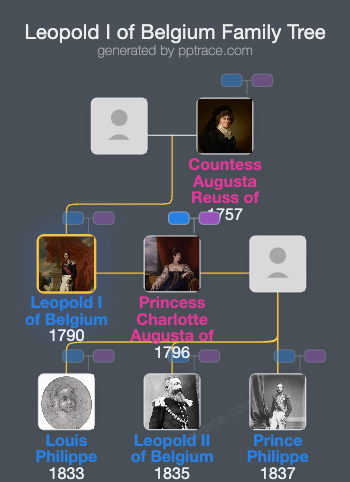
Family Tree
Tap  to expand more relatives
Introduction
Leopold I (Leopold George Christian Frederick) was born on 16 December 1790 at Ehrenburg Palace in Coburg, which was then part of the small German duchy of Saxe-Coburg-Saalfeld. He was the eighth child and youngest son of Francis, Duke of Saxe-Coburg-Saalfeld, and his second wife, Countess Augusta Reuss of Ebersdorf. In 1826, the duchy of Saxe-Coburg-Saalfeld acquired the city of Gotha and was renamed Saxe-Coburg and Gotha. Leopold's paternal grandfather was Princess Sophie Antoinette of Brunswick-Wolfenbüttel. His baptismal name, Leopold, honored Leopold II, Holy Roman Emperor.
During his early years, Leopold was educated by tutors including Charles-Theodore Hoflender and Johann Philipp Hohnbaum. His studies encompassed biblical history, languages such as Greek, Latin, Russian, French, German, and English, as well as mathematics. His paternal grandmother, Princess Sophie Antoinette, played a significant role in his upbringing, and Leopold maintained a personal diary from age thirteen, reflecting his interests in military history, racing pigeons, and floriculture.
Leopold's military career began with honorary titles in the Imperial Russian Army in 1797, when he was six years old. He held ranks such as captain in the Izmaylovsky Regiment and colonel by September 1798. He learned Russian and accompanied his family on military journeys, including to Moravia in 1805. During the Napoleonic Wars, conflicts affected his home duchy, which Napoleon occupied after 1806. Leopold's father died that same year, and Napoleon confiscated his family estates. Leopold and his mother were confined until Russian intervention restored some territories.
Leopold spent time in Paris and Moscow, and in 1808, he joined the Russian Imperial cavalry. He participated in key battles during the wars, including the Battle of Leipzig and the Battle of Waterloo, fighting alongside Russian forces against Napoleon. His military service earned him promotions such as Major General and decorations like the Cross of St. George, the Order of St. Andrew, and the Kulm Cross. He represented his duchy at the Congress of Vienna in 1814–1815.
In 1816, Leopold married Princess Charlotte of Wales, the only child of the Prince Regent (later King George IV) of the United Kingdom. The marriage was short-lived; Charlotte died in 1817 of complications after childbirth. Leopold was deeply affected by her death. He was granted the style of Royal Highness in Britain, and he remained influential in British social and political circles.
Leopold was offered the throne of Greece in 1830 but declined, deeming it too unstable. Instead, he accepted the throne of Belgium, following its independence from the Netherlands in 1830. The Belgian Revolution led to the establishment of a constitutional monarchy, and Leopold swore loyalty to the Belgian constitution on 21 July 1831, which is commemorated as Belgian National Day. He married Princess Louise of Orléans in 1832 and fathered four children with her, including Leopold II. He also had illegitimate children with his mistress Arcadie Claret.
His reign was marked by internal political divisions and external conflicts, notably the Dutch Ten Days’ Campaign in 1831, which Leopold helped repel with French support. Belgium’s independence was recognized by the Treaty of London in 1839. Leopold sought to expand royal power within the constitutional framework, often asserting his role in military and diplomatic matters.
Leopold actively promoted economic modernization, infrastructure development—including Belgium's first railway in 1835—and supported industrialization. He was involved in international diplomacy, maintaining close relations with European monarchs, especially Queen Victoria of the United Kingdom, and aimed to preserve Belgian neutrality amid regional conflicts.
During the Revolutions of 1848, Leopold managed to contain revolutionary threats without significant upheaval. His foreign policy focused on maintaining balance and neutrality, engaging with France, the Netherlands, and German states to safeguard Belgium’s independence.
Leopold's later years saw declining health, with strokes affecting him from the early 1860s. He experienced personal losses, including the death of his second wife Louise in 1850 and family members in the same period. He continued to attend official duties until his health deteriorated significantly in 1865.
On 23 November 1865, Leopold was taken ill and, diagnosed with dysentery, died on 10 December 1865 at the age of 74 at Laeken. He was succeeded by his son Leopold II. His state funeral was held on 16 December 1865, attended by European royalty and diplomatic representatives.
Leopold I’s legacy includes Belgian National Day, various monuments, and his influence on the foundation and stability of Belgium as a constitutional monarchy. Monuments and portraits honor his contributions, and his likeness appears on stamps and coins. His familial connections significantly impacted European royal networks, and his diplomatic efforts earned him the epithet "Nestor of Europe."