Leopold II Of Belgium
| Name | Leopold II Of Belgium |
| Title | King of the Belgians from 1865 to 1909 |
| Gender | Male |
| Birthday | 1835-04-09 |
| nationality | Belgium |
| Source | https://www.wikidata.org/wiki/Q12967 |
| pptrace | View Family Tree |
| LastUpdate | 2025-11-12T01:17:27.272Z |
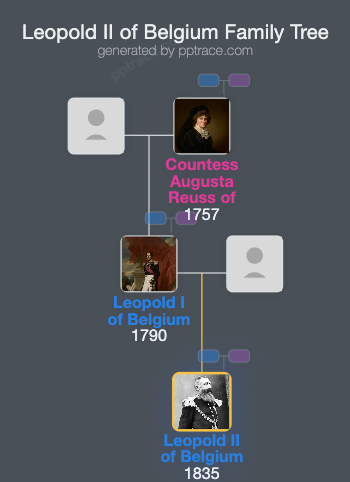
Family Tree
Tap  to expand more relatives
Introduction
Leopold II (9 April 1835 – 17 December 1909) was the second king of the Belgians, reigning from 1865 until his death in 1909. He was born in Brussels as the second child and eldest surviving son of King Leopold I and Queen Louise, daughter of King Louis Philippe of France. In 1840, he received the title of Duke of Brabant and served as a lieutenant-general in the Belgian military. Leopold's early political career included membership in the Belgian Senate, beginning at the age of 20, and active involvement in issues concerning Belgium's development and trade.
He married Marie Henriette of Austria on 22 August 1853 in Brussels. The couple had four children: three daughters—Princess Louise, Princess Stéphanie, and Princess Clémentine—and one son, Prince Leopold, Duke of Brabant, who died at age nine in 1869. The marriage was reportedly unhappy, leading to separation after a last attempt to have another son, resulting in a daughter, Princess Clementine. Marie Henriette died in 1902.
Leopold II's reign as king commenced in 1865, succeeding his father. His domestic policies involved social reforms such as the establishment of free, secular, compulsory primary education through the Frère-Orban Law of 1879, and the extension of voting rights with the 1893 constitutional revisions. He also focused on military fortifications and defense, promoting neutrality and the construction of strategic fortresses at Liège, Namur, and Antwerp. His efforts to promote the Dutch language met with limited success amidst the linguistic conflicts in Belgium.
Leopold was known for his extensive building projects within Belgium, earning him the nickname "Builder King." These included public monuments and urban development projects in Brussels, Ostend, Antwerp, and Tervuren, such as the Parc du Cinquantenaire and the Royal Museum for Central Africa. He also accumulated private estates, some incorporating structures like the Japanese Tower and Chinese Pavilion near the Royal Palace.
In international affairs, Leopold aimed to expand Belgium’s influence through colonization. After failed attempts to acquire colonies in Asia and Africa, he organized the International African Society in 1876, which under his guise, facilitated exploration of the Congo region by Henry Morton Stanley. At the Berlin Conference of 1884–1885, European powers recognized his personal sovereign control over the Congo Free State, a territory he had established as a private colony in 1885.
Leopold used explorer Henry Morton Stanley to establish his claim to the Congo, which was 76 times larger than Belgium. He did not visit the Congo personally but governed through a mercenary force called the Force Publique. Under his administration, exploitation of resources such as ivory and rubber intensified, often through forced labor. His regime was marked by brutal practices, including forced labor, mutilation, torture, and murder of Congolese inhabitants, with estimates of population decline during his rule ranging from one million to fifteen million due to violence, famine, and disease.
His administration was subject to critical international scrutiny, notably following reports by diplomat Roger Casement and the Congo Reform Association, which exposed widespread abuses. Influenced by literary and activist critiques, Leopold was pressured by the Belgian government to relinquish control of the Congo in 1908, turning it into a Belgian colony called the Belgian Congo.
Leopold II died on 17 December 1909 from an embolism at Laeken. His funeral was met with protests over his controversial legacy. In the decades following his death, debates over his role and the atrocities committed under his rule persisted, with commemorative statues erected and later removed amid protests and reevaluation of Belgium’s colonial history.
Leopold II's family included his sister Empress Charlotte of Mexico and his notable cousins Queen Victoria and Prince Albert. His descendants include his daughter Princess Clémentine and his two sons by Caroline Lacroix, who were granted courtesy titles. His legacy remains contentious, especially in the Democratic Republic of the Congo, where his statues have been removed, and critical assessments of his rule continue to be discussed.