Tokudaiji Kin'ito
| Name | Tokudaiji Kin'ito |
| Title | (1821-1883) |
| Gender | Male |
| Birthday | 1821-12-22 |
| nationality | Japan |
| Source | https://www.wikidata.org/wiki/Q7140613 |
| pptrace | View Family Tree |
| LastUpdate | 2025-11-17T09:47:22.912Z |
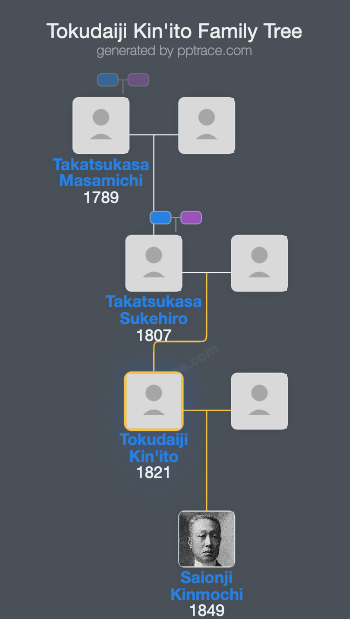
Family Tree
Tap  to expand more relatives
Introduction
Tokudaiji Kin'ito (徳大寺 公純; December 22, 1821 – November 5, 1883) was a Japanese court noble (kugyō) active during the late Edo period, specifically during the Bakumatsu era.
Born on December 22, 1821, Takatsukasa Sukekimi was his birth name. His father was Takatsukasa Masamichi, and his mother was a daughter of Zaihi Karahashi. He was adopted by Tokudaiji Sanekata, which integrated him into the Tokudaiji family line.
Kin'ito’s children included Tokudaiji Sanetsune, Saionji Kinmochi, Suehiro Takemaro, and Sumitomo Tomoito.
In his political career, Kin'ito was appointed to several official positions. In 1850, he attained the rank of dainagon, a high government counselor. In 1857, he was appointed as a gisō, an official tasked with ceremonies and rituals.
In 1858, Emperor Kōmei designated Kin'ito along with Ichijō Tadaka as emissaries to the Ise Grand Shrine. Following the signing of the Treaty of Amity and Commerce, he was implicated in opposition to the treaty and was subjected to a purge known as the Ansei Purge, orchestrated by Ii Naosuke. Kin'ito was detained for fifty days but was released after approximately one month.
Following this period, Kin'ito supported the kōbu gattai policy, which sought to strengthen political cooperation between court and shogunate, in collaboration with Nijō Nariyuki. He also opposed the marriage between Princess Kazu and Tokugawa Iemochi, which led to his resignation from his official posts under pressure from the shogunate.
After resigning, Kin'ito returned to his family estate and served as a minor court official (shissei). During this period, he experienced personal and political instability; notably, in 1863, his vassals were killed by rōnin who opposed the civil war and the political upheaval of the time.
Following the Meiji Restoration in 1868, Kin'ito remained in Kyoto. He continued to live through the transitional period of Japan’s political restructuring and died on November 5, 1883, at the age of 61.