Saionji Kinmochi
| Name | Saionji Kinmochi |
| Title | Japanese politician (1849-1940) |
| Gender | Male |
| Birthday | 1849-10-23 |
| nationality | Japan |
| Source | https://www.wikidata.org/wiki/Q297628 |
| pptrace | View Family Tree |
| LastUpdate | 2025-11-17T10:07:51.909Z |
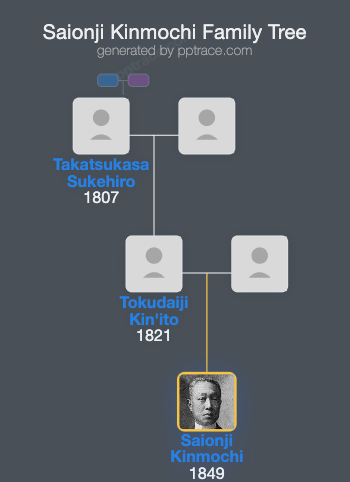
Family Tree
Tap  to expand more relatives
Introduction
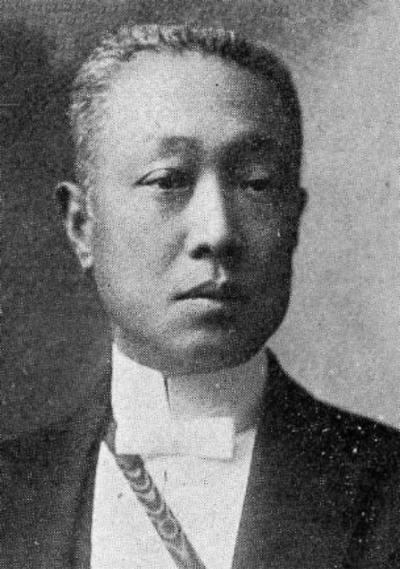
Prince Saionji Kinmochi (Japanese: 西園寺 公望), born on December 7, 1849, and deceased on November 24, 1940, was a Japanese statesman and diplomat. He served as Prime Minister of Japan twice, first from 1906 to 1908 and subsequently from 1911 to 1912. Saionji was the last surviving member of the genrō, an influential group of elder statesmen who exerted significant control over Japanese politics during the Meiji and Taishō periods.
He was born in Kyoto as the second son of Tokudaiji Kin'ito, a court noble (kuge). His birth name was Yoshimaru, and his birth year was deliberately reported as 1847 to qualify him for certain court appointments. In 1851, he was adopted by Saionji Morosue, the head of another noble family. Both families were branches of the Fujiwara clan and had a history of serving the Imperial Court. Saionji became involved in court politics at a young age, occupying the position of Chamberlain at age four, and was close to the prince who would become Emperor Meiji.
During the Boshin War (1868–1869), Saionji participated as an imperial commander and governor, leading forces in northern Japan with predominantly bloodless surrenders. Following the Meiji Restoration, he briefly founded a private school, the Ritsumeikan, which was soon shut down by authorities for harboring "dangerous ideas".
In 1871, Saionji departed for France, where he studied law at the Sorbonne for nearly a decade. During his time in Paris, he was mentored by Émile Acollas, a legal theorist with liberal views, and became familiar with European liberalism and constitutionalism. He developed a deep admiration for French liberal ideals. Saionji also befriended several notable political figures, including Georges Clemenceau. His experiences in Paris influenced his political outlook, and he became associated with the Japonisme movement, gaining notoriety among Europeans for his presence.
Returning to Japan in October 1880, Saionji co-founded the Tōyō Jiyū Shinbun (Oriental Free Press) with Nakae Chōmin to promote the Freedom and People's Rights Movement. The paper was quickly banned, and he was compelled to resign due to disapproval from the Imperial Court. Nevertheless, in November 1881, he was appointed as a vice-councillor in the Sangiin, a government body involved in drafting a constitution.
Saionji’s diplomatic career included postings in Austria-Hungary, Germany, and Belgium. In 1894, he joined Itō Hirobumi’s cabinet as Minister of Education, advocating for educational reforms such as the promotion of English and opposition to the traditional teaching of classical Chinese texts and religion. He also served as acting Foreign Minister during the negotiations that led to the Treaty of Shimonoseki (1895), ending the First Sino-Japanese War, and during the Triple Intervention diplomatic crisis.
In 1900, Itō Hirobumi founded the Rikken Seiyūkai (Friends of Constitutional Government) party, with Saionji playing an active role in its formation. Saionji became president of the party in 1903 following Itō’s resignation. He forged a political compromise with General Katsura Tarō, which resulted in an alternating prime ministership known as the Keien era. During this period, Saionji and Katsura held the premiership in succession, with Saionji serving as Prime Minister from 1906 to 1908 and again from 1911 to 1912. His first term was marked by efforts to stabilize party influence and pursue policies including improved relations with Western nations and the reduction of military dominance in civilian government.
In 1912, following the Taishō political crisis, Saionji was elevated to the rank of genrō, becoming a key adviser to the Emperor and influencing political decisions by recommending prime ministerial candidates for the rest of his life. Throughout the 1920s, he supported the development of party-based governance during the period referred to as "Taishō democracy," and led Japan’s delegation at the Paris Peace Conference in 1919, where he secured territorial gains for Japan.
Saionji’s influence diminished with the rise of militarism in the 1930s, and he retired from politics in 1937. He passed away in 1940, a year before Japan entered the Second World War.