Mishima Michitsune
| Name | Mishima Michitsune |
| Title | Japanese politician (1835-1888) |
| Gender | Male |
| Birthday | 1835-06-26 |
| nationality | Japan |
| Source | https://www.wikidata.org/wiki/Q4142982 |
| pptrace | View Family Tree |
| LastUpdate | 2025-11-17T06:47:05.732Z |
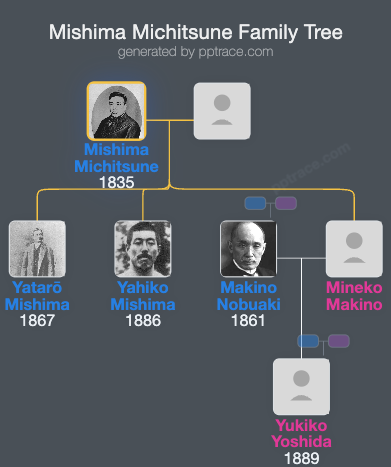
Family Tree
Tap  to expand more relatives
Introduction
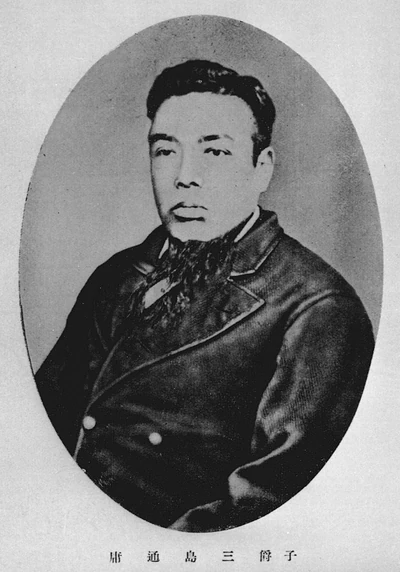
Viscount Mishima Michitsune (Japanese: 三島 通庸; born June 26, 1835 – died October 23, 1888) was a Japanese politician and bureaucrat during the late Edo period and early Meiji era. He was originally a samurai of the Satsuma Domain during the Late Tokugawa shogunate. Following the Meiji Restoration, Mishima transitioned into government service and attained the title of viscount.
He was also known by the names Yahei or Yahée (弥兵衞 Yahee). Mishima’s familial ties included his second daughter Mineko, who was married to Makino Nobuaki, the second son of Ōkubo Toshimichi. His children included two sons: Yatarō Mishima, who became the eighth-generation custodian of the Bank of Japan; and Yahiko Mishima, a track and field athlete who participated in the 1912 Summer Olympics. His grandson, Michiharu Mishima, served as the fourth Chief Scout of the Scout Association of Japan.
In 1874, Mishima was appointed as the Ordinance of Sakata Prefecture. His tenure involved addressing protests from farmers and peasants, notably the Wappa Rebellion, which was a demonstration against taxes and labor practices that persisted from the feudal era. Mishima implemented a policy of reform by reorganizing officials and clerks, which helped resolve the protests through legal channels by 1875, with farmers receiving monetary compensation.
During the subsequent administrative reorganization, Sakata Prefecture was renamed Uruoka Prefecture, and it later became part of Yamagata Prefecture through the merging of Okitama and Yamagata. As Ordinance of both Uruoka and Yamagata prefectures, Mishima prioritized infrastructure development, including roads, bridges, and public facilities. The region historically had strong commercial ties with Osaka via shipping routes, but during the Meiji era, land transportation infrastructure was emphasized. Notable developments included the completion of the Kuriko Highway connecting Yonezawa and Fukushima in 1880 and the Sekiyama Highway from Yamagata to Sendai in 1882, both accommodating horse-drawn carriages.
In 1884, while serving as Governor of Tochigi Prefecture, Mishima was targeted in the Mount Kaban Incident, where members of the Liberal Party plotted his assassination. Despite such threats, he continued his administrative duties and was involved in enforcing law and order measures. On December 25, 1887, as Superintendent General, he enacted the Regulations for the Preservation of Law and Order through imperial edict. This legislation aimed to suppress individuals deemed dangerous and was partly in response to the activities of the Freedom and People's Rights Movements, such as the Sandai Jiken Kempaku Undō and the United Front Movement.
As Superintendent General of the Metropolitan Police, Mishima also implemented the Public Order & Police Law of 1900, which laid the foundation for the Peace Preservation Law of 1925. It is suggested that Mishima actively promoted the Regulations for the Preservation of Law and Order, with opposition from Chancellor Itō Hirobumi and a passive stance from Home Minister Yamagata Aritomo. His enforcement actions targeted political figures such as Ozaki Yukio, Kataoka Kenkichi, Nakae Chōmin, and Hoshi Tōru.
Beyond his official duties, Mishima engaged in land development activities, notably through the Chōkōsha firm in Nasunogahara, Tochigi (present-day Mishima Farms). He involved his son Yatarō Mishima as managing director and recruited close associates to participate as shareholders, aiming to prevent monopolization of land cultivation in the region.