Yatarō Mishima
| Name | Yatarō Mishima |
| Title | Japanese politician (1867-1919) |
| Gender | Male |
| Birthday | 1867-05-04 |
| nationality | Japan |
| Source | https://www.wikidata.org/wiki/Q5385640 |
| pptrace | View Family Tree |
| LastUpdate | 2025-11-17T06:47:10.164Z |
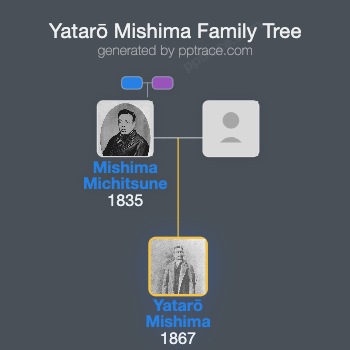
Family Tree
Tap  to expand more relatives
Introduction
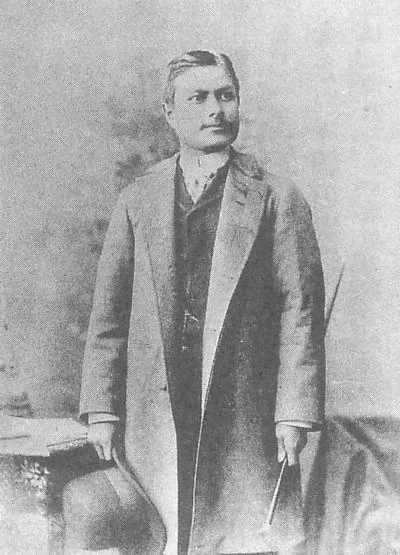
Viscount Yatarō Mishima (三島 彌太郎, Mishima Yatarō) was born on May 4, 1867, in Kagoshima Prefecture, Japan. He was born into a samurai family; his father was Mishima Michitsune, who later served as the governor of Tochigi Prefecture. Mishima pursued studies in English and agriculture at the Komaba Agricultural School in Japan. Subsequently, he studied abroad in the United States at the Massachusetts Agricultural College (now the University of Massachusetts Amherst), where he was awarded the Clark Gold Medal and the Grinnell Gold Medal for academic achievement. He also obtained a certificate from Harvard University’s summer chemistry program before returning to Japan in 1888. In 1890, Mishima earned a master's degree in entomology from Cornell University.
Professionally, Mishima began his career working for the government of Hokkaido, followed by positions in the Ministry of Agriculture and Commerce, as well as the Ministry of Communications. In 1897, he was elected to the House of Peers as a viscount member and became associated with the Kenkyūkai faction. From 1911 to 1913, Mishima served as president of the Yokohama Specie Bank, during which time he oversaw the expansion of its branches into Calcutta, Harbin, and San Francisco, and played a role in establishing the Franco-Japanese Bank.
On February 28, 1913, Mishima was appointed as the eighth Governor of the Bank of Japan, a position he held until his death in 1919. His tenure as governor was marked by efforts to stabilize Japan’s monetary system during and after World War I. Mishima advocated for monetary restraint and policies aimed at price stability. He encouraged the government to utilize fiscal surpluses to acquire foreign currency reserves for the Bank of Japan and was instrumental in establishing Japan’s first inter-bank agreement on deposit interest rates.
Mishima died suddenly on March 7, 1919, at the age of 51, while still serving as governor. He was interred at Aoyama Cemetery in Tokyo.
In his personal life, Mishima was briefly married in 1893 to Ōyama Nobuko, eldest daughter of Field Marshal Ōyama Iwao. She contracted tuberculosis shortly after their marriage, leading to their divorce in 1895. This relationship inspired Kenjirō Tokutomi's 1899 novel *Hototogisu* (The Cuckoo). Mishima later married Shijō Kaneko, daughter of Marquis Shijō Takataka. Family records indicate that Mishima kept a small leather notebook which contained a photograph of his first wife until his death.
Throughout his career, Mishima received various honors. He was awarded the Senior Fourth Rank on June 20, 1902; the Fourth Class of the Order of the Rising Sun on April 1, 1906; the Junior Third Rank on July 1, 1910; the Third Class of the Order of the Rising Sun on November 10, 1915; the Second Class of the same order on April 1, 1916; and the Grand Cordon of the Order of the Rising Sun (First Class) on March 7, 1919, the day of his death. Additionally, he was a recipient of the Gold Cup award in 1919.
His life spanned the late Meiji and early Taishō periods of Japan, during which the country underwent significant financial modernization and integration into international finance systems. Mishima's leadership helped lay the groundwork for Japan’s monetary policies during its transition through the First World War.
References include works by Naoichi Masaoka, Mark Metzler, Michael Smitka, Janice P. Nimura, and Japanese-language sources such as Mishima Yatarō’s letters and historical accounts of his family and career.