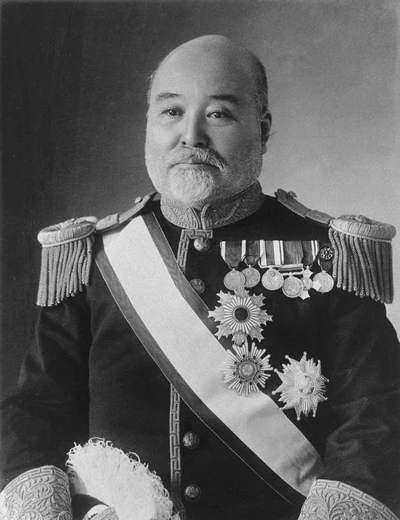
Takahashi Korekiyo
| Name | Takahashi Korekiyo |
| Title | Japanese politician (1854-1936) |
| Gender | Male |
| Birthday | 1854-07-27 |
| nationality | Japan |
| Source | https://www.wikidata.org/wiki/Q315842 |
| pptrace | View Family Tree |
| LastUpdate | 2025-11-17T06:48:45.816Z |
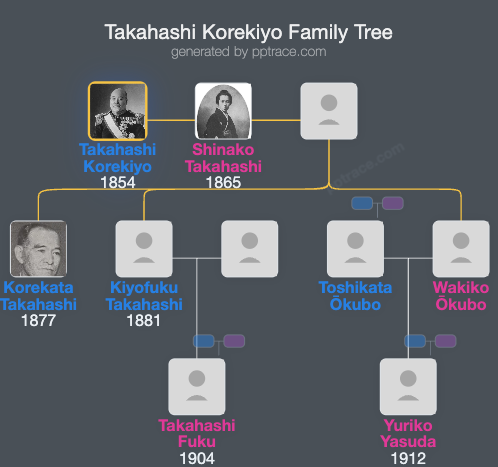
Family Tree
Tap  to expand more relatives
Introduction
Takahashi Korekiyo (高橋 是清; born 27 July 1854, died 26 February 1936) was a Japanese politician and bureaucrat. He served as the Prime Minister of Japan from 1921 to 1922 and was the Minister of Finance at the time of his assassination. He was also a member of the House of Peers and held the position of governor of the Bank of Japan. His tenure coincided with significant contributions to Japan's economic development in the early 20th century, including the introduction of the country's first patent system and securing foreign loans for the Russo-Japanese War.
Born in Edo, now Tokyo, during the late Edo period under the Tokugawa shogunate, Takahashi was the illegitimate son of a court painter residing at Edo Castle. He was adopted by Takahashi Kakuji, a low-ranking samurai serving the Date clan of Sendai Domain. His early education included studying English and American culture through a private school operated by missionary James Hepburn. In 1867, he traveled to the United States, with some accounts stating he set sail for Oakland, California, and worked as a laborer, while other stories suggest he studied there but was sold into slavery and subsequently returned to Japan.
Following his return to Japan in 1868, Takahashi worked as an English teacher and became the first headmaster of the Kyōryū Gakkō high school in Tokyo. Concurrently, he held bureaucratic positions within the Ministry of Education and later in the Ministry of Agriculture and Commerce. He played a pivotal role as the first chief of the Bureau of Patents, organizing Japan’s patent system.
Takahashi briefly left government service to attempt a silver mining enterprise in Peru, which was unsuccessful. He joined the Bank of Japan in 1892, advancing quickly and becoming vice-president in 1898. During the Russo-Japanese War (1904–1905), he was instrumental in securing foreign loans from American financier Jacob Schiff and the Rothschild family, which were crucial to Japan’s war effort. His efforts led to his appointment to the House of Peers in 1905. In 1906, he became president of the Yokohama Specie Bank, and in 1907, was granted the peerage title of baron (danshaku).
Takahashi served as Governor of the Bank of Japan from 1911 to 1913. His political career included appointments as Minister of Finance under Prime Ministers Yamamoto Gonnohyōe (1913) and Hara Takashi (1918). His nobility title was elevated to viscount (shishaku) in 1920.
In 1921, following Prime Minister Hara Takashi's assassination, Takahashi was appointed Prime Minister and head of the Rikken Seiyūkai political party. His brief premiership lasted less than seven months, primarily due to factional difficulties and his outsider status within the party. After resigning as Prime Minister, he continued to serve as party president and was elected to the Lower House of the Diet of Japan in 1924. During this period, he also served again as Minister of Agriculture and Commerce.
As Finance Minister from 1927 to 1936, under various administrations, Takahashi implemented expansionary monetary and fiscal policies to combat the Great Depression. These included abandoning the gold standard in 1931 and financing government deficits through Bank of Japan support. These policies faced opposition domestically and contributed to internal conflicts within Japan’s military establishments.
In 1936, Takahashi was assassinated during the February 26 incident, a rebellion by militarist officers opposed to his fiscal policies and military spending reductions. He is interred at Tama Reien Cemetery in Fuchū, Tokyo. Alongside Saitō Makoto, who was also assassinated during the same incident, Takahashi was one of the last former Japanese prime ministers to be assassinated until Shinzo Abe's assassination in 2022.
Takahashi appeared on a 50 Yen banknote issued by the Bank of Japan in 1951, marking the only appearance of a former Bank of Japan president on Japanese currency. His residence is now the Takahashi Korekiyo Memorial Park in Tokyo’s Minato Ward, with some original structures preserved in the Edo-Tokyo Open Air Architectural Museum. His fiscal policies during the Great Depression are sometimes compared to Keynesian economics, and he is credited with helping Japan recover from economic downturns through monetary expansion and deficit spending. His influence has been acknowledged by figures such as Ben Bernanke and Prime Minister Shinzō Abe.