H. T. Lowe-Porter
| Name | H. T. Lowe-Porter |
| Title | American translator (1876-1963) |
| Gender | Female |
| Birthday | 1876-06-15 |
| nationality | United States of America |
| Source | https://www.wikidata.org/wiki/Q5628593 |
| pptrace | View Family Tree |
| LastUpdate | 2025-11-26T23:34:12.543Z |
Family Tree
Tap  to expand more relatives
Introduction
Helen Tracy Lowe-Porter (née Porter) was born on June 15, 1876, and died on April 26, 1963. She was an American translator and writer primarily recognized for translating the works of German novelist Thomas Mann into English. Her translations, completed over a span of several decades, include prominent titles such as "Buddenbrooks," "The Magic Mountain," "Death in Venice," "Mario and the Magician," and the series "Joseph and His Brothers."
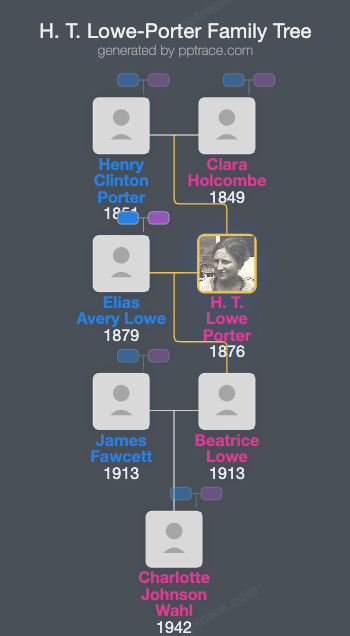
Lowe-Porter was the daughter of Clara (née Holcombe) and Henry Clinton Porter. She was related to Charlotte Endymion Porter, who served as editor of the poetry journal *Poet Lore* and was known for her expertise on Shakespeare, Elizabethan literature, and the Browning family. Lowe-Porter completed her early education in Towanda, Pennsylvania, and attended Wells College in Aurora, New York, earning her degree in 1898 as a member of Phi Beta Kappa.
In 1911, she married Elias Avery Lowe, a paleographer. The couple resided in Oxford, and after 1937, they lived in Princeton, New Jersey. Their great-grandson is Boris Johnson, who served as Prime Minister of the United Kingdom.
Lowe-Porter acquired the exclusive rights to translate Thomas Mann's works in 1925 from Alfred A. Knopf. She discussed her translation approach in her essay "On Translating Thomas Mann," where she noted the necessity of adapting Mann’s style for the English-speaking audience, sometimes simplifying or "emasculating" the original language to suit both British and American markets. She also reflected on the challenge of translating the "organic work of art" in her translation of *Der Zauberberg* (*The Magic Mountain*), emphasizing the creative and interpretive aspects of translation.
In addition to her translation work, Lowe-Porter wrote an original play titled *Abdication*, which was first produced in Dublin in September 1948. The play is considered a commentary on the abdication of Edward VIII and was published by Alfred A. Knopf.
Her translations of Thomas Mann had a considerable influence on English-speaking readership for many years, with Mann himself acknowledging her efforts, although he expressed reservations about her linguistic proficiency. Critics have recognized her translation of Mann's work as conveying the author's style effectively, despite occasional inaccuracies. Theodore Ziolkowski appreciated her role in making Mann accessible to an English-speaking audience.
However, starting from the 1950s, scholarly critique questioned the accuracy of Lowe-Porter's translations. Studies such as Timothy Buck's identified significant distortions and omissions, attributing some inaccuracies to Lowe-Porter’s limited command of German, which led to mistaken comprehension, omissions, and unnecessary simplifications of Mann’s complex syntax. For instance, her translation of *Buddenbrooks* was criticized for leveling the language and omitting passages, resulting in the loss of much of the novel's humor.
Modern translation scholarship has revisited Lowe-Porter’s approach, contextualizing her work within the standards of her time. David Horton’s analysis expanded understanding beyond error correction, recognizing her stylistic choices as consistent with contemporary translation practices and highlighting her contribution to making literature accessible.
Lowe-Porter’s published works include biographies, essays, and her translations. Her notable publications include her 1960 autobiography, *A Sketch of My Life*, and her translations of numerous major works by Thomas Mann, extending from 1924 to 1951.
Her contributions to literary translation remain historically significant, though they have been subject to critical reassessment in later scholarship.