Elias Avery Lowe
| Name | Elias Avery Lowe |
| Title | Lithuanian-American palaeographer (1879-1969) |
| Gender | Male |
| Birthday | 1879-10-15 |
| nationality | United States of America |
| Source | https://www.wikidata.org/wiki/Q833420 |
| pptrace | View Family Tree |
| LastUpdate | 2025-11-26T13:05:37.435Z |
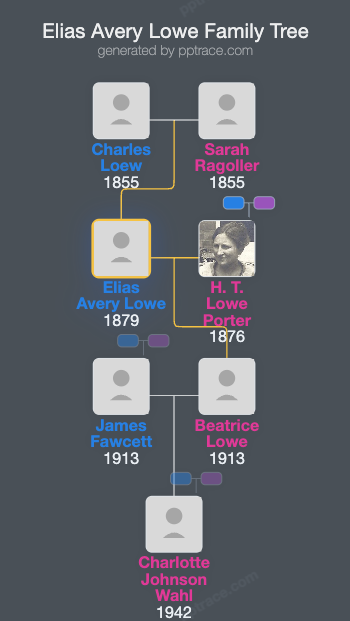
Family Tree
Tap  to expand more relatives
Introduction
Elias Avery Lowe (15 October 1879 – 8 August 1969), originally born with the surname Loew, was a scholar specializing in palaeography. He was affiliated with the University of Oxford and Princeton University during his academic career. Lowe held positions as a lecturer and later as a reader at the University of Oxford from 1913 to 1936. In 1936, he became a professor at the Institute for Advanced Study at Princeton University.
Early Life:
Elias Avery Lowe was born in Moscow, then part of the Russian Empire, on 15 October 1879. His family was Jewish; his father was Charles Loew, a merchant dealing in silk and embroidery, and his mother was Sarah Ragoler. He emigrated to New York City with his parents in 1892 and became a United States citizen in 1900. In 1918, he changed the spelling of his surname from Loew to Lowe.
Education:
Lowe studied at the College of the City of New York from 1894 to 1897. He earned a Bachelor of Arts degree from Cornell University in 1902. Subsequently, he studied at the University of Halle briefly and then at the University of Munich, where he completed his doctorate in 1908 under the supervision of Ludwig Traube.
Academic Career:
Lowe first lectured at the University of Oxford in 1913, and in 1914, he delivered the Sandars Lectures on bibliography at the University of Cambridge. That same year, Oxford appointed him as a regular lecturer, and he was promoted to a reader in 1927. Most of his teaching in palaeography took place at Oxford. In 1936, he became one of the first professors at Princeton's Institute for Advanced Study, a position he held while continuing to lecture at Oxford during Trinity terms until 1948. He also served as a palaeography consultant for the Library of Congress and as a research associate at the Carnegie Institution of Washington from 1911 to 1953.
Major Works:
Lowe authored several significant publications in early medieval palaeography. Notably, his 1914 book, "The Beneventan Script," analyzed the oldest extant manuscript of St Benedict's rule. His collected "Palaeographical Papers, 1907–1965," was published posthumously in 1972. His most renowned work is the eleven-volume "Codices Latini Antiquiores" (1934–1971), which provides detailed descriptions and facsimiles of over 1,800 Latin manuscripts written before the ninth century across repositories in twenty-one countries.
Recognition:
Lowe was recognized internationally for his expertise in palaeography. He received the Haskins Medal from the Medieval Academy of America in 1957 and the gold medal of the Bibliographical Society in 1959. Honorary degrees were awarded to him by the University of Oxford (1936), the University of North Carolina (1946), and the National University of Ireland (1964). From 1954 until his death, he was an Honorary Fellow of Corpus Christi College, Oxford.
Personal Life:
In 1911, Lowe married Helen Tracy Lowe-Porter, a translator. They had three daughters. His descendants include artist Charlotte Johnson Wahl and her son, Boris Johnson, a former Prime Minister of the United Kingdom. While he maintained a strong connection with the Jewish community, Lowe did not practice Judaism and expressed a hypothetical preference for Roman Catholicism if he were to adhere to a religion.
Death and Legacy:
Elias Avery Lowe died on 8 August 1969 in Bad Nauheim, Germany. His ashes were interred at Corpus Christi College, Oxford. A series of lectures focusing on palaeography, known as the Triennial E. A. Lowe Lectures, continues to honor his memory at Corpus Christi College.
Selected Publications:
- Die ältesten Kalendarien in Monte Cassino (doctoral dissertation, 1908)
- Studia Palaeographica (1910)
- The Beneventan Script: A History of the South Italian Minuscule (1914; 2nd ed., 1980)
- Codices Lugdunenses Antiquissimi (1924)
- Handwriting: Our Medieval Legacy (1969)
- Palaeographical Papers, 1907–1965 (published 1972)
References and further information about his work and contributions are available through scholarly articles, biographies, and online repositories dedicated to historical palaeography.