Liu Jiande
| Name | Liu Jiande |
| Title | Former Deputy Political Commissar of the Logistics Department of the Lanzhou Military Region |
| Gender | Male |
| Birthday | 1923-01-01 |
| nationality | — |
| Source | https://baike.baidu.com/item/%E5%88%98%E5%BB%BA%E5%BE%B7/8911803 |
| pptrace | View Family Tree |
| LastUpdate | 2025-09-26T11:27:07.127Z |
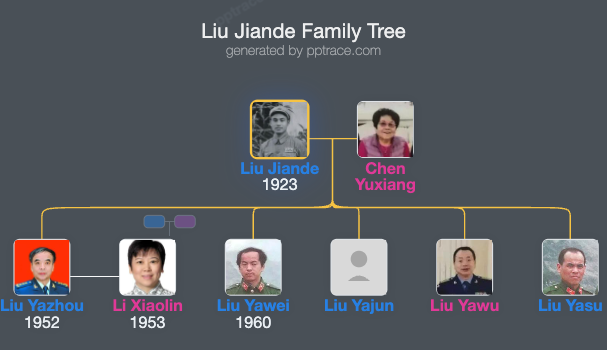
Family Tree
Tap  to expand more relatives
YouTube
Introduction
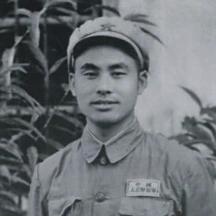
Liu Jiande, whose birth and death years are unknown, was an important military figure in the Chinese People's Liberation Army. Early in his life, he joined the Fourth Division of the New Fourth Army, serving as a squad leader. Subsequently, he joined the Chinese Communist Party and took on the role of Party Group Leader of a battalion. During the Huaihai Campaign, Liu Jiande served as an instructor for the 3rd Battalion of the 187th Regiment, whose commander was the East China-level Hero of the People, Lu Rui. In this campaign, all five of his hometown comrades-in-arms were killed, with only he surviving. The Fourth Division of the New Fourth Army was initially formed in the Hubei-Henan-Anhui area, originally as the 28th Red Army unit, and was later incorporated into the Second Division of the New Fourth Army following the Anhui Incident, under the command of Division Commander Luo Binghui.
During the Chinese Liberation War, Liu Jiande’s forces were incorporated into the Second Column of the East China Field Army, commanded by Chen Yi and Su Yu, which was later renamed the 3rd Field Army. The column was led by Commander and Political Commissar Wei Guoqing and participated in major battles such as the Menglianggu Campaign and the Huaihai Campaign. In February 1949, his troops were reorganized into the 21st Army of the 7th Army Group, with Teng Haiching as the commander and Kang Zhiqiang as the political commissar. In April of the same year, the troops took part in the Crossing the Yangtze River Campaign, successfully liberating Hangzhou, and subsequently advanced into Wenzhou, Ningbo, Fenghua, and Xiangshan regions.
In the battles at Wenzhou Bay, Zhoushan, and the coastal defense missions in eastern Zhejiang, southern Zhejiang, and northern Fujian, Liu Jiande’s troops achieved notable success. On May 15, 1951, Liu Jiande married Chen Yuxiang, a female soldier from Wenzhou; they had five children, the eldest of whom was Liu Yazhou.
After the outbreak of the Korean War, Liu Jiande’s 21st Army departed from Changdianhekou in Liaoning and was incorporated into the Volunteer Army’s 20th Corps under the command of Yang Yong. The unit participated in key battles including the Spring Counter-landing Operation, the Summer Counterattack, and the Geumseong Counterattack. In March 1953, after the armistice agreement was signed at Panmunjom, Liu Jiande’s forces were stationed in North Korea, involved in post-war reconstruction and maintaining the ceasefire. During this period, Chen Yuxiang reunited with her young son Liu Yazhou in Korea.
In July 1958, Liu Jiande’s unit was transferred back to China and stationed in Datong, Shanxi, under the Beijing Military Region. In 1967, the unit moved from Shanxi to Baoji in Shaanxi, with Liu Jiande serving as the Deputy Political Commissar of the 63rd Division. During this time, he sent his son Liu Yazhou to the “Hero Company” (the Eighth Company of the 187th Regiment), where he had previously served as a company instructor, for training. This company was named by the Ministry of National Defense and had previously defeated the Qiu Qingquan Troop during the Huaihai Campaign, leaving only six survivors after the battle. Liu Jiande had a deep attachment to this unit, as he had been its superior.
This is the main account of Liu Jiande’s life and career.