Arthur Hamilton-Gordon, 1st Baron Stanmore
| Name | Arthur Hamilton-Gordon, 1st Baron Stanmore |
| Title | British politician and colonial administrator (1829-1912) |
| Gender | Male |
| Birthday | 1829-11-26 |
| nationality | United Kingdom of Great Britain and Ireland |
| Source | https://www.wikidata.org/wiki/Q335510 |
| pptrace | View Family Tree |
| LastUpdate | 2025-11-26T23:29:34.283Z |
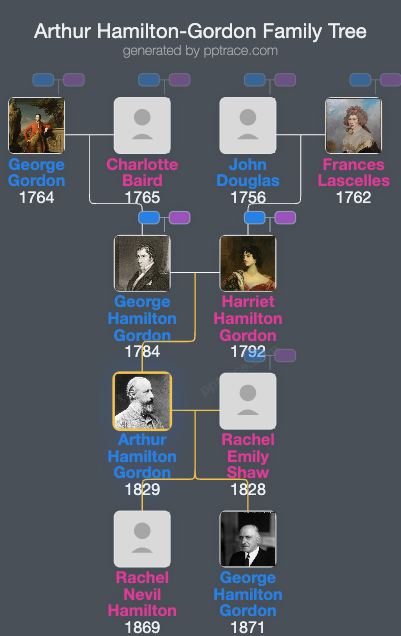
Family Tree
Tap  to expand more relatives
Introduction
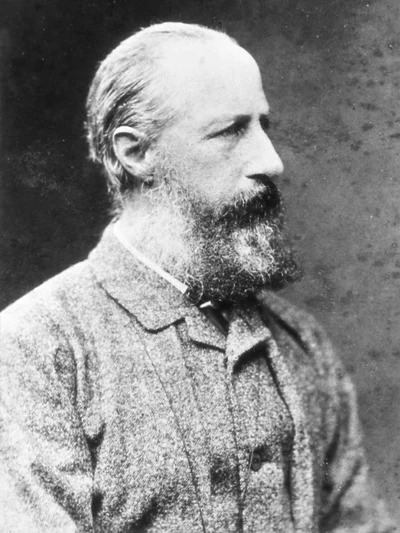
Arthur Charles Hamilton-Gordon, 1st Baron Stanmore (26 November 1829 – 30 January 1912), was a Scottish politician affiliated with the Liberal Party and a colonial administrator. His career included multiple gubernatorial appointments across the British Empire, as well as a close association with Prime Minister William Ewart Gladstone.
Born at Argyll House in London in 1829, Hamilton-Gordon was the youngest son of George Hamilton-Gordon, 4th Earl of Aberdeen, and Harriet Douglas. His mother was previously the widow of Viscount Hamilton. He received private education before attending Trinity College, Cambridge, where he served as President of the Cambridge Union Society in 1849. He graduated in 1851.
Between 1852 and 1855, Hamilton-Gordon served as Assistant Private Secretary to the British Prime Minister, his father. He was elected Member of Parliament for Beverley in 1854, serving until 1857.
His colonial administrative career commenced with appointments to various territories. In 1861, he was appointed Lieutenant-Governor of New Brunswick, serving until 1866 and facilitating New Brunswick's acceptance of Canadian Confederation. From 1866 to 1870, he was Governor of Trinidad. He served as the 11th Governor of Mauritius from February 1871 to August 1874.
In 1875, Hamilton-Gordon was appointed the first Governor and Commander-in-Chief of Fiji and held this position until 1880. Concurrently, he was designated Consul-General and High Commissioner for the Western Pacific from 1877 to 1880, although these roles provided limited additional authority.
He then governed New Zealand from November 1880 to June 1882, followed by a term as Governor of Ceylon (modern-day Sri Lanka) from 1883 to 1890. His contributions to British colonial administration were recognized through several honors: he was made a Knight Commander of the Order of St Michael and St George (KCMG) in 1871 and a Knight Grand Cross of the same Order in 1878. His peerage was conferred on 21 August 1893, when he was created Baron Stanmore, of Great Stanmore, Middlesex.
In 1897, Lord Stanmore became chairman of the Pacific Islands Company Ltd (PIC), a firm involved in phosphate mining in the Pacific, particularly on Banaba (Ocean Island) and Nauru. PIC was founded by John T. Arundel and operated out of London, with their activities involving negotiations with German-controlled licenses. In 1902, PIC merged with the Hamburg-based Jaluit Gesellschaft to form the Pacific Phosphate Company, engaging in phosphate extraction in the Pacific Islands.
Hamilton-Gordon assembled an ethnographic collection in Fiji during his governorship, which was subsequently donated to the British Museum in 1878. He was appointed to the Royal Commission on Historical Manuscripts in March 1900.
He married Rachel Emily Shaw Lefevre on 20 September 1865, with whom he had a daughter and a son. In 1861, he was appointed Deputy Lieutenant of Aberdeenshire.
Arthur Hamilton-Gordon died in Chelsea, London, on 30 January 1912.
References:
- William Ewart Gladstone, Baron Arthur Hamilton-Gordon Stanmore (2009) [1961]. *Gladstone-Gordon correspondence, 1851–1896: selections from the private correspondence of a British Prime Minister and a colonial Governor*. American Philosophical Society.
External links:
- Contributions to Parliament by Arthur Hamilton-Gordon (Hansard)
- Biography at the Dictionary of Canadian Biography Online