George Hamilton-Gordon, 4th Earl Of Aberdeen
| Name | George Hamilton-Gordon, 4th Earl Of Aberdeen |
| Title | British politician (1784-1860) |
| Gender | Male |
| Birthday | 1784-01-28 |
| nationality | United Kingdom of Great Britain and Ireland |
| Source | https://www.wikidata.org/wiki/Q24631 |
| pptrace | View Family Tree |
| LastUpdate | 2025-11-26T23:29:33.333Z |
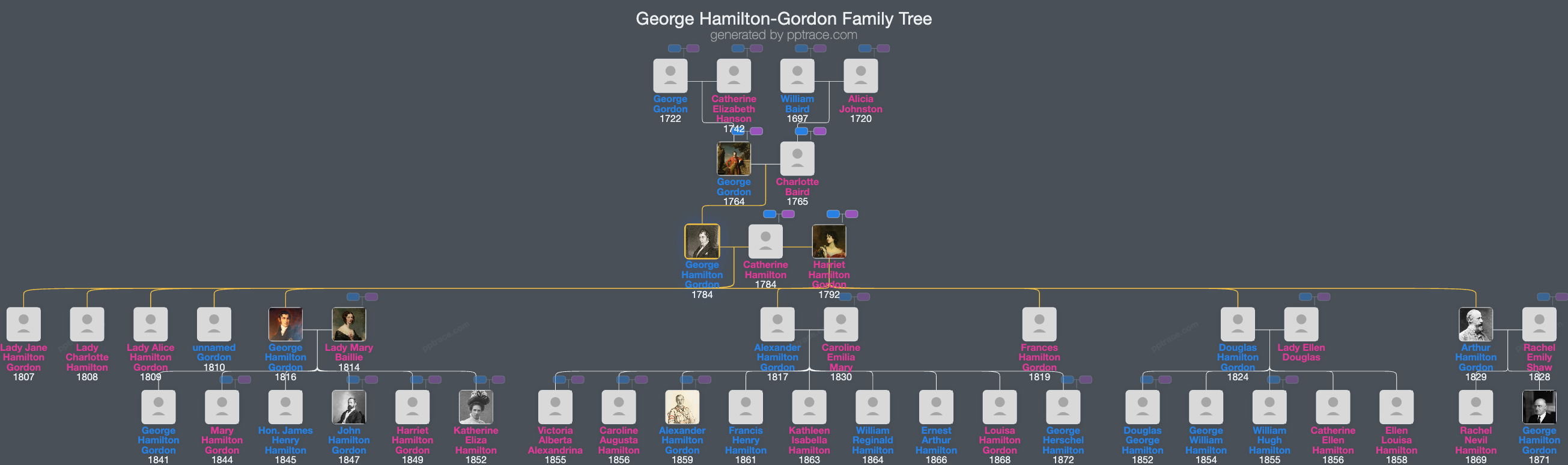
Family Tree
Tap  to expand more relatives
Introduction
George Hamilton-Gordon, 4th Earl of Aberdeen (28 January 1784 – 14 December 1860), was a British politician, diplomat, and landowner. He was born in Edinburgh, Scotland, as the eldest son of George Gordon, Lord Haddo, and Charlotte Baird. His paternal grandfather was George Gordon, 3rd Earl of Aberdeen. He inherited the title of Earl of Aberdeen in 1801 upon the death of his grandfather. His early education was at Harrow School and St John's College, Cambridge, where he graduated with a Master of Arts degree in 1804.
Aberdeen's parents died when he was approximately eleven and his family arrangements included being raised by Henry Dundas, 1st Viscount Melville, and William Pitt the Younger. Before university, he traveled extensively throughout Europe, including Greece, developing an interest in classical civilizations and archaeology. He married Lady Catherine Elizabeth, daughter of John Hamilton, 1st Marquess of Abercorn, in 1805. She died of tuberculosis in 1812.
His political career began when he took his seat as a Tory Scottish representative peer in the House of Lords in December 1805. He was appointed Knight of the Thistle in 1808. Following his wife's death, Aberdeen entered the Foreign Service in 1812, becoming Ambassador Extraordinary and Minister Plenipotentiary to Austria. During his tenure, he played a significant role in organizing the Sixth Coalition that defeated Napoleon Bonaparte, notably participating in the negotiations leading to the Treaty of Töplitz in 1813 and witnessing the Battle of Leipzig.
In 1814, Aberdeen was elevated to the peerage as Viscount Gordon of Aberdeen and was appointed to the Privy Council. He attended the Congress of Châtillon and helped negotiate the Treaty of Paris. He married Harriet Douglas in 1815, after his first wife’s death, though this marriage was less harmonious. Between 1828 and 1830, Aberdeen served as Foreign Secretary and briefly as Chancellor of the Duchy of Lancaster. He resigned over the Reform Bill of 1832.
Aberdeen held the portfolio again during the first Peel ministry (1834–1835) as Secretary of State for War and the Colonies, and from 1841 to 1846 as Foreign Secretary in the second Peel government. His diplomatic accomplishments during this period included resolving boundary disputes with the United States via the Webster-Ashburton Treaty (1842), the Oregon Treaty (1846), and ending the First Opium War with the Treaty of Nanking in 1842, which resulted in Britain acquiring Hong Kong.
Despite his diplomatic success, Aberdeen was known for his reserved and somewhat awkward demeanor, with limited oratorical skill. His close associate William Ewart Gladstone remarked on his profound personal regard for Aberdeen.
Throughout his career, Aberdeen was committed to foreign policy and diplomacy, with notable involvement in European diplomacy and the shaping of international relations following the Napoleonic Wars. His role expanded into leadership positions when he served as Prime Minister from 1852 to 1855, heading a coalition government that included Whigs, Peelites, Radicals, and Irish representatives. His tenure was marked by Britain’s entry into the Crimean War, which ultimately led to the fall of his government. Following his retirement from politics, he remained a notable figure in British public life until his death in 1860.